The content of the article includes:
- How does the dishwasher clean the dishes?
- What factors affect the washing time of the dishwasher?
- Water supply
- Power supply
- Arrangement of dishes, appropriate amount of detergent
- Choosing the wrong washing mode
- Why does the dishwasher take so long?
- How to save time with the dishwasher?
- Why does my dishwasher run for hours?
- When should I replace my dishwasher?
- Let Kocher dishwasher enhance your quality of life
1. How does the dishwasher clean the dishes?
- After starting the machine, it automatically fills with water
- Then it heats the water to an appropriate temperature of about 60 to 80 degrees Celsius.
- At the right moment, the machine will automatically open the detergent compartment
- The machine sprays hot water combined with detergent at extremely high pressure to clean food residues on the dishes
- First dirty water rinse
- The machine sprays more hot water at high pressure to rinse the dishes. Meanwhile, the spray arms continuously rotate quickly, and the water jets are sprayed to reach every nook and cranny of the dishes, making them spotless
- Second dirty water rinse. Drying is the final step.
- The heating element at the bottom of the machine will heat the air inside to help dry the dishes, kill bacteria, and eliminate odors. These actions cannot be achieved by hand washing.
- The time for a clean washing cycle is about 45 to 90 minutes and consumes 10 – 12 liters of water.
- For regular dishwashers, the energy consumption is about 1-3 kWh, while for high-end dishwashers, the energy consumption is reduced to about 0.9 kWh, maximizing energy savings.
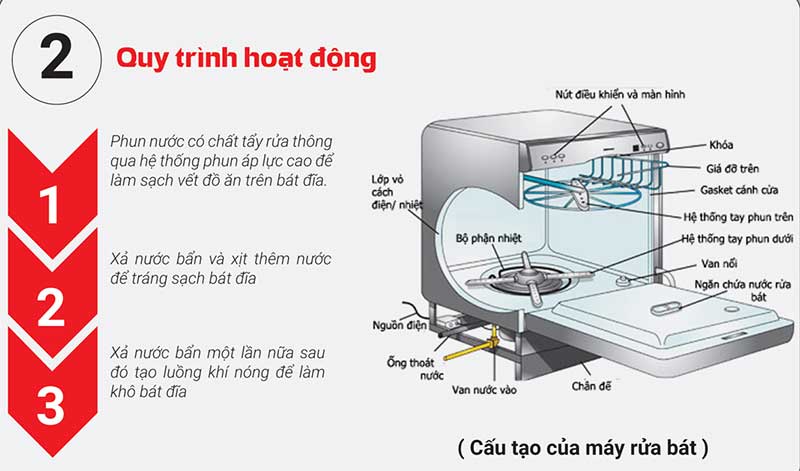
Thus, the dishwasher operates through many stages from pre-washing with warm water, thorough washing with hot water, rinsing 2-3 times, and then drying. How long will it take for the dishwasher to complete such a washing cycle? And what factors influence it?
2. What factors affect the washing time of the dishwasher?
Water supply
Power supply
Arrangement of dishes, appropriate amount of detergent
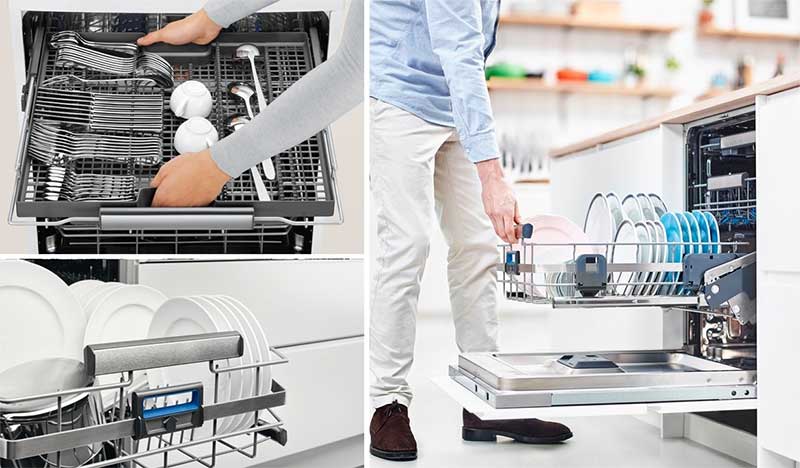
- Regarding the arrangement, each machine has a different tray structure; you should arrange according to the machine’s tray, as detailed in the manufacturer’s instructions.
- Adjust the amount of detergent according to the volume of dishes.
Choosing the wrong washing mode
3. How long does the dishwasher take to finish?
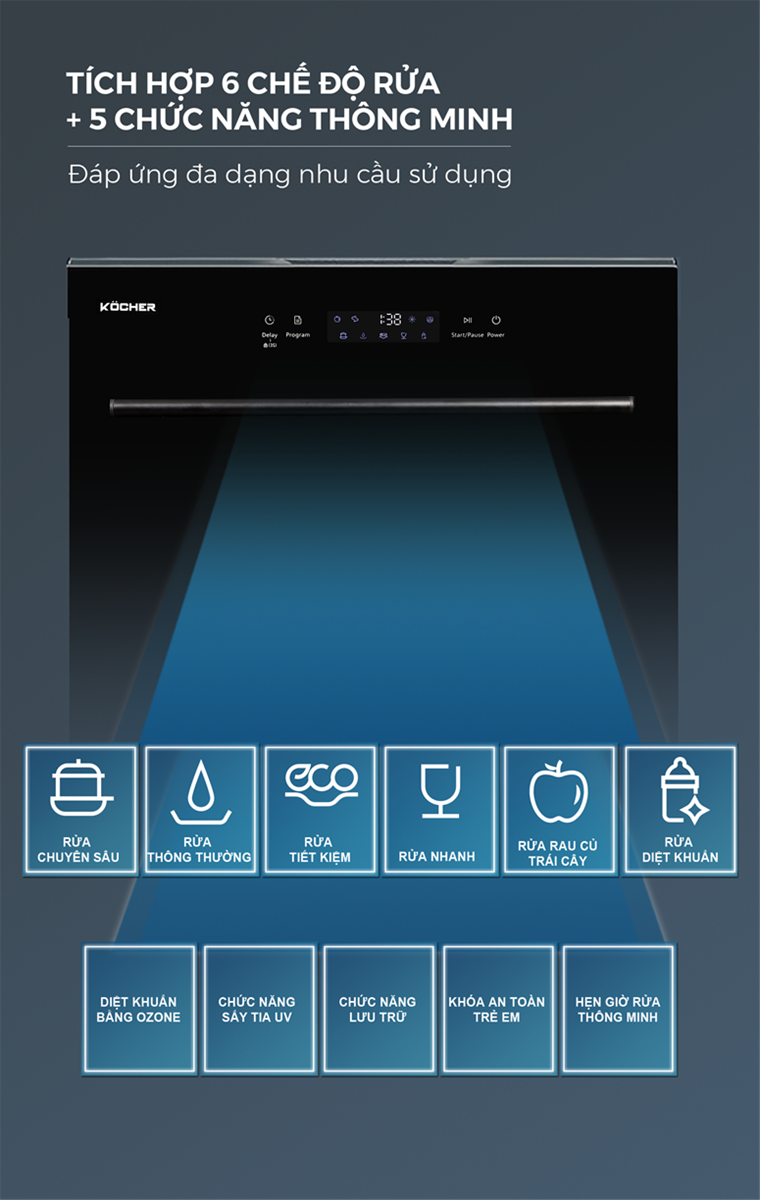
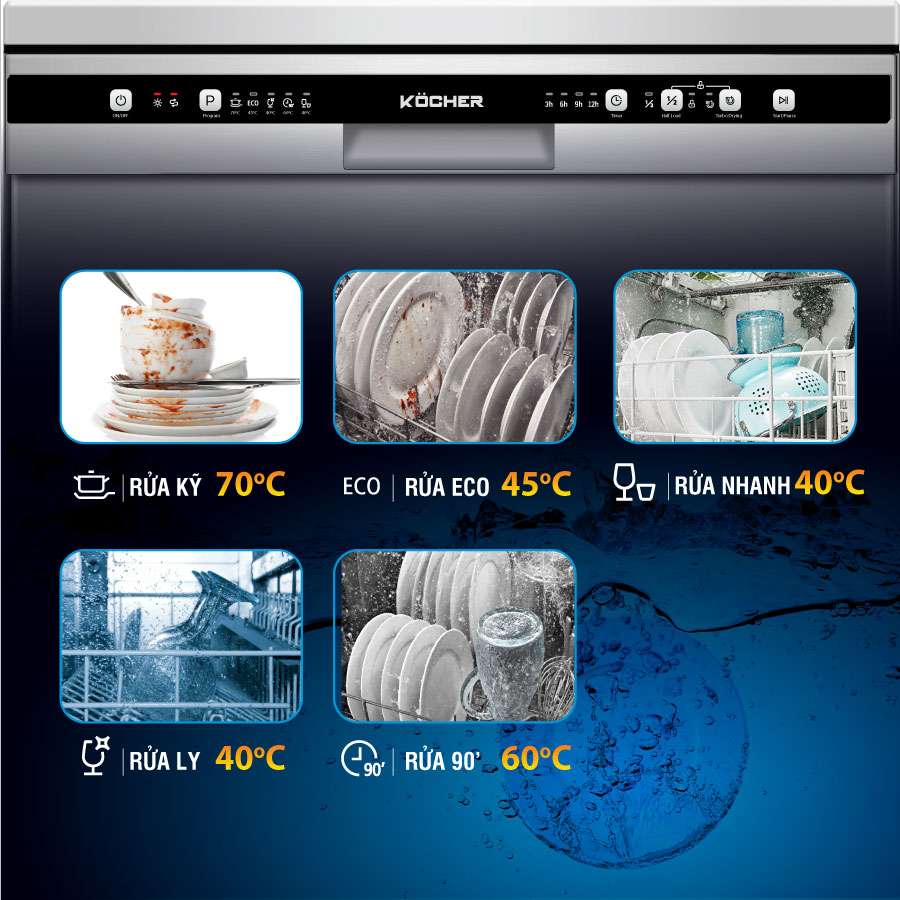
Currently, there are many household dishwashers from various brands on the market. Each type of dishwasher is programmed and set with different washing modes, suitable for each type of dish, the degree of dirtiness of cooking utensils, with varying times to help you use it more flexibly. Therefore, to know how long the dishwasher takes to finish washing, you need to carefully check the user manual to know the exact time for each washing mode.
Currently, all types of dishwashers on the market, if the above factors meet the standards, then:
- The washing time of a cycle will be about 45-60 minutes.
- If you choose the rinse mode twice, the total time will be about 120 – 180 minutes depending on the brand of the machine.
- In a day, you should wash a maximum of 3-4 times for the best longevity of the machine.
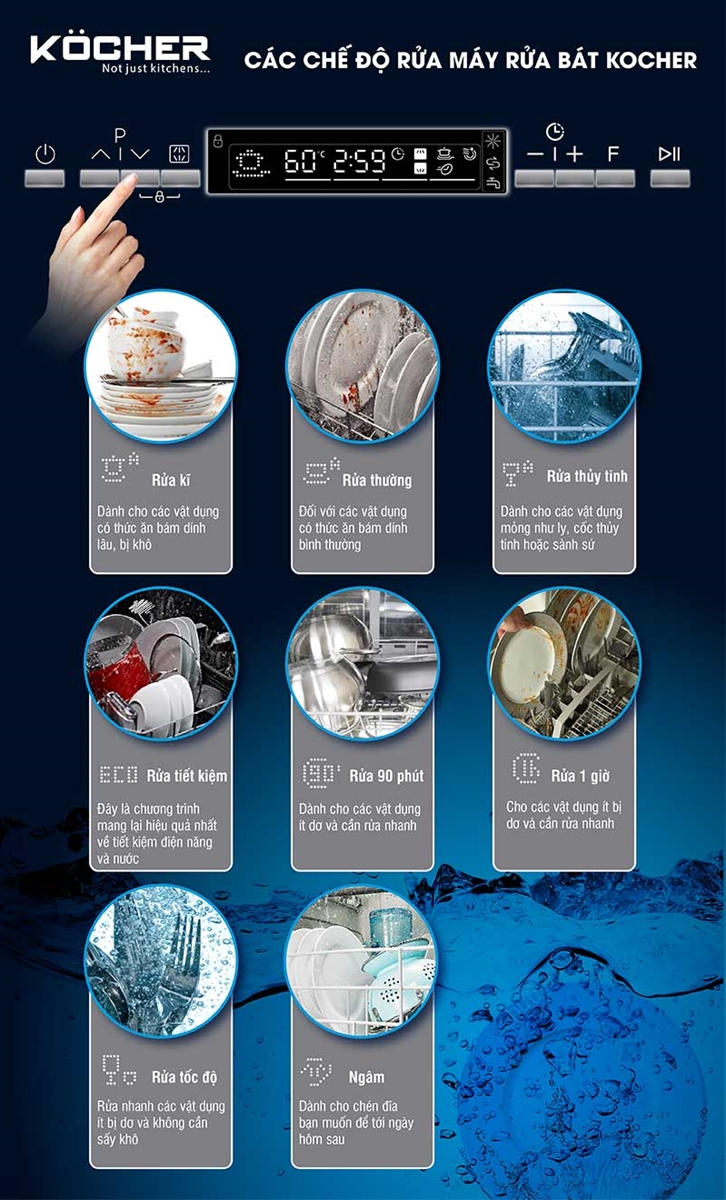
How long does the deep wash mode take?
How long does the soak wash mode take?
How long does the quick wash mode take?
How long does the half wash mode take?
- Washing glasses, bowls – washing within 90p
- Non-steam washing, drying – washing within 90p
- Enhanced steaming operates for about 120 – 150p.
How long does the automatic wash mode take?
Typically, this washing mode usually lasts from 90p – 180 minutes.
The above standards only apply to household dishwashers; industrial dishwashers will have different times and usage frequencies suitable for their needs.
The time for the dishwasher to clean the dishes is about 2 – 3 times longer than washing dishes by hand in the traditional way, depending on the selected washing mode. However, it includes pre-rinsing time, cleaning, drying, sterilizing, and deodorizing. So, the dishwasher takes longer, but it cleans better, saves effort, and does not consume too much electricity.
| >>> See more: |
4. Why does the dishwasher take so long?
Modern dishwashers today often take longer to wash dishes than older models. It sounds paradoxical and unrealistic, doesn’t it? When we learned this, it seemed a bit off.
But upon deeper investigation and use, we found a point that non-technical people regarding dishwashers might not know. That is, according to common theory, anything that operates for a longer time consumes more electricity and water, and also takes more time. However, the operating mechanism of modern dishwashers is completely different. New dishwashers have increased washing time, but their operating mechanism helps save water and electricity.
Today’s dishwashers operate quietly and are designed harmoniously to suit all interior styles.
You don’t have to worry too much about the operating time of the dishwasher; instead, pay attention to the energy and water consumption of each dishwasher you are considering choosing.
What are the operating cycles of the dishwasher?
Usually, only a few women are interested in the processes and operating mechanisms of dishwashers. However, it is good for them to know a little about it.
However, if you are a man in the family, you should definitely learn about the processes of the dishwasher to operate it most effectively and optimally. Especially in some situations that arise during use, understanding the operating mechanism will help you somewhat predict where the problem occurs and how to resolve it.
For some minor issues, you can resolve them yourself without waiting for the manufacturer’s technical staff. This will not disrupt your family’s use of the dishwasher.
The dishwasher is a type of machine that performs a series of quite complex operations to ensure your dishes are clean. But in terms of their operating mechanism, they are quite simple. Most dishwashers follow the same 7-step process as follows:
- Add water: this does not actually fill the dishwasher with water but only fills the water contained in the bottom water reservoir of the machine.
- Heat the water: this heats the water in the upper water reservoir to prepare for the dishwashing process.
- Add detergent: detergent is automatically added at the right washing stage by the dishwasher’s timer.
- Wash the dishes: hot water and detergent are pumped through the spray arms, and the pressure causes them to rotate and spray water with enough force to ensure the dishes are spotless.
- Drain dirty water: perform the draining of dirty water after the washing process out of the machine.
- Rinse the dishes: clean water is added and heated as before. But this time there is no detergent. This water is pumped through the spray arms to ensure no dirt or detergent residue remains on the dishes.
- Drain all water for the second time.
Why does the dishwasher run for hours?
As mentioned above, dishwashers usually take from one to several hours to clean and dry your dishes. If you find that the dishwasher is running for too many hours, you should pay attention to the following points:
- Limits on energy and water usage: as mentioned in the previous section, manufacturers always set standards for total water and total electricity consumption.
- Brand of the machine: each brand of dishwasher will have its own common technologies and proprietary technologies. Therefore, when buying a dishwasher, you should also pay attention to this point to choose a technology that suits your needs and goals.
- Type of machine: each brand of dishwasher usually has many different models, with different technologies and costs. Just because a dishwasher is expensive doesn’t mean it’s the best for your needs. And just because a cheaper machine doesn’t mean it won’t suit your family’s needs. Therefore, you should pay attention to researching the type of machine to choose one that is suitable for you. So that when using it, you won’t have to worry about the operating time of the machine.
- Washing mode: each type of dishwasher will usually have many different washing modes. You need to learn about the functions of each washing mode to use them appropriately for each purpose. Using the wrong mode will also cause you to take more time than expected.
How to save time washing dishes?
Once you learn, you can use it for a lifetime. Take a little time to learn about ways to save time washing dishes:
Use the correct washing mode: dishwashers have quite a few functions and washing modes. Therefore, read the manufacturer’s manual to understand the functions and washing modes of the machine provided by the manufacturer. Make an effort to read it even just once. This will save you a lot of time when using the correct washing mode in each case.
Heating element: these are metal pieces that convert electrical energy into thermal energy and heat the water to a certain temperature. Since they come into direct contact with water, they can easily accumulate limescale over time. Therefore, you should regularly clean this metal element gently but effectively at least once a month. This not only helps you save on electricity bills but also saves time washing dishes in the dishwasher.
Pump: this is a motor that pushes water through the spray arms during the cleaning process or to the drain during the draining process. The dishwasher will open and close the valves at the right time to ensure the water goes in the right direction.
Spray arms: these arms are hollow, and the pressure of the water pushed through makes them rotate to ensure the dishes are washed clean. However, food, grease, and other dirt can stick to them. Over time, this can clog these spray arms. Therefore, you need to periodically check to keep them clean and unclogged.
Ensure sufficient water pressure: weak water pressure will not provide enough water for the dishwasher at the right time. This increases the washing time and reduces the machine’s performance. You should also pay attention to this point to intervene when there are signs of weak water pressure.
Keep the filter clean: when your dishwasher starts leaving food particles, your filter may be clogged. This will restrict the flow of water. In the long run, it can affect the lifespan and operating time of the machine. Pull out the bottom rack and remove the filter cover or follow the instructions in the manufacturer’s manual.
Door and rubber seals: you need to always keep the door clean and the seals around the machine with a soft brush or sponge. Food debris can accumulate and weaken the seals, allowing water to leak out during washing. Check for gaps and cracks. A damaged seal should always be replaced. This will help ensure safety, extend the machine’s lifespan, and reduce the time the dishwasher operates.
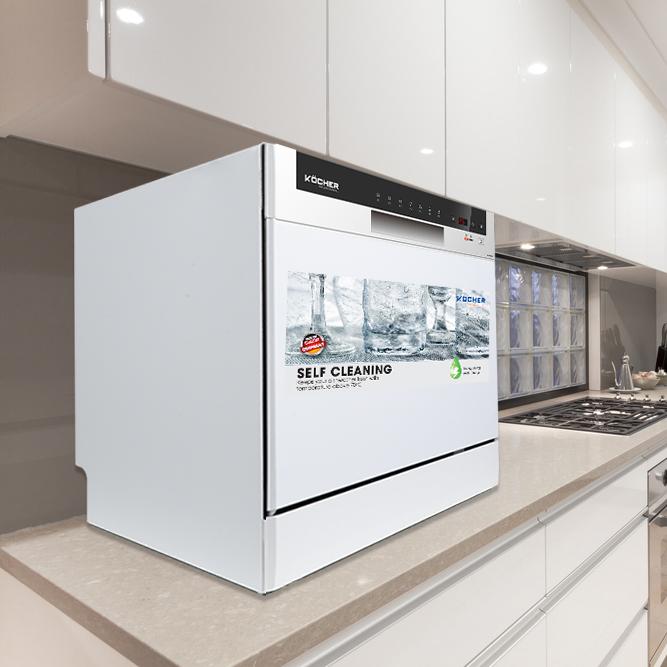
You can refer to some of the latest Kocher dishwashers that save energy and time.
>>> Kocher KDEU 8835 SEMI Dishwasher
>>> Kocher KDEU-8839 Dishwasher
>>> Kocher KDEU-8838 Dishwasher
>>> Kocher KDEU-8835BL Dishwasher
Conclusion: