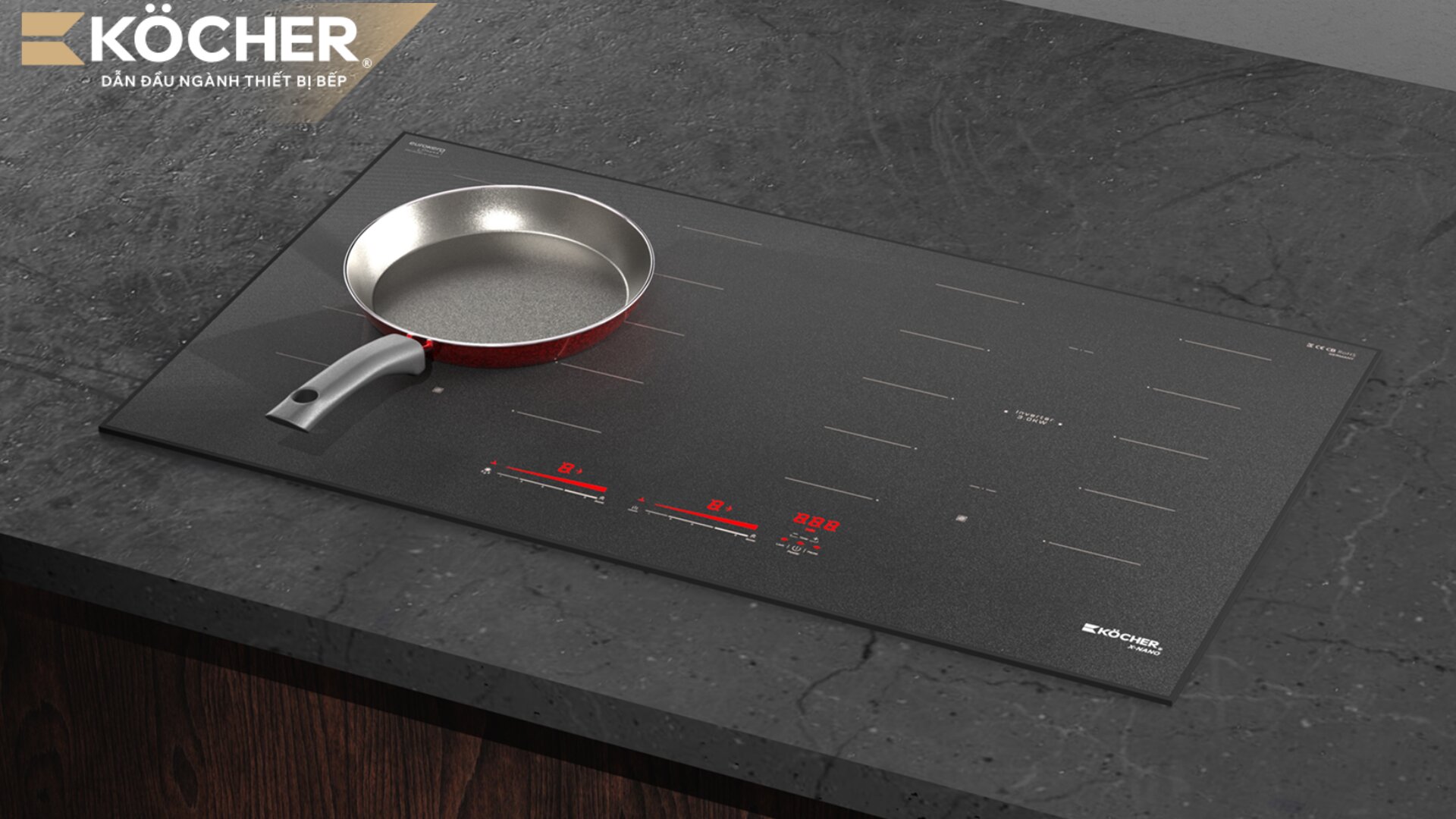
Induction hob not responding to touch is one of the common issues that disrupts the cooking experience of home cooks. This error can arise from improper usage habits or from technical components inside the circuit board having issues. Understanding the operating mechanism of the control panel will help you quickly troubleshoot the error and protect the lifespan of your kitchen appliance.
11 reasons why the induction hob is not responding to touch and how to fix it
The touch control system of modern induction hobs typically operates based on capacitive principles or infrared light sensors. When these signals are obstructed, the microcontroller (IC) will lock the command to ensure safety.
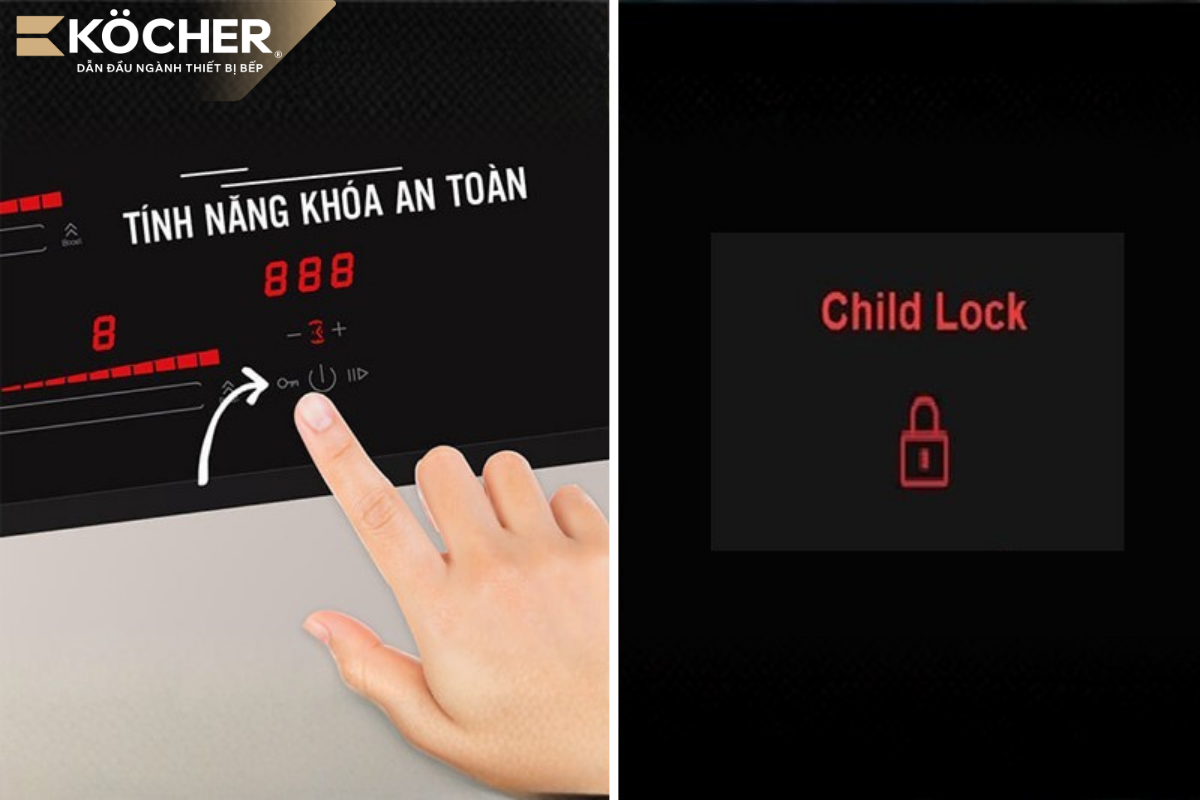
Child Lock function is activated
- Signs to identify: The display shows a lock icon or the letter “L” (Lock). You can still see the power light on, but any touch on other function keys does not respond.
- Technical cause: This is a safety feature to prevent children or small animals from accidentally touching the cooking surface. When activated, the microcontroller (IC) will cut off all signals from the function keys, only keeping the power or lock key active.
How to fix:
- Step 1: Find the key with the lock icon (or the P/L key depending on the model).
- Step 2: Press and hold your finger on that position for about 3 – 5 seconds.
- Step 3: When you hear a “Beep” or the lock indicator light turns off, the keyboard will function normally again.
Water overflow causes the anti-overflow feature to activate
- Signs to identify: The hob emits a continuous warning sound and automatically cuts off all touch functions while cooking.
- Technical cause: Induction hobs with integrated anti-overflow sensors located just below the control panel. When liquid covers this area, the sensor will activate an emergency shutdown command to protect the circuit board.
How to fix: Remove the pot, use a dry cloth to wipe off the water in the control area, wait about 30 seconds for the surface to dry completely before restarting the hob.
The hob surface or user’s hands are wet or greasy
- Signs to identify: The touch keys respond intermittently, or you have to press very hard/multiple times to get a response. Sometimes the hob switches modes by itself (erratic touch).
- Technical cause: Water and grease are conductive substances that disrupt the very small electrical energy on the glass surface, causing the capacitive sensor underneath to not accurately determine the touch location of the finger.
How to fix:
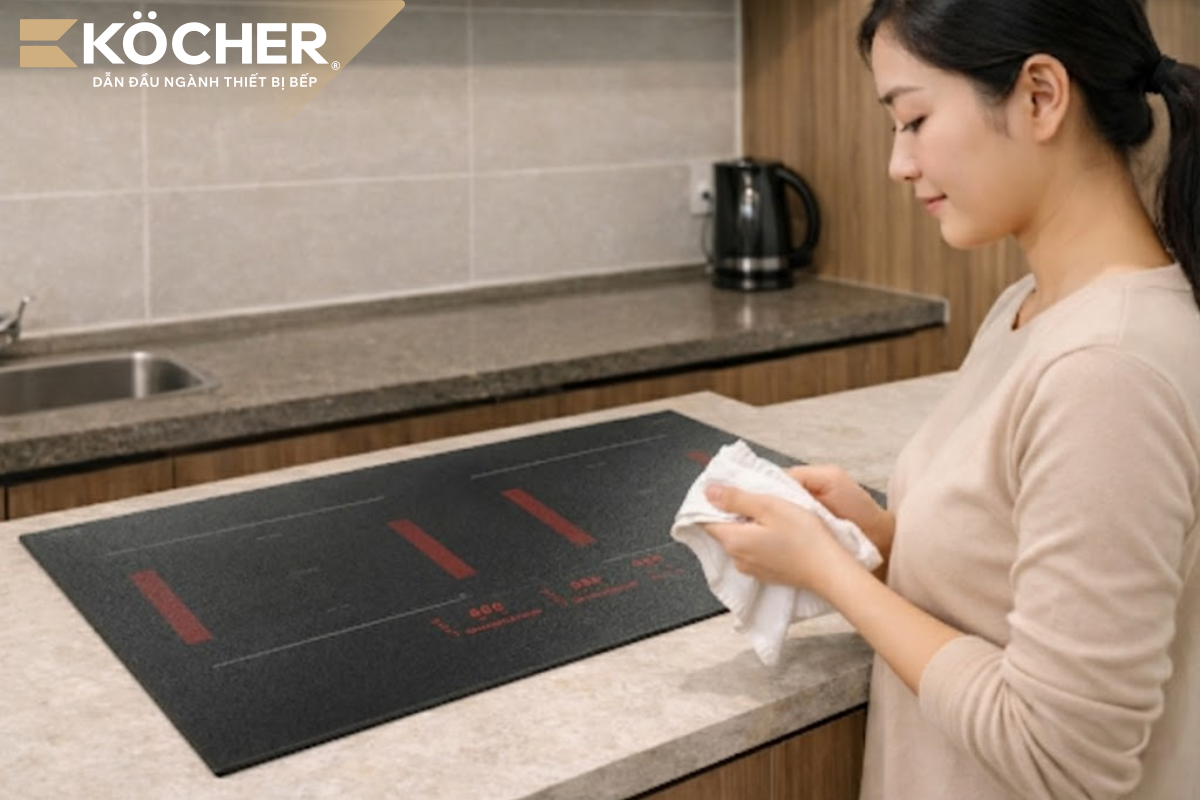
- Turn off the hob, use a soft cloth to wipe off all water, grease, or food residue on the control area.
- Ensure your hands are dry and not greasy before touching the keys. If your hands are too cold (in winter), warm them up before operating to increase capacitive sensitivity.
- Use Köcher’s X-Nano induction hob series that applies the exclusive X-Nano crystal structure from EuroKera (France) to resist grease and fingerprints, keeping the glass clean for a long time. You can refer to the test video on dirt, grease, and fingerprint resistance below.
Incompatible cooking utensils (Pot without induction)
- Signs to identify: The display flashes the cooking zone light or shows error E0, not allowing power adjustment even though the pot is placed on the hob.
- Technical cause: Induction hobs operate on the principle of eddy current; if the bottom of the pot is not magnetic, the induction coil cannot create a closed magnetic field, and the current sensor will report back to the control center to cut off control.
How to fix: Use a pot with a magnetic bottom (test with a magnet) and ensure the bottom of the pot is flat and clean for the best contact with the glass surface. This pot compatibility also varies depending on common types of induction hobs on the market. Double induction hobs, triple induction hobs, or combined infrared induction hobs will have their own specific requirements or flexible cooking zones, so you need to choose the right type of pot compatible with each specific cooking zone.
Pot size not compatible with the cooking zone
- Signs to identify: The hob accepts the pot but heats very slowly or continuously cuts off, and the control panel sometimes freezes when you try to increase the power.
- Technical cause: If the diameter of the pot’s bottom is too small (usually <10cm), the dispersion of the magnetic field will cause the sensor to not measure the heat absorption level correctly, leading to a safety shutdown command. If you continue to use a pot that is too small, the hob may report an error similar to the electric hob not recognizing the pot due to insufficient magnetic field contact area.
How to fix: Choose a pot that is the right size for the induction coil of the hob, prioritizing the use of hobs with automatic pot size detection features (Pot Detect).
Poor quality glass surface
- Signs to identify: The touch function works intermittently, or you have to press very hard for the hob to respond.
- Technical cause: Poor quality glass, or cracks, or breaks affect the signal transmission capability.
How to fix: Choose induction hobs that use high-quality glass such as Köcher’s X-Nano series to ensure smooth interaction and long-lasting durability. Additionally, you may consider replacing the glass surface.
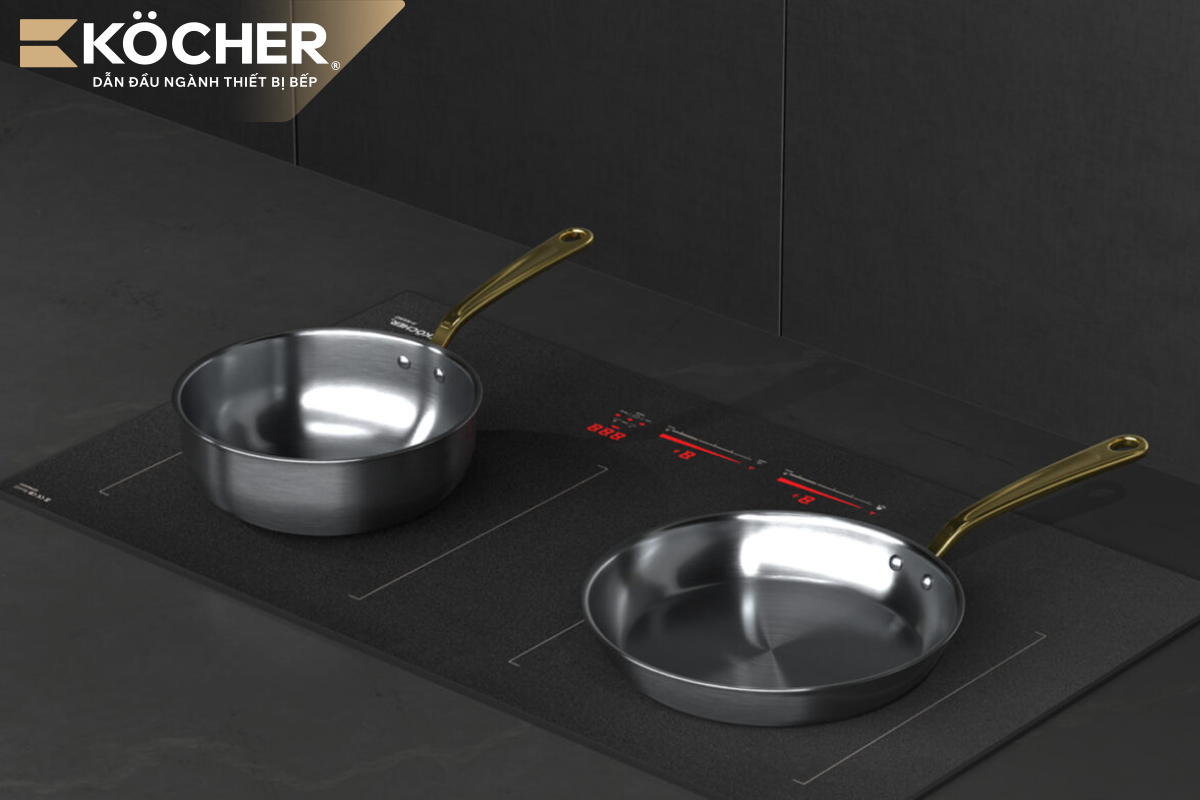 It is advisable to choose induction hobs with high-quality glass like X-Nano to reduce scratches by up to 5 times while ensuring magnetic capability.
Issues with unstable power supply
- Signs to identify: The hob is cooking, but the control panel freezes, blinks continuously, or completely turns off the touch function even though the power is still on.
- Technical cause: Components like the power IC require a stable input voltage. When voltage drops or electrical noise occurs, the protection system will cut off the control signal to prevent damage to the main circuit board.
How to fix: Use a separate circuit breaker for the induction hob if the power supply in the area is often unstable. Do not share the socket with high-power devices like refrigerators or washing machines.
 It is advisable to install a separate circuit breaker for the induction hob to ensure electrical safety.
Faulty control board or internal components
- Signs to identify: The hob still powers on, but all buttons do not work, or the hob continuously reports system errors right after startup.
- Technical cause: Long-term humidity or high voltage spikes can damage the control IC, kill the IGBT, or oxidize the copper traces on the control board.
How to fix: This is a specialized technical error, so you need to contact a professional warranty center to check the circuit or replace the control board to ensure safety.
To minimize complex circuit board failures from the start, savvy consumers often prioritize purchasing brands from the good German induction hob manufacturers that are reputable in Vietnam. These German-standard hobs use high-quality control systems and induction coils from E.G.O, helping the hob handle electrical loads well, operate durably, and minimize the rate of touch freezing or failure.
Electromagnetic interference or static electricity
- Signs to identify: The touch function jumps erratically when other electronic devices (such as microwaves, phones) are placed near the hob or when the weather is too dry.
- Technical cause: Electromagnetic waves from other devices or static electricity accumulation on the glass surface can distort the capacitance parameters that the sensor records.
How to fix: You need to ensure that the hob is installed with a proper grounding wire (neutral wire) and keep electromagnetic wave-emitting devices away from the control area of the hob.
 Placing a microwave near the induction hob can lead to the induction hob not responding to touch.
Cooling components (cooling fan) not working
- Signs to identify: The hob can cook for a few minutes and then suddenly stops, powers on but does not respond to touch, and you do not hear the sound of the cooling fan.
- Technical cause: If the fan is faulty, the temperature at the IGBT and induction coil will spike. The temperature sensor will report back to the main IC to lock the entire touch system to protect the circuit board from melting risks.
How to fix: Check the ventilation holes to see if they are blocked. If the fan is faulty, contact a technician to replace the cooling fan.
Touch surface or touch keys are stuck/broken
- Signs to identify: Some keys work, while others are completely unresponsive even though the glass surface is clean.
- Technical cause: The signal transmission spring is deformed, rusted, or the capacitor of the touch key no longer has the ability to store charge to recognize touch actions.
How to fix: You need to disassemble the hob for cleaning, adjust the touch spring, or replace the control key set if necessary. If damaged, contact a technician to replace the touch control board.
 You need to contact a technician to check the hob if you encounter the induction hob not responding to touch due to stuck keys.
5 tips to keep the induction hob touch panel durable
To maintain sensitivity and prolong the lifespan of the touch system, users should note:
- Always clean the glass surface with a soft, clean cloth or specialized solution after each cooking session to remove grease residue.
- Touch gently, avoiding sharp objects or pressing too hard on the touch area.
- Regularly check and clean the device to ensure internal components remain cool.
- Use a voltage stabilizer or power protection device; maintaining a stable power supply helps protect the touch IC from “electric shock,” preventing long-term key failure.
- Prioritize choosing high-quality induction hobs like Köcher’s scratch-resistant X-Nano series, ensuring the circuit board and sensors operate durably over time.
We hope that the detailed analysis of the induction hob not responding to touch situation has helped you gain experience in effectively troubleshooting issues. Choosing reputable brands like Köcher with European-standard components is the optimal solution for a smart and durable cooking experience.
With elegant product design and dedicated support services, Köcher is committed to providing an exceptional cooking experience and elevating the prestige of your kitchen.
|
Köcher induction hob pioneers German technology – For detailed product information, please contact:
|