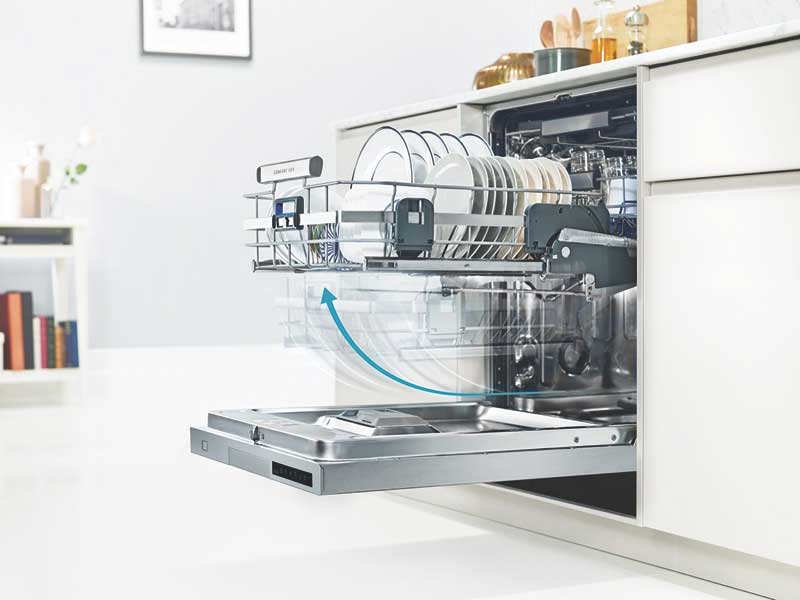
Experience in buying a dishwasher!
The emergence of dishwashers has brought about a major technological revolution, freeing the hands of women from detergents and eliminating the usual fatigue in daily life.
Let’s explore the criteria for choosing a dishwasher with Kocher.
Learn more:
- Advantages of dishwashers
- Items not to put in the dishwasher
- How to clean the dishwasher properly
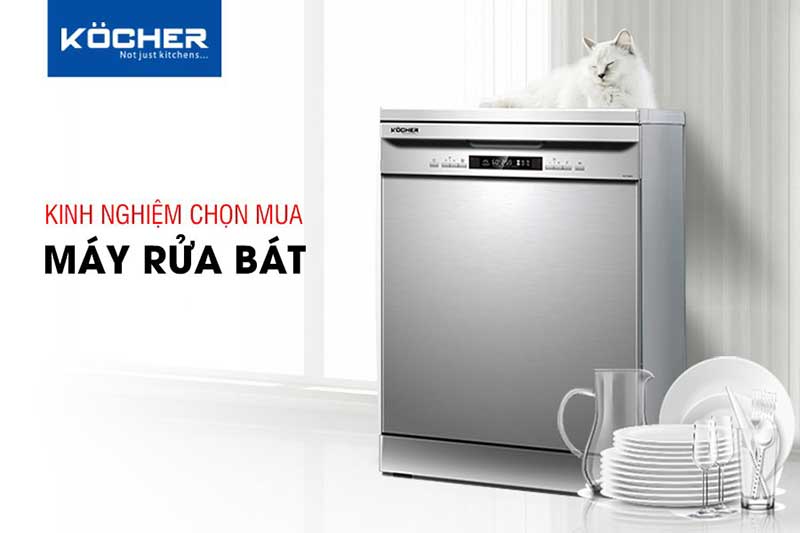
Experience in buying a dishwasher according to criteria?
1. Number of users and actual needs:
- For small families (2-3 people): You can choose mini dishwashers with 6 sets, which cannot wash pots.
- A family of about 3-4 people can choose 8-set models or opt for 12-set models that can comfortably wash pots and pans.
- A family of about 5-6 people (high usage needs) should choose 12-15 sets. This type has a large capacity, can wash many dishes, pots, and pans. There are many premium brands of 15-set dishwashers that even have separate washing zones.
2. Investment cost:
- A 6-set model from Japan, display or liquidation costs only about 5-6 million, while European products vary in price depending on the brand and features.
- An 8-set model costs about 8-12 million.
- A 12-set model costs about 11-12 million or more.
- A 15-set model costs around 14 million or more.
3. Size of the dishwasher:
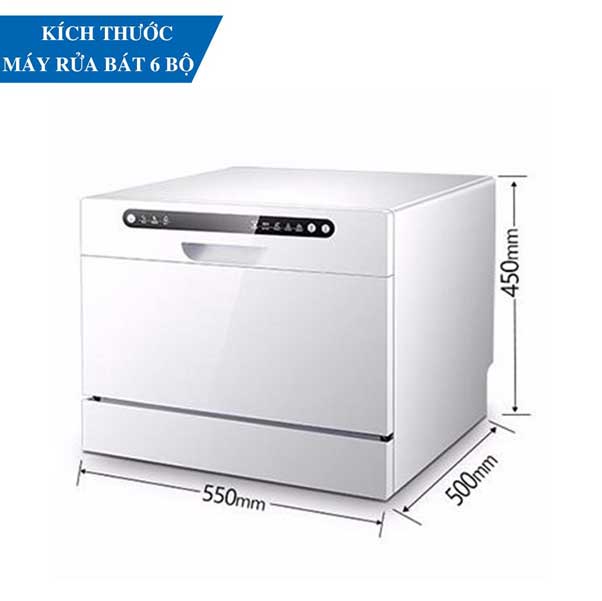
Size of the 6-set dishwasher:
- Advantages: Suitable for families with 1-2 members, in tight spaces. Can be placed anywhere in the kitchen.
- Disadvantages: Small washing compartment, only one washing compartment, so large utensils like pots and pans cannot be washed.
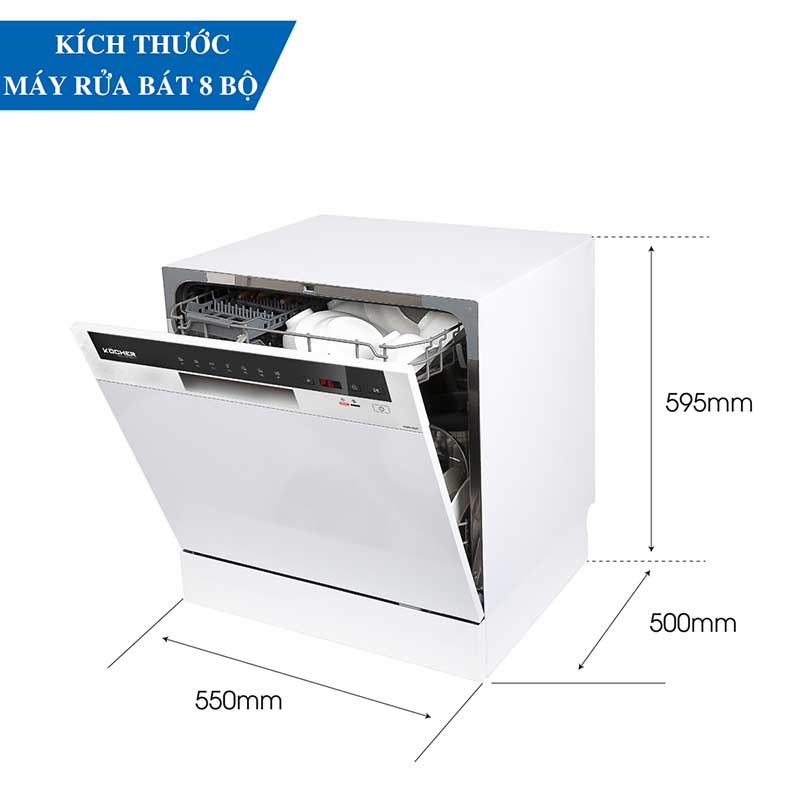
Size of the 8-set dishwasher:
- Advantages: Suitable for families with few members (1-2 people), in tight spaces. Can be placed on a table or installed under the counter. The 8-set dishwasher is designed with 2 washing compartments, allowing you to wash pots and pans.
- Disadvantages: Small washing compartment, so it can hold fewer items, and does not integrate many smart features.
Size of the 12-set and 15-set dishwasher
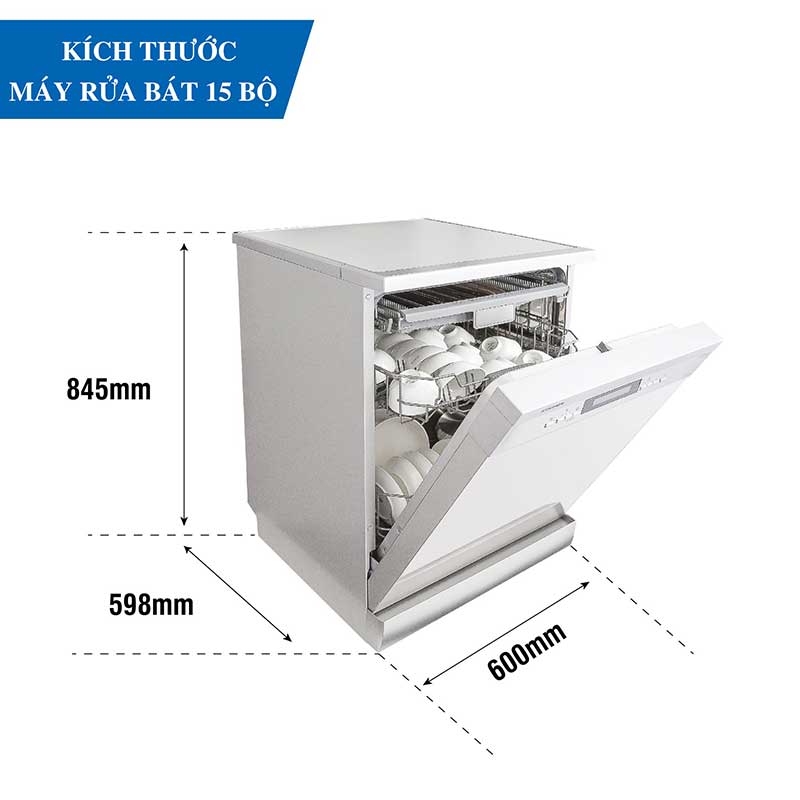
- The 12-set model has dimensions: (H*W*D): 815*598*550mm
- The 15-set model has dimensions: (H*W*D): 845*598*600mm
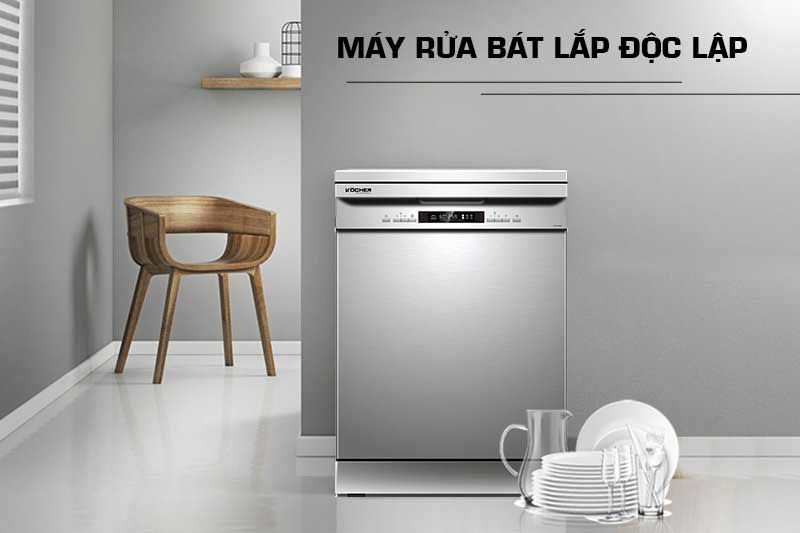
Size of the standalone dishwasher:
- Advantages: Suitable for large families, designed with 2-3 compartments allowing you to wash more dishes, pots, and pans. Integrates many smart features.
- Disadvantages: Higher cost
Size of the built-in dishwasher:
This type of dishwasher is installed inside a cabinet or kitchen shelf. For this model, when designing the kitchen, the compartment for the dishwasher must be calculated in advance to fit the space and kitchen shelf system.
This type has two categories: Fully integrated and semi-integrated
- Fully integrated: Designed to be completely hidden inside the kitchen cabinet, the control panel is also located inside the door handle.
- Semi-integrated: The control panel is exposed, while the rest can still close the cabinet door to synchronize with the kitchen cabinet design.
Advantages: High aesthetic value and maximizes space efficiency, harmonizing with the kitchen cabinet. Suitable for both small and spacious kitchens. This type, like the standalone dishwasher, has a spacious washing compartment, allowing for washing many sets of dishes along with cooking utensils.
Disadvantages: Requires designing a compartment for the dishwasher and the cost is quite high, suitable for luxurious, modern spaces.

4. Reasonable placement of the dishwasher:
For families with narrow or small rooms or where the initial design did not plan for a dishwasher, you can only choose a 6-set or 8-set dishwasher.
For families with spacious and comfortable kitchens, it is advisable to choose 12 or 15-set models, which are both beautiful and allow for washing all dirty utensils comfortably.
5. Material of the outer shell and inside the dishwasher:
Many customers are still unclear and curious about what materials the outer shell and inside of the dishwasher are made of.
Typically, the outer shell of a dishwasher is made of metal such as steel, high-quality stainless steel that does not rust, or it can also be made of steel coated with powder paint on the outside. The inside of the dishwasher is made of high-quality stainless steel that does not rust or plastic.
All materials used for dishwashers are tested and researched thoroughly for good heat resistance. Depending on the brand, different materials are chosen.
Some opinions suggest that using plastic materials inside the dishwasher will not rust and produce less noise. However, the durability is not as good as stainless steel.
6. Power of the dishwasher
7. Noise level of the dishwasher
The noise level of the dishwasher is also one of the extremely important factors you need to pay attention to. The human hearing range is only about 0-125dB. Noise below 42dB is almost inaudible, while above 105dB can cause pain, and above 115dB for a long time can lead to deafness.
The most suitable and common noise level for dishwashers is around 44-49dB (this noise level is equivalent to a normal conversation). However, high-end models have optimized noise levels below 42dB. The lower the noise, the better.
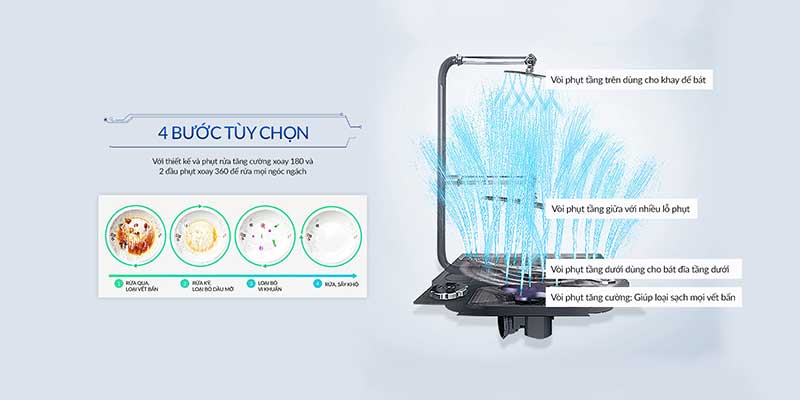
8. Design of the spray nozzle of the dishwasher
- Spray force: Effectively cleans stubborn stains, even those in hard-to-reach corners.
- Spray head: Contains many small-diameter water supply holes on both ends, making it easier to clean dishes.
9. Features of the dishwasher
Most modern dishwashers are integrated with various smart features to optimize operation and achieve the best efficiency during use. Depending on the usage needs and budget of each family, you can choose models with suitable features. Notable features include: drying function, no pre-rinsing required, energy-saving feature.
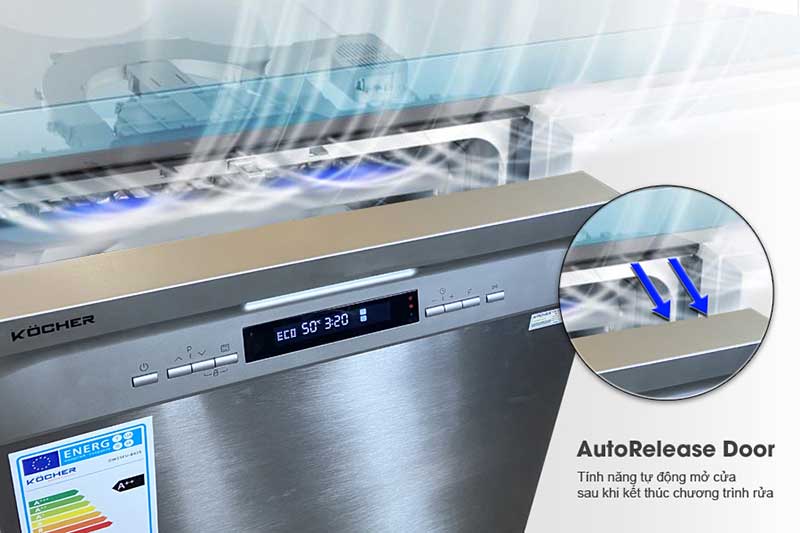
Especially, the feature of automatically opening the door at the end of the cycle is only available in high-end models. In regular models, the automatic opening feature is only available in ECO wash mode, however, in newer dishwasher models like Kocher KDEU 8835 dishwasher, the door opening feature is integrated into most washing programs.
10. Brand
Items that should not be put in the dishwasher!
Although household dishwashers are considered a “savior” for women, helping them reduce the burden of housework. However, not all items can be washed in the dishwasher. If you do not understand and know clearly, it can easily lead to damage to the items and could also be the reason for the dishwasher to malfunction. Let’s find out with Kocher which items should not be used in the dishwasher.

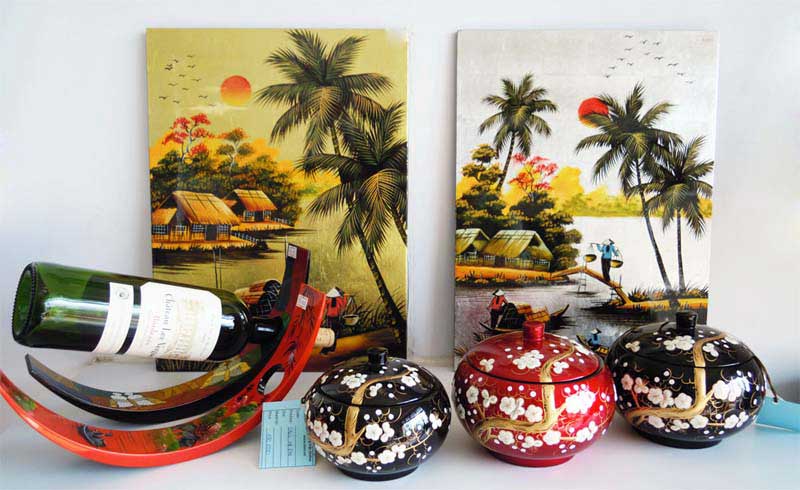
1: Lacquered items
Lacquered items have poor heat resistance, and the lacquer layer can easily peel off when exposed to high temperatures or sudden temperature changes. Therefore, washing lacquered items in the dishwasher will cause them to be damaged due to temperature and water pressure.
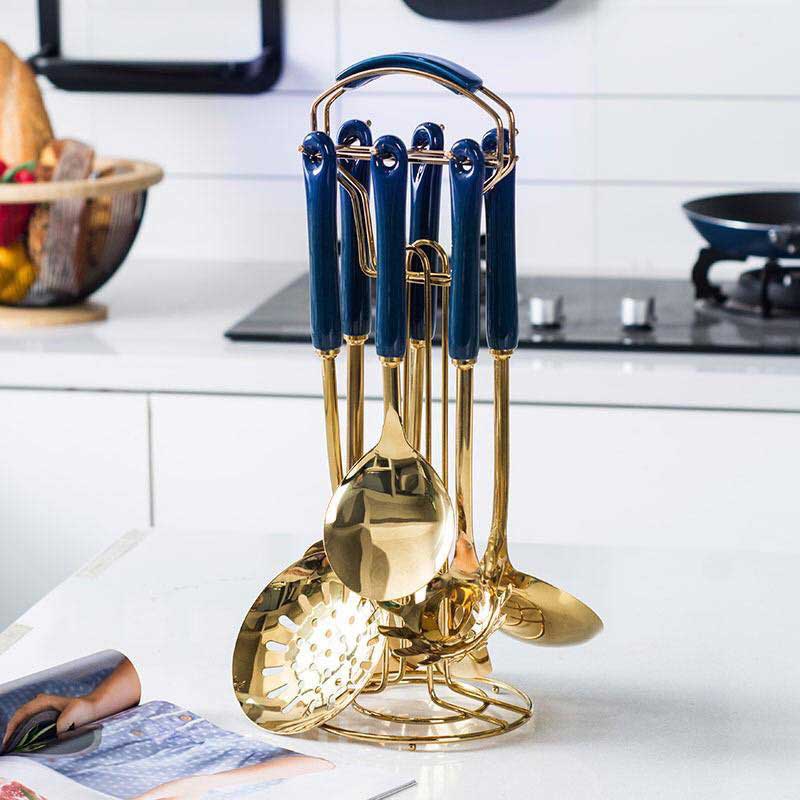
2: Copper and gold-plated items
Items made from these materials are very prone to oxidation, discoloration, and fading when exposed to high temperatures and detergents in the dishwasher. Therefore, if you wash them in the dishwasher, the sparkling beauty of those items will definitely be lost.
3: Aluminum items
Aluminum items can technically still be used in the dishwasher. However, after a long time of use, aluminum items are very prone to discoloration and losing their original shine. So you should also be cautious when putting them in the dishwasher.
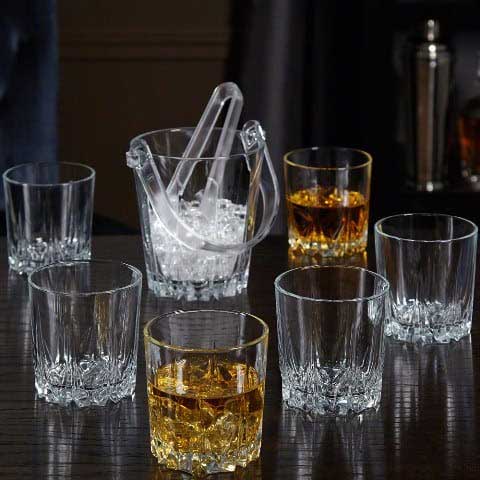
4: High-quality glass items
High-quality glass items are very thin and fragile due to the strong impact of water force and temperature. Moreover, the detergents in the machine can cause them to become cloudy after a long time of use.
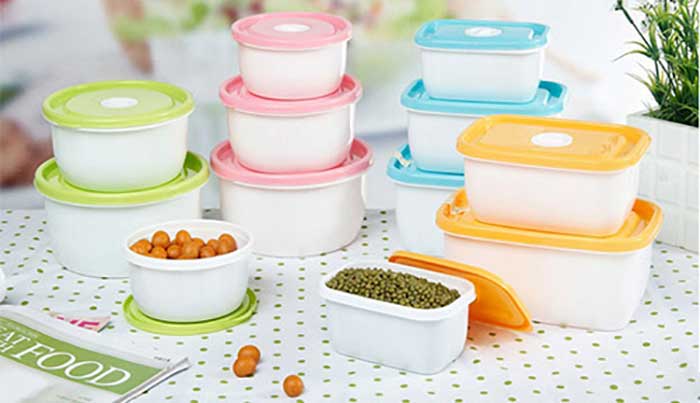
5: Thin plastic or synthetic fiber items
Because the water temperature in the dishwasher can be quite high, sometimes reaching 70°C, putting these items in can easily cause deformation or produce harmful substances affecting health. Even harder items like plastic cutting boards or high-quality plastic bowls should not be put in as they will still discolor.
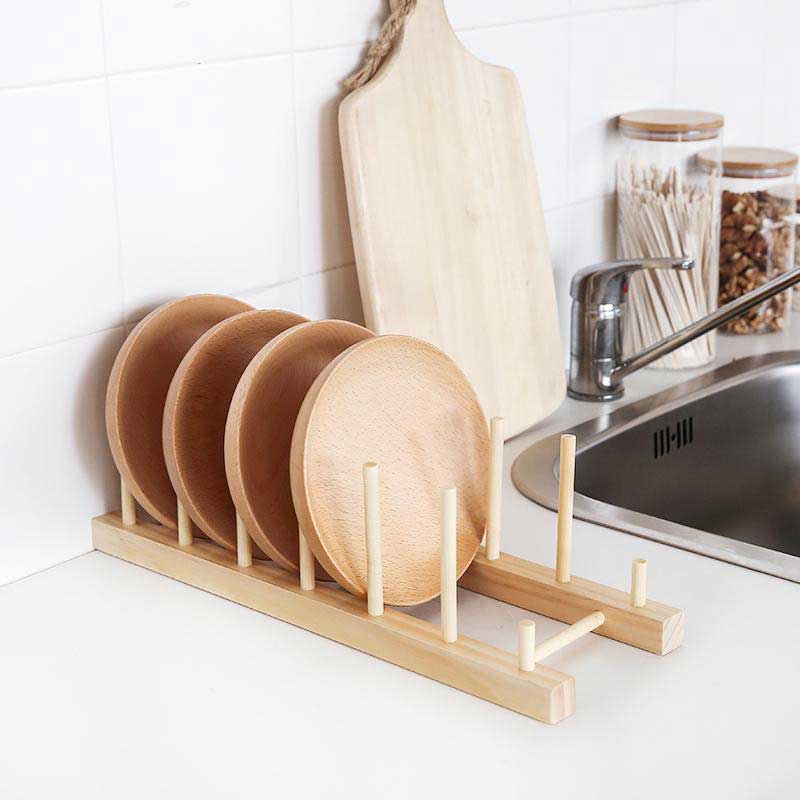
6: Wooden items
7: Non-stick coated utensils
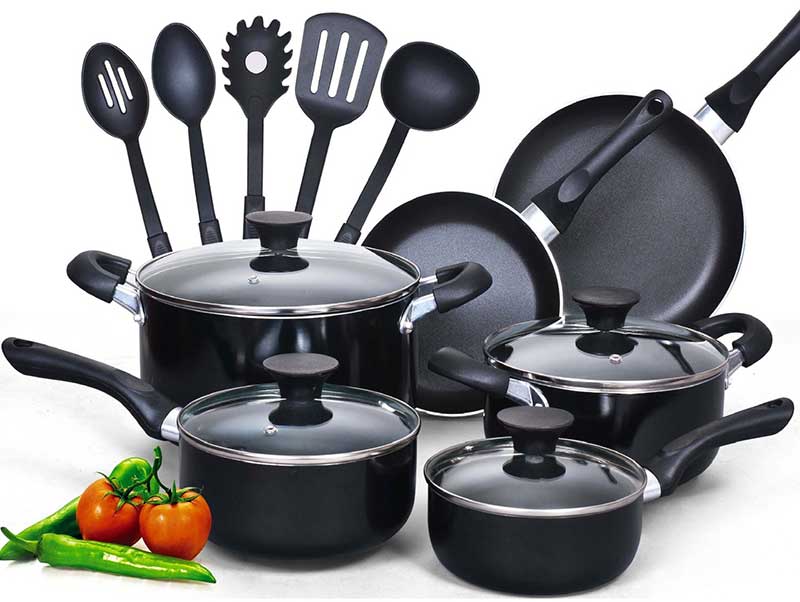
For utensils with a non-stick coating such as pots and pans, you should not put them in the dishwasher. Because to clean them, the dishwasher must operate at high temperatures, with strong water jets under high pressure and high detergent concentration, which can cause the non-stick coating to peel off, affecting health after a long time of use.
For these utensils, it is best to clean them by hand to ensure safety and long-term usability.
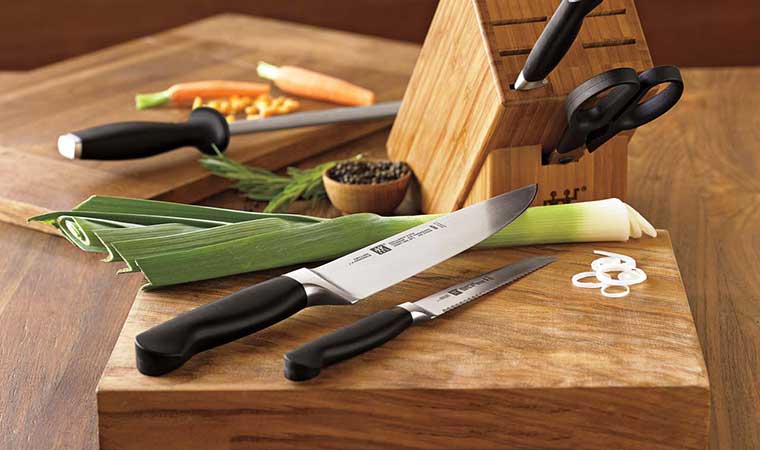
8: Knives and scissors
9: Bottles, jars, and containers with small openings
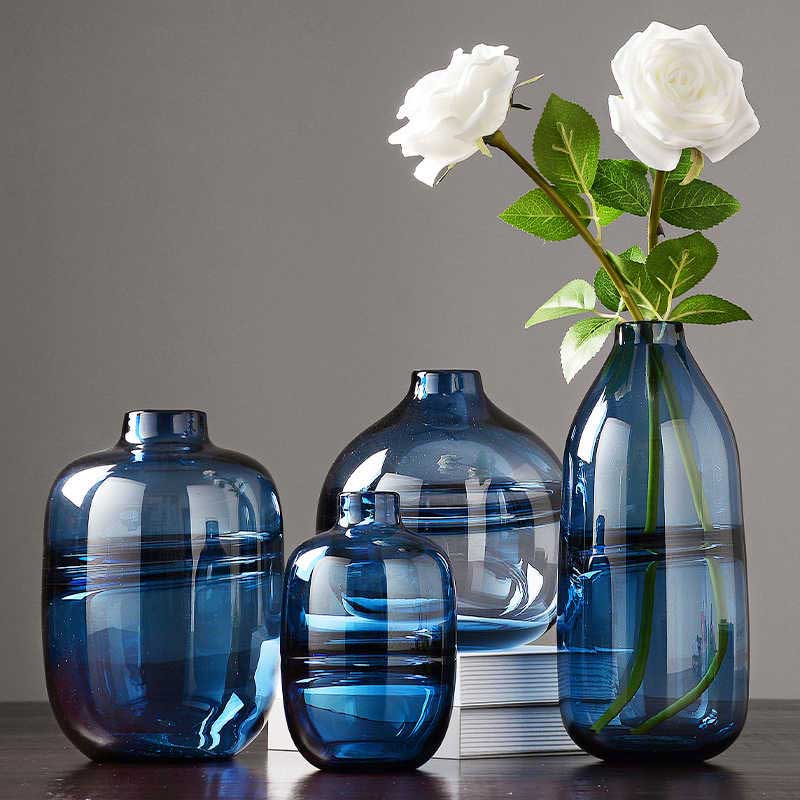
Items like bottles, jars, and glass containers with small openings may not be completely cleaned by the dishwasher. Because the water jets may not reach inside the containers.
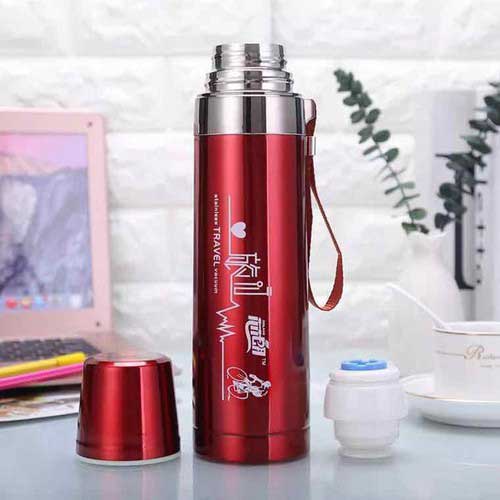
10: Thermal bottles or cups
The temperature in the dishwasher is quite high, so washing thermal bottles or cups will reduce the thermal retention components inside. If you want to wash them, it is best to place them on the top rack away from the heating element of the machine to ensure safety.
How to use the dishwasher to extend its lifespan?
- Choose a reputable, genuine brand to ensure quality. Some well-known dishwasher brands in the market that many people choose are Kocher, Bosch, Teka, Hafele…
- Regularly clean and maintain the dishwasher inside and out. Periodic cleaning every 6 months will help keep the machine clean and more durable.
- Use a stable power source that can handle the pressure for the machine to operate stably.
- Do not turn off the power while in use. It is necessary to turn it on and off correctly to avoid causing conflicts among the internal components of the machine.
- Properly loading dishes is also an important factor that helps the machine operate more durably.
- Use specialized detergent for dishwashers. Because regular detergents not only do not clean dishes but also reduce the lifespan of the machine. Using the right detergent specifically for dishwashers is one of the secrets to help the machine operate stably, effectively, and durably.
- Do not overload the machine. Putting too many dishes in the machine causes it to operate under overload, which is also a reason for reducing the lifespan of the machine.