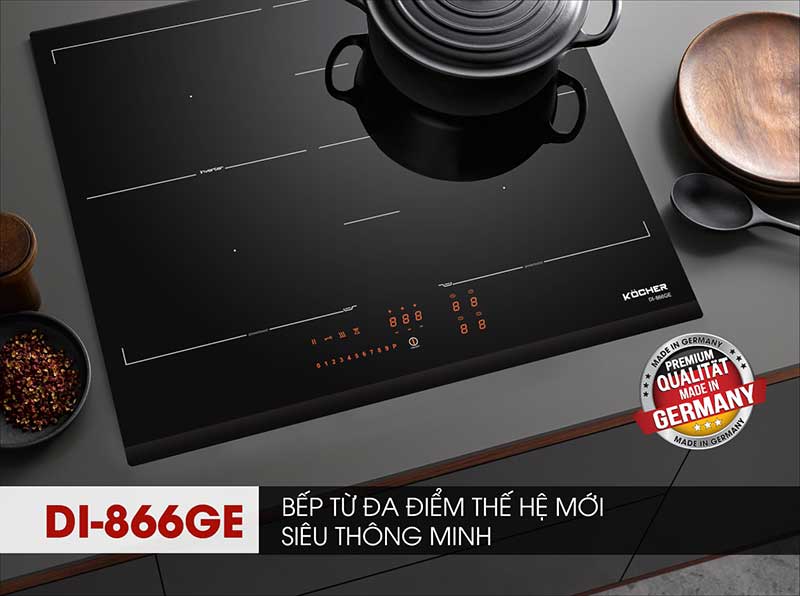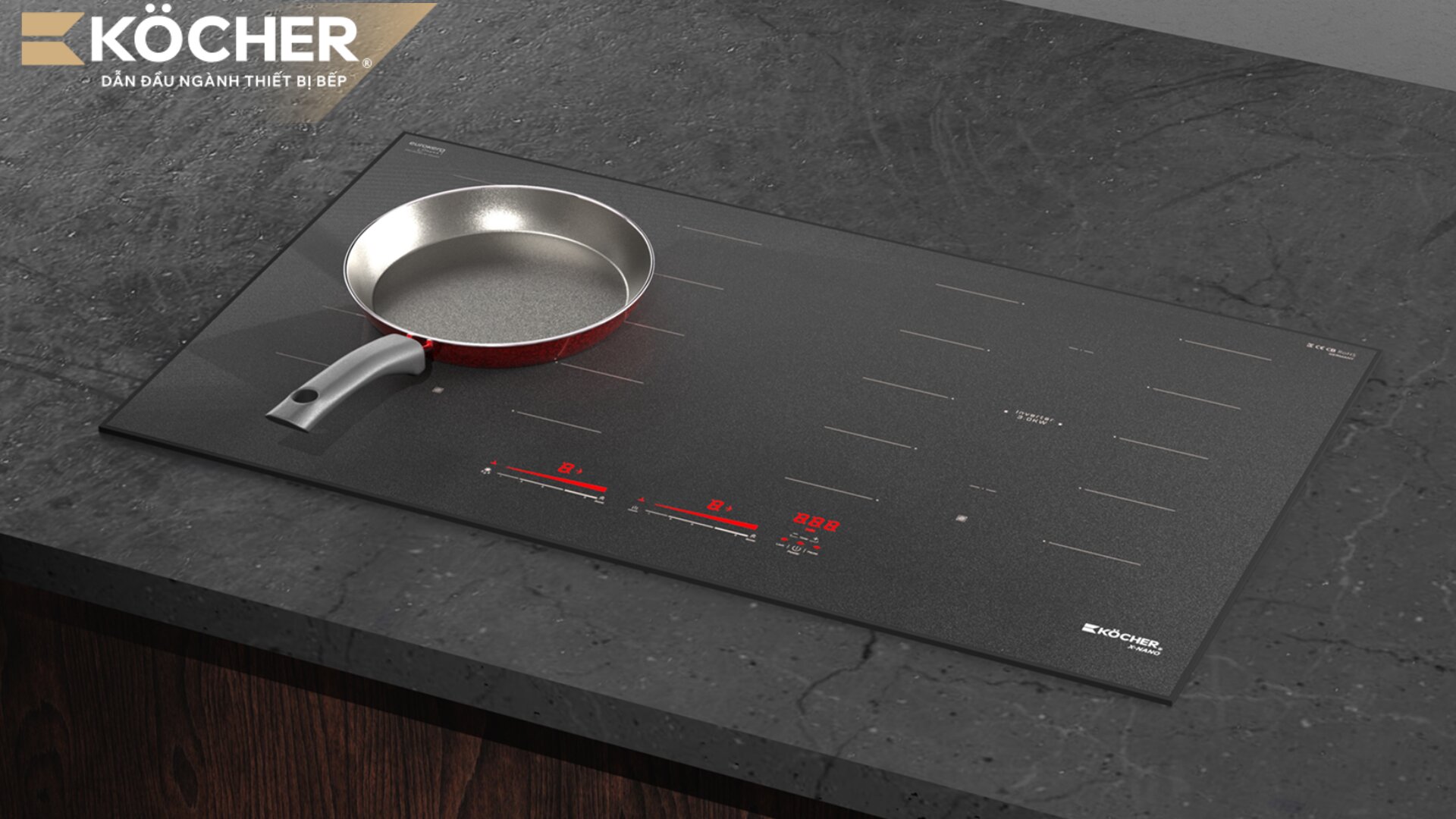
The intermittent induction cooktop not only disrupts the cooking process but also poses a risk of damaging components if not addressed promptly. This issue often arises from unstable power supply, improper usage habits, or technical faults within the circuit board. Below are 9 common causes and solutions to help the cooktop operate stably.
Using loose sockets or plugs (for single induction cooktops)
This is the most common mechanical fault in single induction cooktops, occurring when the electrical contact area at the plug is inadequate, causing interruptions in power supply.
- Cause: The socket may become loose over time due to the copper contacts inside expanding and losing elasticity after multiple plug-ins/unplugging, or due to poor socket quality, improper usage (plugging in incorrectly, using incompatible plugs, overloading), incorrect installation, or physical impacts.
- Solution: Remove low-quality extension sockets. You should plug the cooktop directly into a wall socket or use a high-load socket (minimum 10A) with good elastic copper contacts to securely grip the plug pins, ensuring that the current is always transmitted smoothly. Ensuring good electrical contact helps prevent the situation of the induction cooktop not powering on, which disrupts meals.
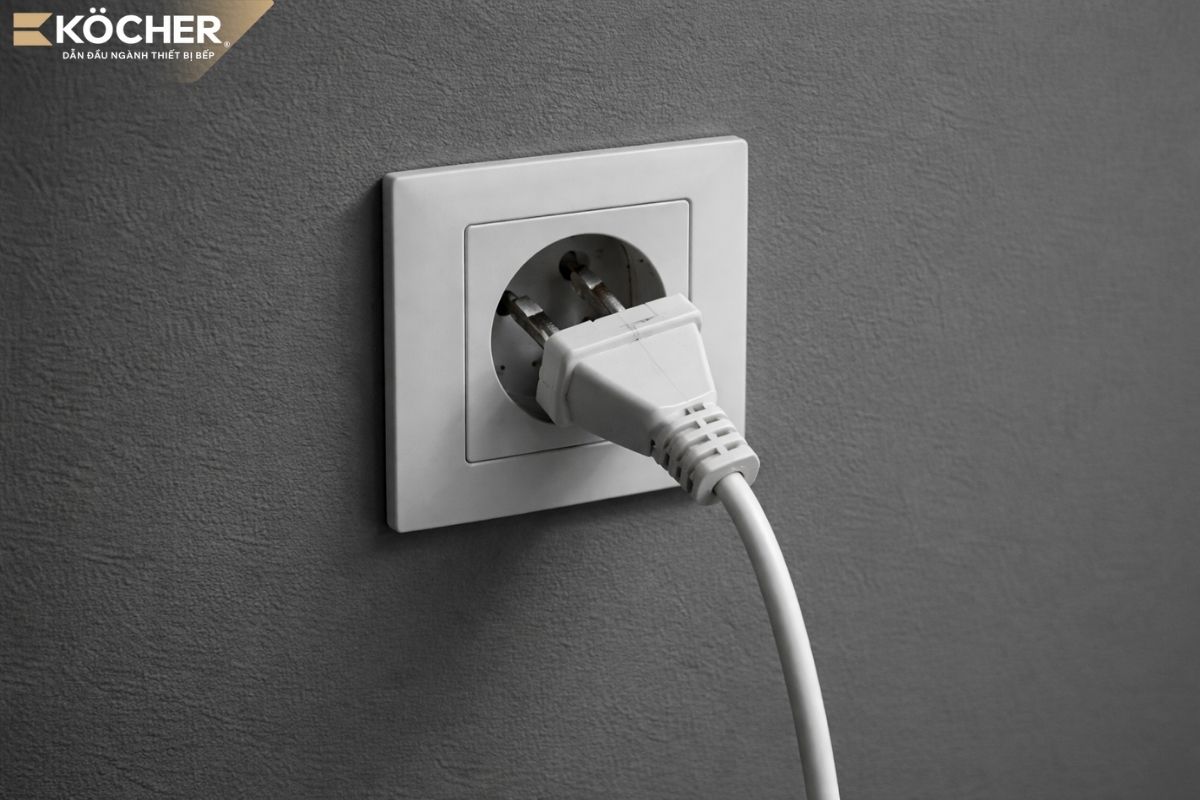 A loose socket can be the cause of the induction cooktop being intermittent[/caption>
Unstable voltage
This issue often occurs in older residential areas, remote regions, or apartments using too many electrical devices during peak hours (6 PM – 8 PM).
- Cause: When the grid voltage drops below 180V – 190V (weak power) or spikes above 240V, the protection system on the circuit board will activate the power cut command to protect the capacitor and IGBT. If the voltage stabilizes afterward, the cooktop will restart automatically. This cycle repeats, causing the cooktop to intermittently turn on and off.
- Solution: Check with a multimeter; if the voltage frequently drops below 190V, and the lights in the house flicker continuously or are always dim, you need to equip an automatic voltage regulator (AVR) with a capacity of 5KVA or more to maintain a stable 220V voltage for the cooktop to operate. Additionally, you can consider induction cooktops like DIB4-888 developed by Köcher in collaboration with two groups EGO (Germany) and EuroKera (France), specifically designed for areas with unstable voltage.
Moisture or grease on the control panel
This error often appears in high-humidity kitchen environments or when the glass surface is not cleaned regularly.
- Cause: The control panel of modern induction cooktops uses capacitive touch technology. When the glass surface is wet or greasy, these impurities can cause interference with the capacitance on the sensor area. This alters the dielectric constant at the contact point, causing the microcontroller (MCU) to misinterpret noise pulses as control commands or vice versa, leading to key malfunctions or localized touch failure.
- Solution: Use specialized cleaning solutions to completely remove grease, ensuring that the control panel area is always dry and clean. Also, always keep your hands dry before touching the buttons.
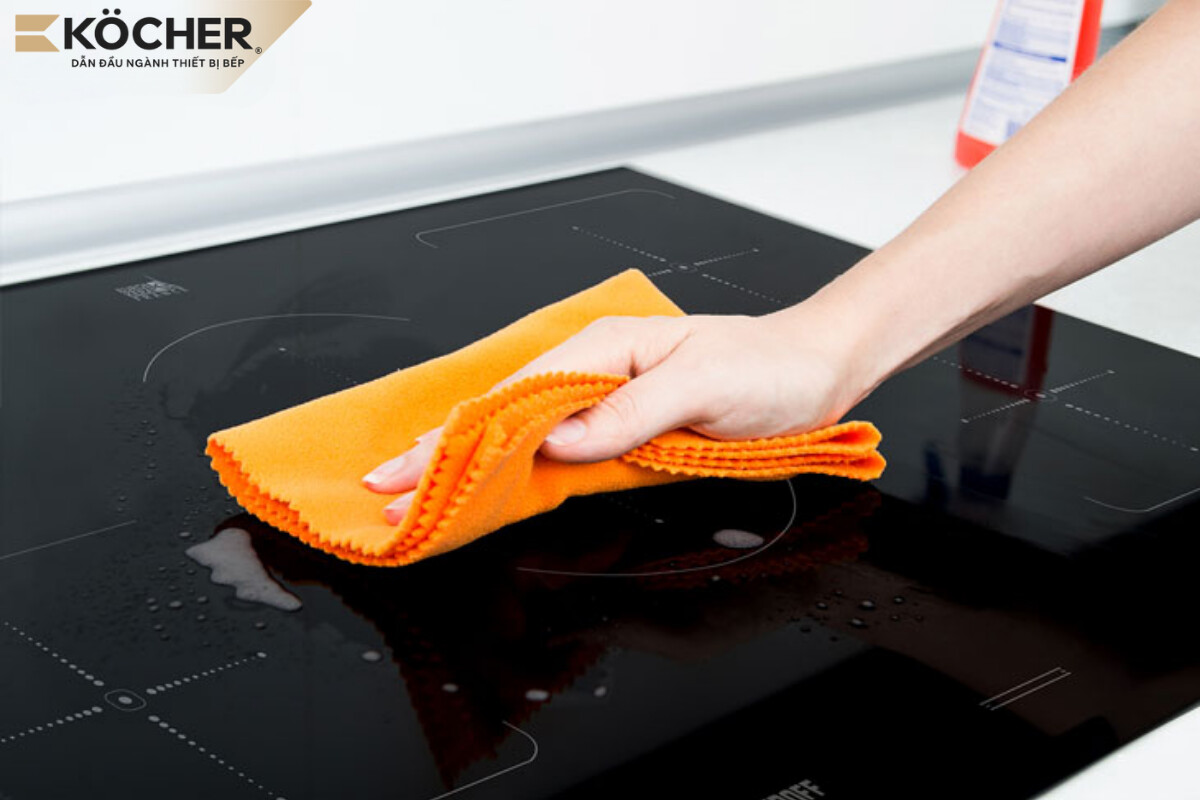 Cleaning water or grease on the glass surface can fix the intermittent induction cooktop issue[/caption>
Uneven pot bottom or small contact area
This situation arises when you use old, deformed pots and pans or when the pot size is incompatible with the current cooking zone of the cooktop.
- Cause: A warped or dented pot bottom creates an uneven distance between the pot bottom and the glass surface. In this case, the automatic size detection feature will continuously interrupt because the magnetic field density is suddenly reduced at non-contact points. This disconnection is equivalent to the e0 error appearing on the screen, causing the device to continuously emit intermittent beeping and stop the cooking process.
- Solution: Check the flatness by placing the pot on a flat glass surface; if the pot can spin like a top or wobble, it does not meet the standard. You need to replace it with a set of stainless steel 430 or cast iron pots with a completely flat bottom, 3 – 5 layers thick to ensure stable magnetic induction.
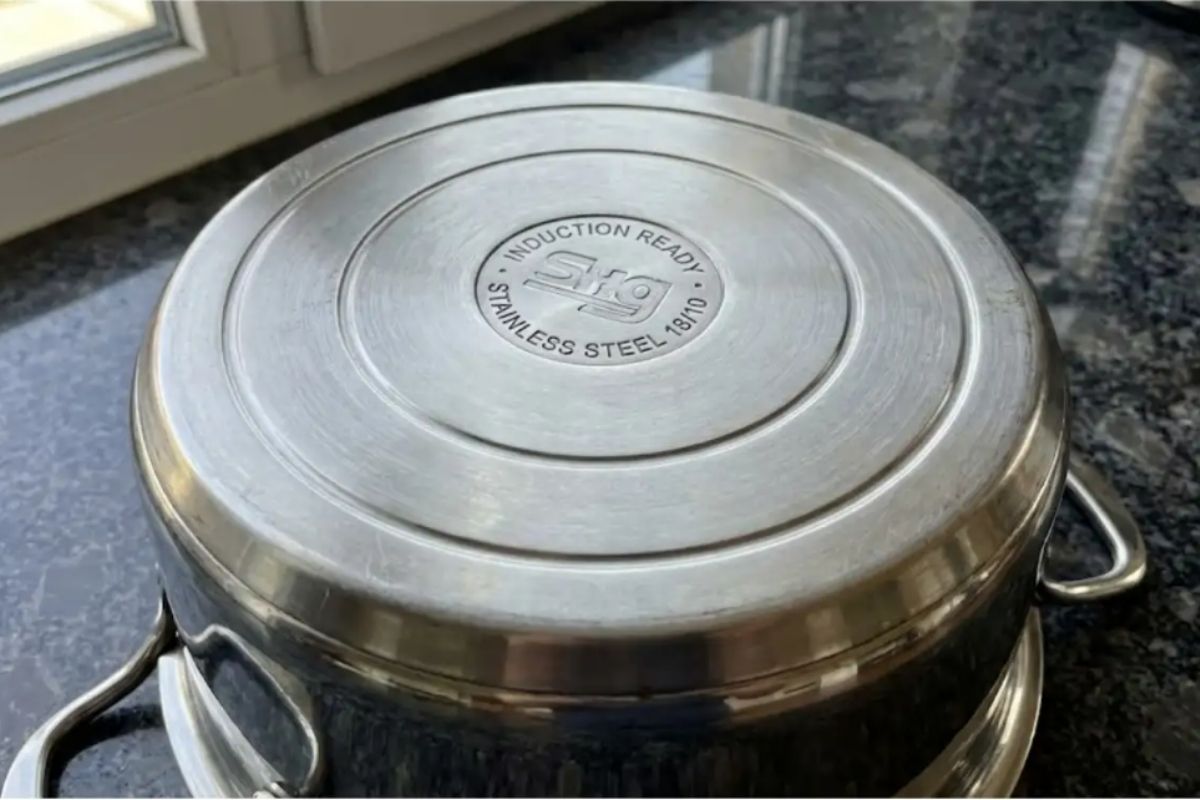 Choose pots with flat bottoms and proper magnetic induction when using induction cooktops (Source: Internet)[/caption>
Off-center pot placement or pot sliding
This error often occurs when cooking dishes that require shaking the pan or due to the lotus leaf effect on the glass surface.
- Cause: When the pot is off-center by more than 1/3 of the area, the magnetic field from the copper coil will not focus entirely on the pot bottom but will leak outside. In some cases, water during cooking spills onto the cooktop at the contact point with the pot bottom, creating a film that reduces magnetic induction capability.
- Solution: Make sure to place the pot accurately in the center of the cooking zone, and clean any water or grease splatters on the glass surface and under the pot during cooking.
Insects entering the circuit board (grid type)
This issue often occurs in cooktops that typically have circuit boards because instead of a round box-type board, the humid environment or the area under the cooktop is not cleaned regularly, creating conditions for insects to reside.
- Cause: The flat board structure and exposed components allow insects to enter the circuit board; their bodies or waste create a conductive bridge between components, leading to IC power (IGBT) explosions, blown fuses, or microcontroller failures. You can identify the fault if you notice a strange burning smell or hear crackling sounds inside while using, or find insect bodies falling out from the cooktop’s ventilation slots.
- Solution: Maintain a clean and dry under-cooktop area at least once a month, install insect-proof mesh Sofish Carekit with mesh openings under 1mm, and place cockroach repellent tablets in the corners of the kitchen cabinet. Additionally, you should prioritize using induction cooktops designed with round box-type circuit boards.
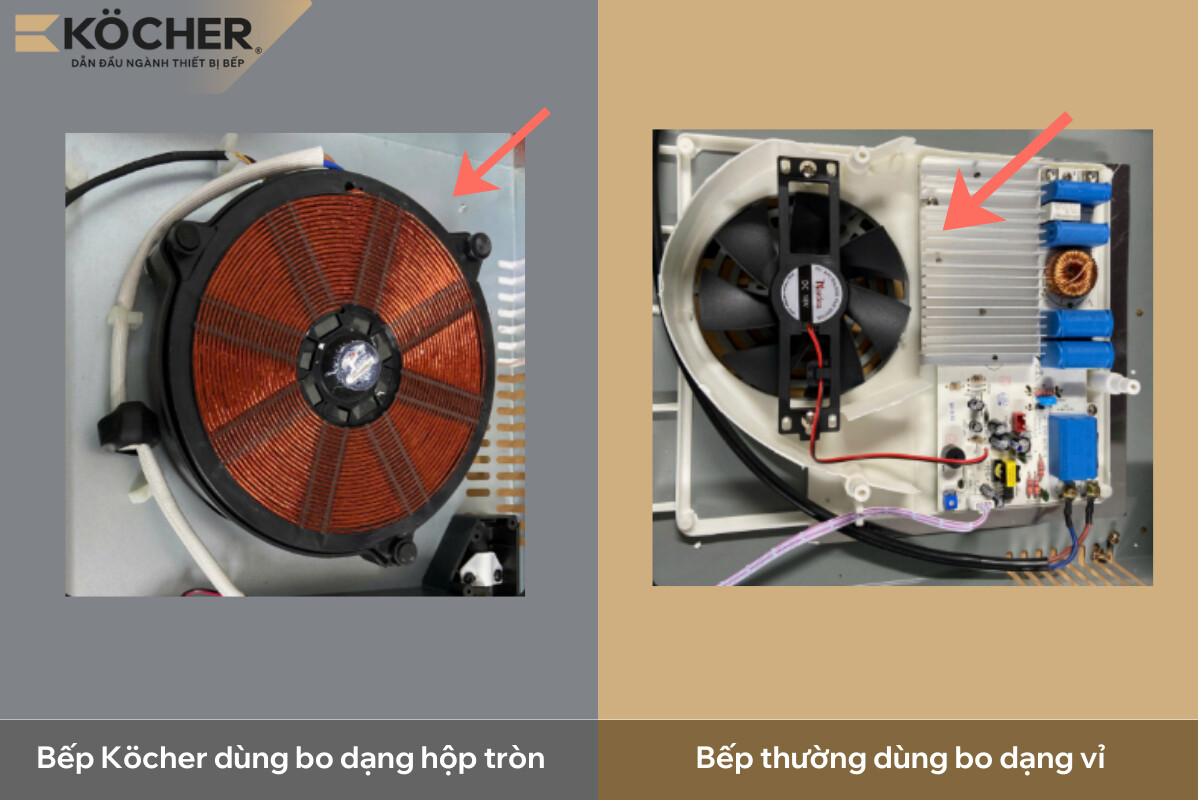 The circuit board placed in a round box with a lid (left image) helps limit dust, foreign objects, and insects from causing short circuits.
Overheating cooktop
This issue is common in built-in cooktops in overly tight cabinets or when the cooling fan has accumulated dust over time.
- Cause: When cooking at high power, if the aluminum heat sink is too thin or the cooling fan is weak, the temperature at the IGBT will exceed the threshold. At this point, the automatic protection system of the circuit board will activate a warning signal e1 error to notify that the device is in a state of severe overheating. The cooktop will only resume operation when the cooling fan reduces the temperature to a safe level, creating a prolonged on-off cycle.
- Solution: Ensure a minimum distance of 20cm between the cooktop and any items below it. Also, prioritize choosing cooktops with a dual thick heat sink design and quiet fans for quick heat dissipation.
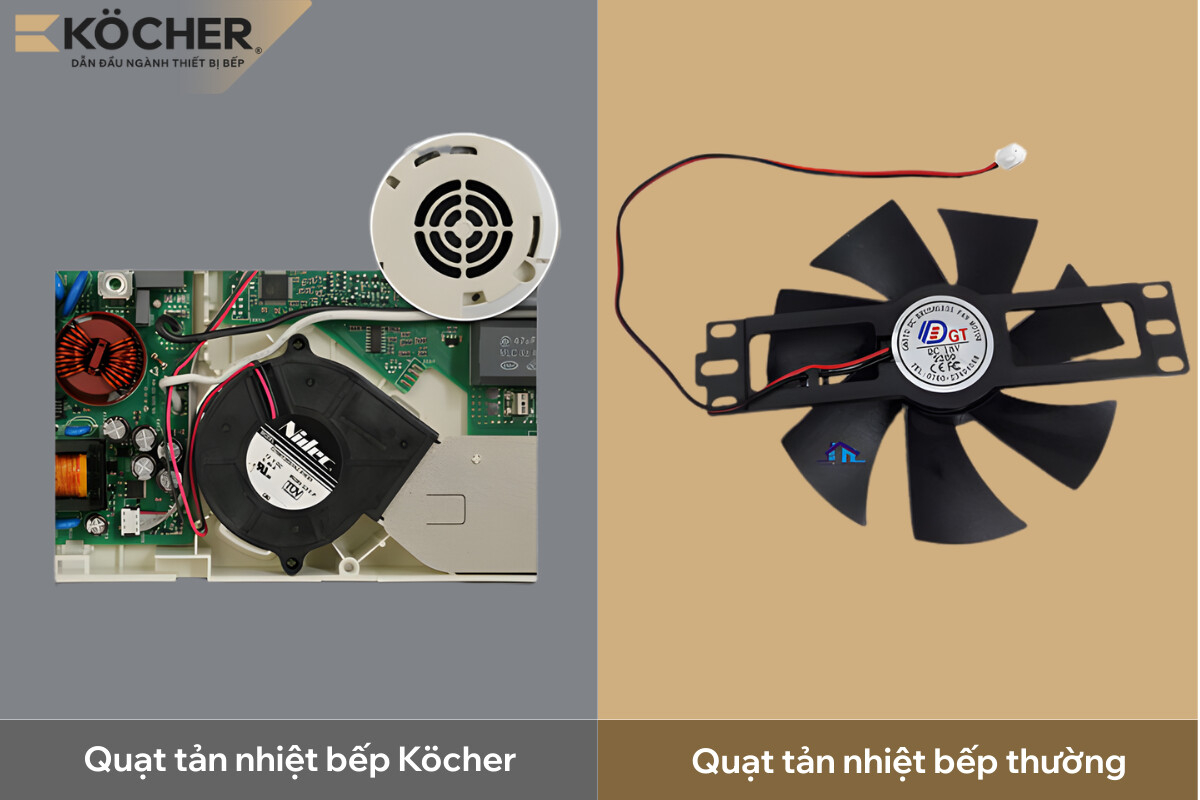 A quality cooling fan helps the cooktop operate smoothly without overheating, leading to continuous shutdowns.
Faulty power filter capacitor on the circuit board
This issue often appears after about 3 – 5 years of use (equivalent to about 10,000 hours of operation) or may appear sooner on low-quality cooktop products.
- Cause: The capacitor (5uF power filter capacitor) after prolonged exposure to high temperatures will dry out the electrolyte or bulge. When the ability to store and discharge electricity decreases, it causes the cooktop to intermittently turn on and off according to the capacitor’s discharge rhythm.
- Solution: This is a complex hardware fault. You need to contact a professional technician to use a capacitance meter for testing.
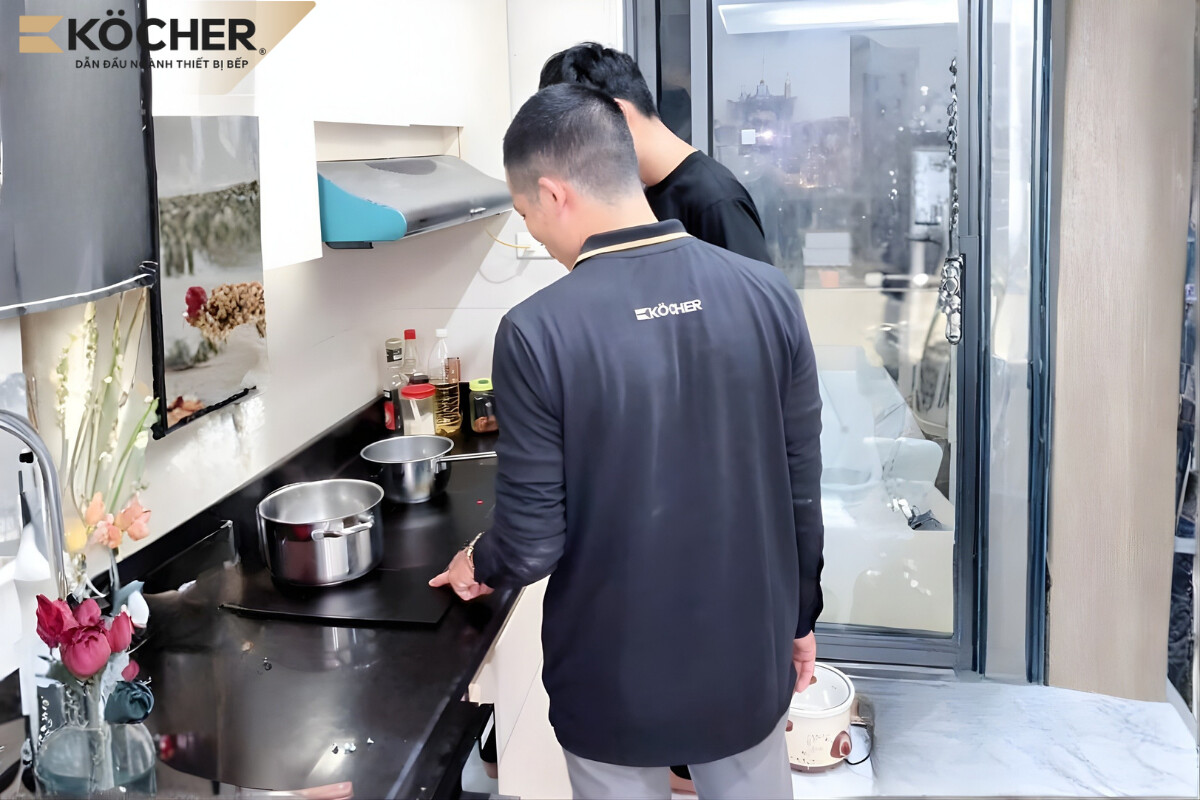 You need to contact a qualified technician to check the device instead of attempting to repair it yourself.
Faulty pot detection sensor
A faulty pot detection sensor causes the induction cooktop to operate intermittently (sometimes detecting, sometimes not, or turning off while cooking and displaying an error).
- Cause: The resistors on the pot detection line may have increased resistance or broken, leading to the cooktop not maintaining a continuous pot detection state. In severe cases, a completely faulty sensor can lead to one side of the induction cooktop not powering on even though the power light is still on.
- Solution: Check the wiring from the sensor to the circuit board for looseness or breaks. If the sensor has aged, it needs to be replaced with genuine new components for the system to accurately detect the temperature and cooking pot.
 The intermittent induction cooktop may be due to a faulty sensor inside the device.
4 Important notes when encountering intermittent induction cooktop errors
Proper handling when the cooktop shows signs of instability not only helps extend the device’s lifespan but also ensures safety for the cook. Here are the principles you need to remember:
- Disconnect the power immediately upon detecting abnormal signs: Immediately turn off the main circuit breaker when you see sparks, a burning smell, or the cooktop continuously flickering to prevent fire hazards and protect the internal circuit board.
- Do not continue using the cooktop when it is faulty: Stop cooking immediately if the cooktop is unstable to avoid damaging important components like IGBT or power capacitors, helping to save repair costs. After turning off the cooktop manually or the system automatically shuts down, if you observe the display showing the symbol Induction cooktop displaying H, this is a warning signal that the residual heat on the glass surface is still very high, absolutely do not clean or touch directly to avoid burns.
- Check the error code displayed on the screen: Note down symbols like E0, E1, E2… and compare them with the user manual to accurately identify the cause before proceeding with further troubleshooting steps.
- Absolutely do not disassemble the cooktop yourself: Contact a professional technician instead of opening the cooktop to avoid the risk of electric shock due to capacitors still holding energy even after the power has been disconnected.
Above are the 9 most common causes and solutions for the intermittent induction cooktop issue today. We hope these insights will provide you with useful knowledge to accurately identify faults and come up with the most appropriate solutions.
With superior X-Nano scratch-resistant glass technology and E.G.O standard components from Germany, Köcher proudly offers durable and high-class cooking solutions for families.
|
Köcher induction cooktops pioneer German technology – For detailed product information, please contact:
|