Does the dishwasher consume electricity?
Using a dishwasher does not consume as much electricity and water as many people think. Typically, each time you use the dishwasher, it consumes about 1 – 1.5 kWh, equivalent to 2,000 – 3,000 VND per wash. In a month, you will spend about 80,000 VND if you wash dishes once a day, and about 160,000 VND if you wash dishes twice a day. Using a dishwasher will save you about 15 minutes each time you wash, 450 minutes each month, and 5,400 minutes each year, which is equivalent to 90 hours. The dishwasher helps clean and sanitize dishes, which is very good for health and does not harm your hands. You can read the detailed article below shared by Kocher’s dishwasher to understand more.
DO DISHWASHERS CONSUME ELECTRICITY?
Household dishwashers use electricity to operate, so users are always concerned about the amount of electricity the machine consumes each time and whether the monthly electricity cost increases significantly.
To answer the question: “Do dishwashers consume electricity?” is actually very simple. You just need to know the power of the dishwasher and the washing time each time to calculate the amount of electricity consumed right away. However, each type of dishwasher has different power, different washing times, and the washing needs of each family also vary, so to know whether the dishwasher consumes electricity and how much electricity it consumes each month depends on each specific case.
To help you calculate the amount of electricity consumed when using a dishwasher, Kocher provides you with a simple formula as follows:
Power of the dishwasher
Before finding out whether the dishwasher consumes electricity, we need to know the power level of the dishwasher, measured in kW/h.
The power of the dishwasher is calculated based on the total power of the electrical components. It includes 3 main components as follows:
1. Hydraulic pump system
2. Heating element for water
- Holds the dishes that need cleaning
- Heats the water from the hydraulic pump to clean the dishes more easily and thoroughly
- Creates steam to dry the dishes after cleaning
The final drying process takes about 15 – 20 minutes, plus sterilizing the dishes, consuming less than 1 kWh.
The electricity consumption of the heating element is only equivalent to that of a regular water heater, even less than an air conditioner (1HP air conditioner consumes 8200W/h). Extremely energy-efficient for users.
3. Control panel
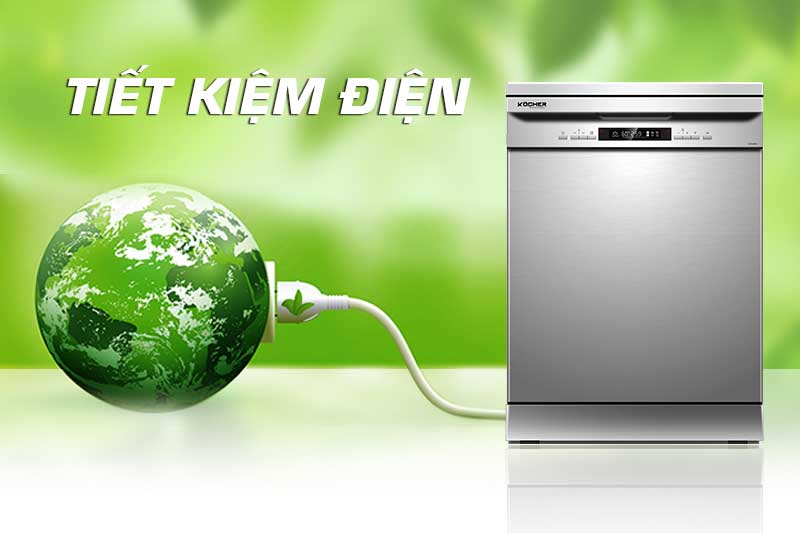
- The power of the dishwasher is only equivalent to that of a water heater or a regular washing machine.
- Compared to manual washing, the dishwasher saves time and does not consume as much electricity as people mistakenly think.
How much electricity does a dishwasher consume per month?
After knowing the power of the dishwasher, we have a basis to calculate whether the dishwasher consumes electricity and how much electricity it consumes each month. Depending on the usage needs, the power of the machine, and the washing time, the electricity consumption of the dishwasher will also vary.
We will take an example to calculate more accurately for your understanding.
For example: To clean dishes for a family of 4 – 5 people with a normal meal, using a dishwasher with a power of 900W. Depending on the washing mode, the time to complete the washing cycle also varies. Typically, the washing time for one cycle will be about 45-60 minutes depending on the brand of the machine.
Based on the above data, we will take some necessary information to calculate the electricity consumption of the dishwasher relatively.
- Power: 700W
- Time per wash: 45 minutes
Electricity consumption per wash = power x time = 700W * 0.75h = 525W ~ 0.5 kWh. If washing 2 times a day, then each month will consume (0.5*2) * 30 = 30 kWh.
If you use a mini dishwasher with a power of about 700W/h, then each month it will consume about 30 kWh. Assuming the electricity price is 2,000 VND/1 kWh, then in one month you will spend 60,000 VND on electricity. Depending on your usage needs and the washing modes you choose, the electricity consumption of the dishwasher will vary.

DO DISHWASHERS CONSUME WATER?
How many liters of water does a dishwasher use per month?
Let’s do a simple comparison to know the amount of water consumed between using a dishwasher and washing dishes by hand.
To clean dishes for a family of 4 – 5 people with a normal meal (about 12 sets of dishes):
- When washing dishes by hand, you must rinse at least 2-3 times, equivalent to consuming about 35 – 40 liters of water.
- Meanwhile, the dishwasher saves much more water as the water is sprayed with high pressure, at high temperatures, and more concentrated. If washing with a regular dishwasher, it only consumes about 10-12 liters of water per wash cycle. For high-end dishwashers, the water consumption per wash is only 9 liters for machines that wash 12-15 sets.
Thus, using a dishwasher will help you save about 1/3 of the amount of water compared to traditional hand washing.
Not only that, the dishwasher also helps you avoid skin damage from frequent contact with detergents, or saves a lot of time for more family time,… And the dishes are always clean thanks to the machine’s features such as: washing with hot water or sterilizing,…
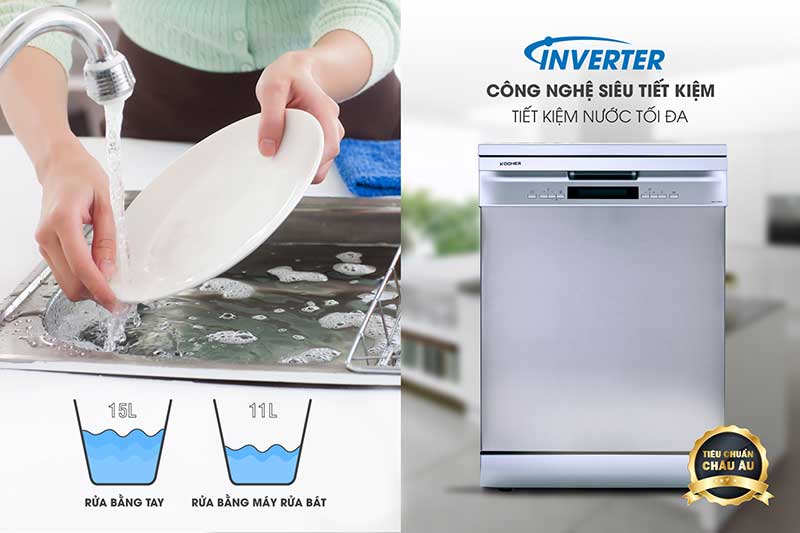
Using a dishwasher saves much more water than washing by hand
HOW TO USE A DISHWASHER TO SAVE ELECTRICITY AND WATER
Using a dishwasher to save electricity
- Check the energy rating: Labels such as A, AA, AAA on the dishwasher indicate the machine’s energy-saving capability. A is the lowest and AAA is the most efficient.
- Choose a dishwasher with integrated energy-saving technology: such as inverter technology, eco sensors,…
Using a dishwasher to save water
- Sort dishes before placing them in the dishwasher: This sorting helps dishes to be cleaned more evenly. Place plastic items on top to avoid exposure to heat, fragile items should be kept separate, and pots or pans should be placed at the bottom.
- Arrange the dishes neatly: Do not place dishes haphazardly, as this will obstruct the water flow, preventing the machine from cleaning effectively.
- Regularly clean the machine for better efficiency: The dishwasher will operate more effectively when the rubber food drain holes, water spray arms, and areas prone to dust and water accumulation are cleaned.
- Fill the machine as much as possible each time you wash.
- If you do not have many dishes, you can choose the half-load feature. Note that you should not select this feature if the machine is fully loaded.
- If your dishwasher has an automatic wash program, you should use this setting. The machine will flexibly adjust the modes to optimize electricity and water consumption by calculating the number of dishes, the level of cleanliness required, etc.
| >>> See more: |
SUMMARY:
If you need advice on choosing the most energy-efficient dishwasher, please contact Kocher immediately so our experts can help you choose the most suitable dishwasher for your family.
Does the dishwasher consume electricity and water?
- Does using a dishwasher consume more electricity and water than we imagine?
- Does using a dishwasher consume a lot of water?
- Why does a dishwasher use less water than washing dishes by hand?
- How much water does a dishwasher consume each time?
- How to use a dishwasher to save water
- Does using a dishwasher consume a lot of electricity?
- How does a dishwasher use electricity?
- How much electricity does a dishwasher consume per wash, per month, per year?
- How to calculate the electricity cost that the dishwasher uses
- How to use a dishwasher to save electricity
- What is the cost to run a dishwasher once?
Does using a dishwasher consume as much water as we imagine?
Modern dishwashers today often take longer to wash dishes than older models. It sounds paradoxical and unrealistic, right? When I learned this, it seemed a bit off to me too.
But digging deeper into understanding and using it, I found one point that non-technical people about dishwashers cannot know. That is, according to conventional theory, anything that operates for a longer time consumes more electricity and water, and also takes more time. However, the operating mechanism of modern dishwashers is completely different. New dishwashers have increased washing time, but their operating mechanism helps save water and electricity overall.
To make it easier to understand, you can imagine this. I wonder if any of you here have ever bathed in the old style using a scoop of water? Using this method to bathe and rinse is quite quick. But in reality, it consumes a lot of water because you have to scoop a lot of water to wet and rinse your body. Nowadays, we usually shower with a showerhead, and the shower time may be slightly longer than using a scoop. But the amount of water lost when using a shower is very little. The operating mechanism of a dishwasher is similar.
In Vietnam, it is simpler, but on a global scale, people are very strict about saving electricity and water. Therefore, regulatory agencies have controlled dishwasher manufacturers to save water and electricity. It’s similar to the emissions limits for cars that you often hear about. This is a limit on water and electricity consumption. Regulatory agencies do not control the operating time of the machine. Therefore, dishwasher manufacturers have changed the way the machines operate; they may take longer to clean dishes but save electricity and water in the overall process.
Modern dishwashers also operate very quietly and are designed to harmonize with the interior. Therefore, the time may be longer than older dishwashers, but it generally does not significantly affect our lives.
Would you want to spend 20 minutes washing a comforter by hand, wringing it out until your hands hurt? Or would you prefer to put that comforter in the machine and let it work for 120 minutes? Dishwashers are the same, so you don’t have to worry too much about the time; instead, pay attention to the energy and water consumption of each dishwasher you are considering.
To simplify, you can refer to a model of a dishwasher from the famous Kocher brand today to avoid overthinking.
Does using a dishwasher consume a lot of water?
Previously, I heard that each time washing dishes, dishwashers had to run for 1 to 3 hours. Just thinking about a few hours like that makes me think it consumes a lot of electricity and probably uses up half a tank of water :D. I always teased my wife like that when considering buying a dishwasher :).
So what is the truth? Does using a dishwasher really consume that much water?
When I delved deeper, I realized: using a dishwasher does take quite a bit of time. But it does not consume as much water as I imagined and according to common analyses.
I misunderstood because I did not fully understand the mechanism and operation of the dishwasher. We still follow the conventional thinking like using an induction stove or a fan. The longer you use an induction stove or run a fan, the more electricity it consumes. That is natural :).
However, dishwashers have both similarities and differences. The similarity is: dishwashers do consume electricity and water :D. Of course, using an electric device for washing dishes will consume electricity and water. But the difference here is that longer time does not necessarily mean that the amount of water consumed increases exponentially. Because water is reused in the dishwasher, not continuously lost over the hours the dishwasher operates.
This is a very important point. As for how water is reused, you can read more content right below this line :).
Why does a dishwasher use less water than washing dishes by hand?
According to research, washing dishes by hand uses 5 times more water than an efficient dishwasher and 3.5 times more than a regular dishwasher.
Why is that?
Typically, we always assume that dishwashers fill water to the brim or spray a continuous stream of clean water. But you (including me before) are completely wrong.
Dishwashers may have used 25 to 40 liters of water per cycle 15 years ago. But that was 15 years ago. Nowadays, everything is very different.
Today, modern dishwashers use a complex system of pumps, filters, and spray nozzles to filter and reuse water throughout the cleaning process. Clean water is only used at the beginning and for the final rinse. During the washing process, the water is filtered and heated for maximum cleaning. With reused water, using strong pressure spray nozzles creates fine jets (water-saving) to clean the dishes.
But newer dishwashers have implemented some design changes to suit their dirty game. Dishwasher designers are continuously improving the arrangement of racks for dishes so that plates and utensils optimally contact the water jets inside the machine during a cycle. More importantly, modern dishwashers have sensitive technology to detect the turbidity of the water in the machine. A cycle starts by using a small amount of water. After washing, the machine detects the turbidity of the water to measure the amount of food and dirt stuck on the dishes. If the water is still cloudy, the machine adds a little more water, washes a bit more, and then tests again, gradually increasing the water amount until the water is clear.
When you wash dishes by hand, a large amount of water continuously flows through the faucet to wash each of your dishes. Or you might fill the sink 2 to 3 times to rinse the dishes. Overall, this is a considerable amount of water for the number of dishes.
If your spouse thinks that using a dishwasher for 1-3 hours consumes a lot of electricity and water, it is because they do not understand the mechanism of the dishwasher. You can send them this article to explain or share the link for them to read.
Thus, you and your family will find common ground when purchasing a dishwasher.
How much water does a dishwasher consume each time?
A dishwasher typically uses about 10 – 20 liters of water for each full load, depending on the type and size of the dishwasher. While for the same full load of dishes, washing by hand can consume 40 – 50 liters of water depending on the washing method.
How to use a dishwasher to save water
- Prioritize water-saving dishwashers: Typically, water-saving dishwashers are usually more expensive than regular ones. It’s similar to energy-saving light bulbs, which are often more expensive than regular ones. Although a bit more expensive, in the long run, it saves you a lot of water. A dishwasher typically has a lifespan of about 10 – 12 years. You can calculate that the amount of water saved during this time is significant. Therefore, when buying a dishwasher, you should also consider this point.
- Use the dishwasher at full capacity: Dishwashers use the same amount of water to wash a full load as when the machine is only partially filled. Depending on your household size, you can choose a machine with the appropriate power and capacity for your needs. This way, you can balance the power and capacity between washes. Avoid using only 1/2 or 1/3 of the machine’s capacity, which wastes water.
- Do not overload the dishwasher: While using the dishwasher when fully loaded is optimal, you also need to ensure space for circulation between different types of dishes so that the machine can clean effectively. What do you think if after washing the dishes in the dishwasher, you still have to wash some by hand to clean the remaining dirty ones? At that point, you will spend more effort, time, and water.
- Pre-clean dishes before placing them in the dishwasher: If your dishes have too much leftover food, especially stubborn food that can be scraped off, the machine will have a harder time cleaning or you will have to choose a longer washing mode, which consumes more water. Additionally, many stubborn leftovers can clog or damage the machine. Therefore, before placing dishes in the dishwasher, you should pre-clean them.
- Use the appropriate washing mode: Modern dishwashers have many different washing modes with varying water and operating times. Therefore, understanding the washing modes will help you choose the one that suits your needs for each wash. This will help you save more water. Little by little, over time, you will save quite a bit of water.
- Use the water-saving or eco mode if the dishwasher has it: If your machine has these modes, you should prioritize using them. Energy-saving modes typically save 3 liters of water for each operation.
- Perform timely repairs on the dishwasher: When the machine encounters issues with water supply or drainage or component malfunctions, you should stop the machine immediately. Then repair it promptly. This avoids larger damages, more costs, or wasting more water.
- Items that are heavily soiled should be washed by hand: For example, grilling racks or items that are heavily soiled. Putting them in the dishwasher will not guarantee they will be clean. You may have to wash them again after using the dishwasher. Therefore, it is best to separate such items and wash them by hand from the beginning.
- Regularly clean the dishwasher: This helps prevent the spray arms and filters from being clogged with soap scum, mineral deposits, and food debris. These can reduce the machine’s efficiency and hinder effective washing cycles.
- Start washing dishes before they dry: Allowing food and grime to dry will require you to use deeper and longer washing modes, causing more water and electricity consumption. Therefore, it is best to wash dishes before they dry.
- Think broadly about the dishwasher: After applying the above solutions, the last thing is to think broadly. Don’t worry too much about water consumption anymore :). Because using a refrigerator consumes electricity but preserves food and enhances quality of life. Using a washing machine consumes water but makes it easier, more convenient, and cleaner clothes. Using an induction stove consumes electricity but is safe and convenient. Consider the dishwasher as similar to a refrigerator, washing machine, induction stove,… When you use it, you accept a little extra cost :D. But you and your family will be better cared for, more convenient, and comfortable :). A higher quality of life, more leisure time, or more time to earn more money :).
Does using a dishwasher consume a lot of electricity?
Dishwashers typically take 1 – 3 hours for each wash depending on the mode and type of dishwasher. This leads many people to misunderstand that dishwashers consume a lot of electricity. However, in reality, dishwashers do not consume as much electricity as people think.
And of course, we must accept the fact that using electric devices like refrigerators, washing machines, induction stoves, and water heaters consumes electricity :D. Dishwashers are similar. In fact, dishwashers consume the least electricity among these groups.
It’s just that dishwashers have only recently become popular. Many people do not understand much about the operating mechanism of dishwashers. Few people research dishwashers, so they often misunderstand that dishwashers consume a lot of electricity and water.
As analyzed above, you must have seen that dishwashers certainly need electricity, but they do not consume as much energy as we imagine, right?
The electricity consumption of dishwashers compared to the values they bring to our lives is still much better :).
How does a dishwasher use electricity?
A dishwasher is a household appliance used to wash cutlery, dishes, and other kitchen utensils. Modern dishwashers are energy-efficient and do not use much water. Dishwashers use power from 1200 to 2400 watts, with an average dishwasher using 1800 watts.
Most household dishwashers will cost you from 11.9 cents to 28.2 cents for electricity and water for each load of dishes. The electricity cost accounts for the largest portion of the dishwasher’s cost, ranging from 9.9 cents to 25.1 cents for most dishwashers. The amount of electricity it uses will depend on the size of the dishwasher (measured at the installed settings), as well as its energy efficiency star rating.
The larger the dishwasher, the more energy and water it needs to clean the washing space. Therefore, the most important decision made when purchasing a dishwasher from an energy efficiency perspective is the size of the dishwasher. It is best for consumers to buy the smallest dishwasher they need. For example, if a consumer intends to wash small loads frequently, a smaller device will be suitable. On the other hand, for larger households that require washing many dishes at once, a larger device will be appropriate.
| Setting | Temperature | Time | Energy usage |
| P2 30 minutes | 35˚C | 0:30 | 0.72 kWh |
| P3 Eco – Half load | 45˚C | 1:55 | 0.82 kWh |
| P3 Eco | 45˚C | 2:31 | 0.93 kWh |
| P8 Auto | 40˚C – 65˚C | 2:34 | 0.93 kWh |
| P4 Quick and Clean | 60˚C | 0:58 | 1.23 kWh |
| P5 Intensive | 70˚C | 2:23 | 1.37 kW |
These results clearly show that the settings you choose have a significant impact on the energy usage of the dishwasher per load. For example, simply changing from ‘Quick & Clean’ to ‘Eco’ will reduce energy consumption (and costs) by about 25%.
In my experience, the Eco mode is as effective as the other modes. You can save even more by switching to the ‘half load’ option, which also works well. The short load ’30 Min’ even saves more, but it is only suitable for very light loads (and needs to be dried by hand).
Another important result is that temperature is more important than the execution time. Generally, the higher the temperature setting, the higher the energy usage. You can use this result as a preliminary guide to choose a more efficient option on your dishwasher.
Dishwasher energy usage by star rating
At the time of purchase, it is often difficult to know how this star rating differs from others. With the real-world usage table above, we can now consider what star ratings really mean for the electricity usage of dishwashers. The data displayed below is for a ’14 place setting’ dishwasher.
| Dishwasher star rating | Dishwasher electricity usage (per load) | Annual cost* |
| 1 star | 1.84 kWh | $ 192 |
| 2 stars | 1.28 kWh | $ 135 |
| 3 stars | 0.90 kWh | $ 94 |
| 4 stars | 0.63 kWh | $ 66 |
| 5 stars | 0.44 kWh | $ 46 |
| 6 stars | 0.31 kWh | $ 32 |
From these results, you can see that choosing a higher star rating can have a greater impact on energy usage than just changing settings. However, this comes with a significant caveat: the vast majority of dishwashers on the market tend to hover quite closely around the 3 to 4-star range.
In other words, a highly rated device may simply not be available at an affordable price. In that case, your best bet is still to experiment with the settings you have available and choose the lowest temperature option that suits you.
How much electricity does a dishwasher use per wash, per month, per year?
A dishwasher typically uses about 1.5 kWh (1.5 kWh) to run a load of dishes. This is equivalent to about 5,000 VND for each run. To be generous, let’s say it’s 10,000 VND per wash for maximum estimation :).
Each day you wash dishes with the dishwasher 1 – 2 times on average. This means you spend about 10 – 20,000 VND each day. In a month, you will spend about 300,000 – 600,000 VND on dishwashing. In a year, you will spend about 3.6 – 7.2 million VND on electricity. That’s quite a sum, isn’t it? :).
However, on average, each time you wash dishes with the same load in the dishwasher, you will spend about 15 – 20 minutes washing and rinsing the dishes. If you wash dishes 1 – 2 times a day, in a month you will have to wash 30 – 60 times. This means the time spent each month is at least 450 minutes – 900 minutes/month (equivalent to 7.5 – 15 hours/month, 90 – 120 hours/year); at maximum, it is 600 minutes – 1,200 minutes (equivalent to 10 – 20 hours/month, 120 – 240 hours/year). That’s also a considerable amount of time.
If you have a dishwasher, you won’t have to do that. You will have more time to rest. You will have more time to play with your children, take care of your family, or enjoy life more. Or you may have more time to work and earn more money than the cost of the dishwasher.
Everyone has a perspective. You should consider choosing a wise solution to enhance the quality of your life :).
How to calculate the electricity cost that the dishwasher uses
As mentioned above, from the power, we can calculate the electricity that the dishwasher consumes depending on the modes and the time the machine operates. To know the power of the dishwasher, you should carefully check the technical specifications of the machine or the information on the label attached to the machine. Typically, mini dishwashers have a power of 700 – 1500W, while regular dishwashers have a power of 2000 – 2500W.
| Note: this is the power level provided by the manufacturer, while in reality, depending on different washing modes, the electricity consumption will vary. This issue is quite complex as it needs to be divided by each mode and type of machine, so we will assume that the general power of dishwashers in all modes is the same for easier calculation.
After knowing the power of the dishwasher, we have a basis to calculate whether the dishwasher consumes electricity and how much electricity it consumes each month. Depending on the usage needs, the power of the machine, and the washing time, the electricity consumption of the dishwasher will also vary.
We will take an example to calculate more accurately for your understanding.
For example: To clean dishes for a family of 4 – 5 people with a normal meal, using a dishwasher with a power of 900W. Depending on the washing mode, the time to complete the washing cycle also varies. Typically, the washing time for one cycle will be about 45-60 minutes depending on the brand of the machine.
Based on the above data, we will take some necessary information to calculate the electricity consumption of the dishwasher relatively.
- Power: 700W
- Time per wash: 45 minutes
Electricity consumption per wash = power x time = 700W * 0.75h = 525W ~ 0.5 kWh.
If washing 2 times a day, then each month will consume (0.5*2) * 30 = 30 kWh.
If you use a mini dishwasher with a power of about 700W/h, then each month it will consume about 30 kWh. Assuming the electricity price is 2,000 VND/1 kWh, then in one month you will spend 60,000 VND on electricity. Depending on your usage needs and the washing modes you choose, the electricity consumption of the dishwasher will vary.
The formula and calculation method provided by Kocher is for your reference only; actual usage may vary by family. Therefore, whether the dishwasher consumes electricity can only be accurately known through actual use.
How to save electricity when using a dishwasher
- Choose your dishwasher wisely: Look for a dishwasher with certified specifications and highly rated by users for water and energy savings. Researching the specifications of the dishwasher may take some time. But this helps you choose a suitable and optimal dishwasher for your needs.
- Choose a size that fits: A dishwasher that is too large or too small for your needs will consume more energy than necessary. Larger machines typically consume more electricity per use. But a machine that is too small for your needs will require you to use it multiple times, which will also increase your electricity costs.
- Air dry your dishes: You can save electricity and increase efficiency by skipping the heated drying cycle and opening the dishwasher door right after the wash cycle ends to let the dishes dry naturally. You can save 15% of the total energy used by the dishwasher with this method or use the air drying cycle. This feature circulates air in the room through the dishwasher with a fan to dry the dishes.
- Keep the dishwasher clean: The filters and spray arms of the dishwasher can become clogged with soap scum and mineral deposits over time. Regular cleaning is needed to maximize the performance and efficiency of your dishwasher.
- Reduce the water temperature: Most modern dishwashers have a booster heater to heat water from your water tank. Lowering the thermostat of the water tank to 65 degrees helps save more energy without affecting cleanliness.
- Place the dishwasher away from the washing machine and refrigerator: When you place these appliances close together, it makes it difficult for them to dissipate heat. This causes the refrigerator to work harder, consuming more electricity.
- Teach everyone in the house how to use the dishwasher effectively: You may be the one who understands dishwashers after researching. You should also teach everyone how to use the dishwasher to save water and electricity effectively. This is also a way to save electricity and water efficiently and comprehensively :).
- Replace old dishwashers: Typically, dishwashers can last 10 – 12 years. However, the technology of dishwashers is also constantly evolving. Newer models tend to save more water and electricity. Therefore, after 8-10 years or if your current dishwasher has reached this age, you should consider selling it and buying a new one :).
A new dishwasher will save more electricity and water. You can still sell the old one for some money to offset the cost of buying a new machine with more functions and savings :). - Avoid using the dishwasher during peak hours: Because when the total electricity load during peak hours increases, it can cause other devices in your home, such as air conditioners and refrigerators, to consume more electricity. You just need to change the time frame a little to save more. However, if you prioritize convenience, speed, and are willing to spend a little more on electricity, then that’s fine.
With the mission of providing solutions to free labor and enhance the quality of life for Vietnamese families, Kocher – the leading reputable dishwasher brand in Vietnam! continues to assert its position with durable products, energy-saving and optimizing deep cleaning performance. In addition to leading in the cleaning equipment sector, the brand also continuously innovates to perfect the smart and safe kitchen ecosystem for homemakers. Besides dishwashers, Kocher is proud to be the pioneer in Vietnam bringing German technology into induction cookers. The perfect combination of strict European quality standards and understanding of Vietnamese cooking habits has helped Kocher-branded products become a solid foundation, creating a modern and fully equipped kitchen space for every home.