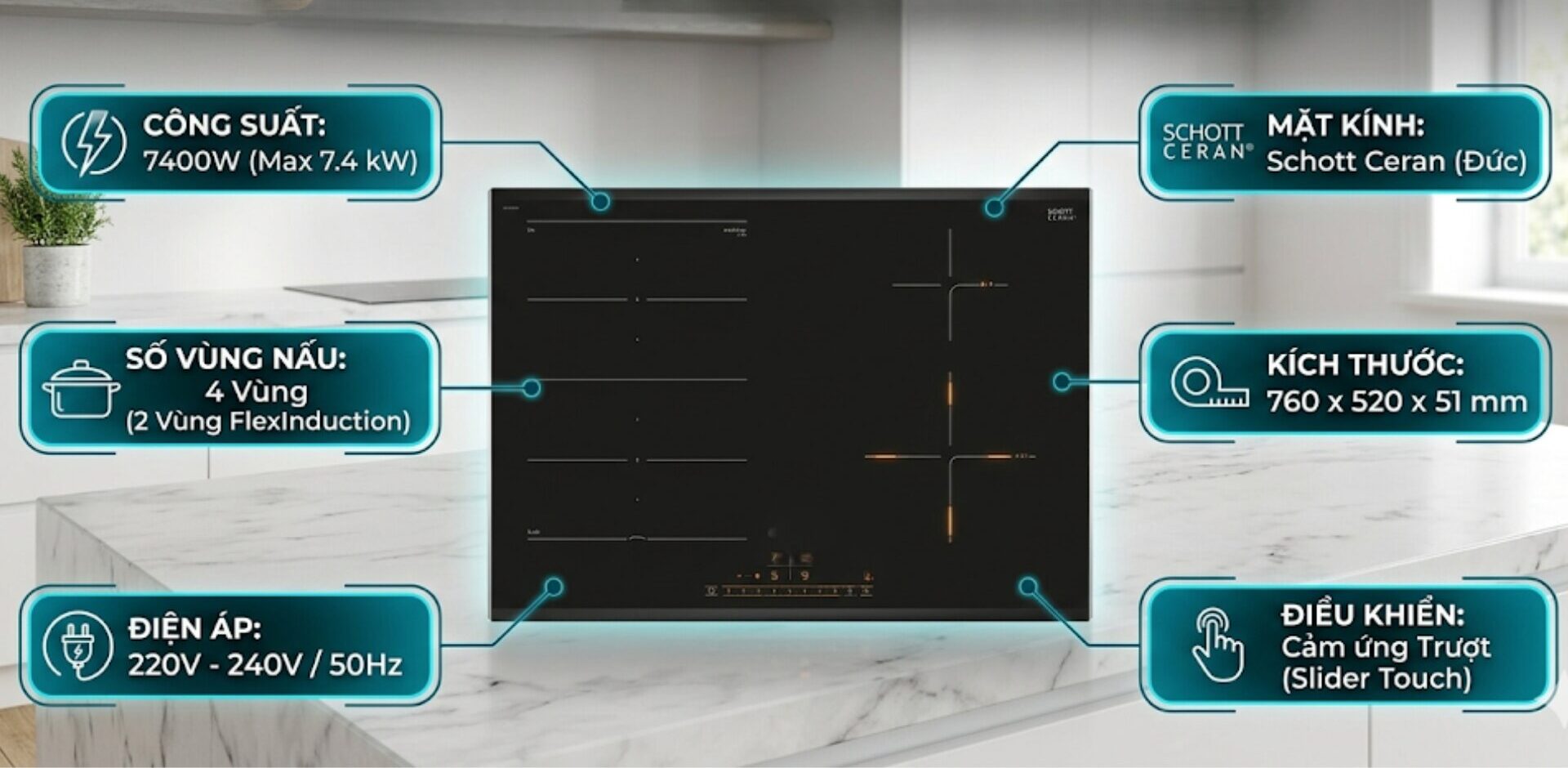
Induction cooktops operate based on the principle of electromagnetic induction (Foucault currents) to directly heat the bottom of the pot. Thanks to this principle, when cooking, the pot gets hot while the glass surface remains almost cool. Understanding the operating principle of induction cooktops not only helps you use the cooktop correctly but also explains why this type of cooktop is safer and more energy-efficient than gas or infrared cooktops.
Operating principle of induction cooktops
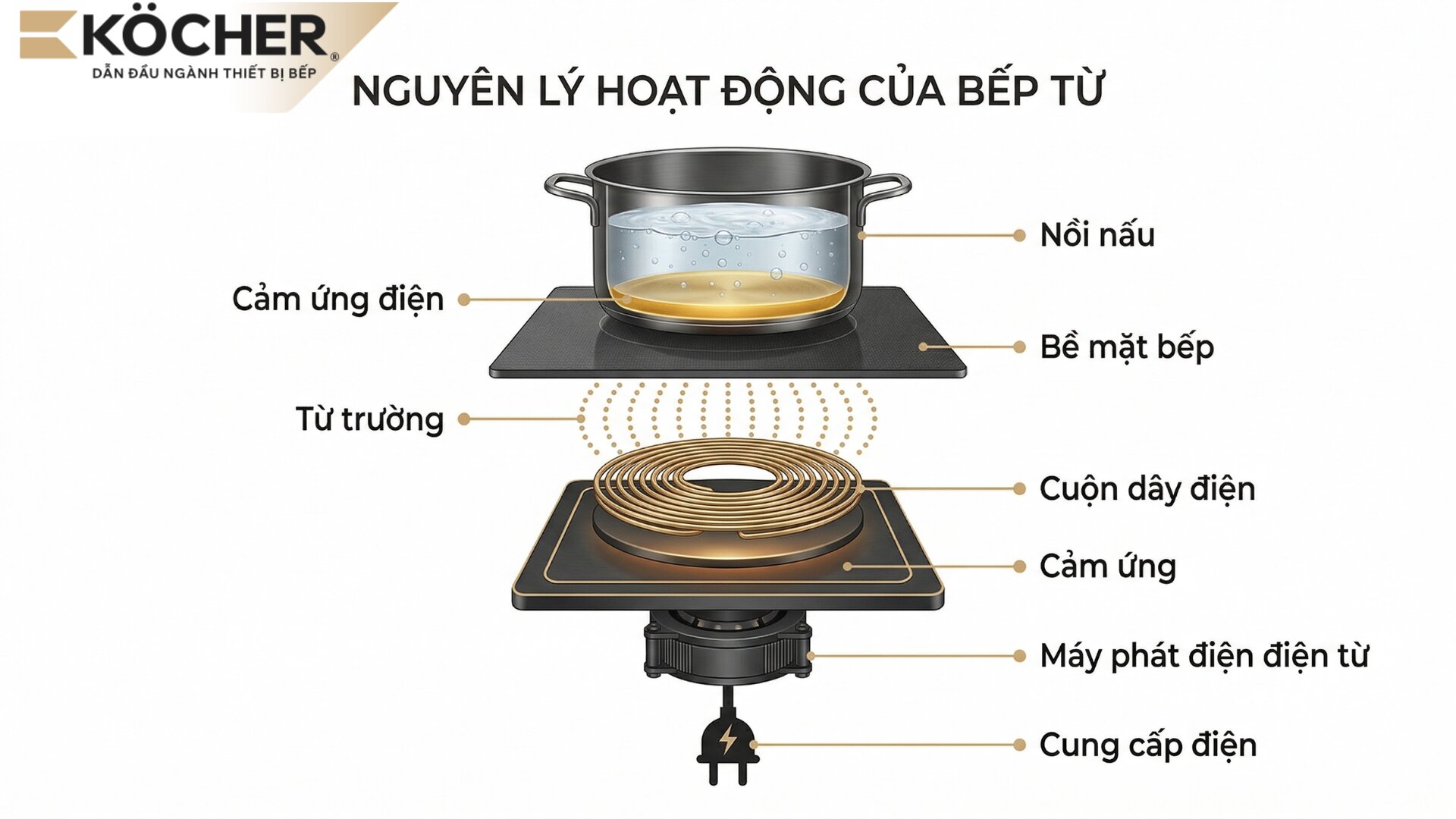
The core point of the operating principle of induction cooktops is that they do not heat the contact surface like gas or infrared cooktops. Instead, heat is generated directly inside the bottom of the pot through induction currents. The entire process occurs in three consecutive steps.
Step 1: Create a variable magnetic field
When plugged in and turned on, alternating current flows through a tightly wound copper coil beneath the glass surface. This coil generates a high-frequency variable magnetic field – usually from 20,000 to 100,000 Hz – that continuously changes direction just below the cooking surface. At this step, no heat is generated; all energy remains in the form of a magnetic field. For this current to transform into a stable magnetic field, the components inside the induction cooktop structure such as the circuit board and induction plate must be designed synchronously and accurately.
Step 2: Generate Foucault currents
The variable magnetic field penetrates the glass surface and affects the bottom of the pot. The bottom of the pot must be made from ferromagnetic materials such as iron, magnetic stainless steel, or cast iron to receive this magnetic field.
The induced magnetic field creates swirling currents – called Foucault currents – that run in a closed loop within the metal layer of the pot’s bottom. This is precisely why the operating principle of induction cooktops requires pots with magnetic bottoms – aluminum, copper, or glass pots do not have magnetic properties and therefore cannot generate Foucault currents, so they will not heat up when placed on the cooktop.
Step 3: Directly generate heat
Due to the pot’s bottom having a certain resistance, the Foucault currents are impeded as they flow through and are directly converted into thermal energy right at the spot. The pot and the food inside heat up, while the cooktop’s glass surface remains almost cool because it is not a heat source – it only gets slightly warm due to contact with the pot’s bottom. This is the fundamental difference that makes induction cooktops safer than any type of flame or conventional resistive cooktops.
Can you watch the following video for a clearer understanding of how induction cooktops work?
Advantages and disadvantages of induction cooktops
Now that you understand the operating principle of induction cooktops, you will see that each advantage and disadvantage has a clear basis – it is not a subjective comment but a direct consequence of this specific heat generation mechanism. Additionally, understanding the technical specifications of induction cooktops such as power and frequency will also help you choose a product that suits your family’s cooking needs.
Advantages of induction cooktops
- High efficiency (~90%): Because heat is generated directly in the bottom of the pot, there is no energy wasted on heating the air or the cooktop surface, induction cooktops achieve thermal efficiency of about 90% – compared to 50% for gas cooktops and 70% for infrared cooktops. As a result, water boils faster and electricity bills are lower when used at the appropriate power level.
- Safety: The glass surface remains almost cool during cooking, so the risk of burns from accidental contact is very low. Heat transfers directly into the bottom of the pot without intermediaries, allowing induction cooktops to cook faster at the same power level. Additionally, induction cooktops have automatic safety protection modes for users:
- Precise temperature control: Induction cooktops have various power levels and separate cooking modes, allowing users to easily adjust the temperature accurately through touch controls.
- No CO2 emissions: Operating entirely on electricity and generating heat through the Foucault principle, induction cooktops do not emit hot air or CO2, ensuring health safety for users.
Disadvantages of induction cooktops
- Pot compatibility: A direct disadvantage from the principle of induction cooktops: Foucault currents can only form in ferromagnetic materials, so aluminum, copper, glass, and ordinary ceramic pots are not compatible. During use, if you see error codes or strange symbols on the glass surface, please refer to the induction cooktop symbols article for timely troubleshooting.
- Cannot be used during power outages: Since it operates entirely on electricity, induction cooktops cannot function when there is a power outage.

The operating principle of induction cooktops can be summarized in three steps: creating a variable magnetic field, generating Foucault currents in the ferromagnetic pot bottom, and converting the current into heat directly where it is needed. Understanding the operating principle of induction cooktops helps you explain everything: why the glass surface is cool, why the efficiency is as high as 90%, and why the induction principle requires magnetic pots. If you are considering buying a cooktop, check your existing pot set with a magnet – that is the most practical first step before investing in this smart cooktop.
With superior X-Nano scratch-resistant glass technology and E.G.O German standard components, Köcher is proud to be the pioneer in Vietnam bringing German technology into induction cooktop products, providing durable and high-class cooking solutions for your family.