Sharing Corner

Why does the induction cooktop turn off by itself?

When the cooking timer has expired, the induction hob automatically turns off to end the cooking process, saving energy. However, if you do not set a timer for the induction hob to turn off automatically while cooking, this is an abnormal situation that may be caused by the following reasons. So, what are those reasons? How to handle an induction hob that keeps turning off?

Why does the induction hob turn off automatically?

The induction hob is a relatively modern cooking product, loved by many for its quick cooking ability, beautiful design, easy cleaning, and especially its compatibility with various cookware. (See more: 8 benefits of induction hobs)

Induction hob turns off automaticallyWhy does the induction hob turn off automatically?

 
Users also love this hob because it has many features, including many types of hobs that have sensors to turn off automatically when a fault occurs or due to the cooking timer, which is completely normal. But if you do not set a timer while cooking and the induction hob turns off, it is certain that there is a fault. The possible causes are:

Voltage fluctuations

When you are cooking and the induction hob turns off automatically, sometimes the hob will give a warning signal before completely shutting down. The cause may be due to circuit overload (power outage or blown fuse). This is a safety feature of the hob to ensure that it does not affect the internal components of the hob or cause further damage to other electrical appliances in the house.

The manifestation of many types of hobs will differ when the supplied voltage is insufficient. For example, many induction hobs will keep turning off when the electricity is unstable. But some induction hobs will turn off completely to preserve the lifespan of the hob as well as its internal components.
Voltage fluctuations
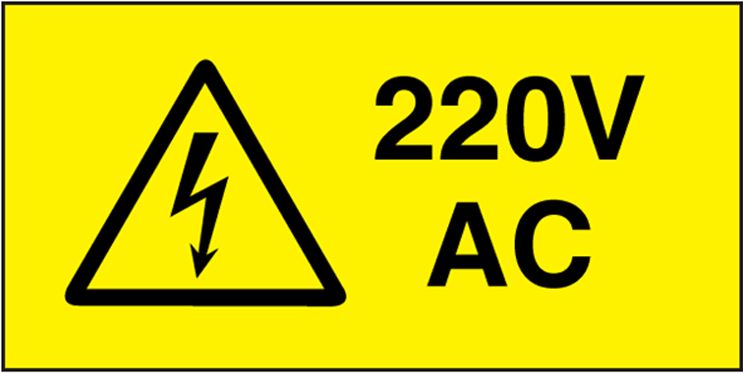
Vietnam uses a voltage of 220V, frequency of 50Hz
Each hob may require different voltages to operate. It depends on the power supply efficiency of each country that distributes different voltages. Most countries today follow the common standard of 220V at a frequency of 50Hz. Very few countries like the USA, Canada, and Japan use 110V as the standard voltage.
 
The circuit requirement for an induction hob is 15 amps. If you are using an induction hob with 4-5 cooking zones, the minimum circuit requirement is 40-50 amps.

Therefore, if the reason the induction hob turns off is due to the power supply. You need to check the voltage of your home, and see if there are any issues. Turn off other unnecessary electrical appliances to ensure enough power supply for the hob.

If you are cooking simultaneously on 3-4 cooking zones at high temperatures on your hob, the best solution is to adjust the temperature of the induction hob by reducing the temperature for each cooking zone. Or reduce the number of cooking zones, do not cook all at once if your home voltage is insufficient.

The induction hob turns off suddenly when it overheats

The induction hob also has a timer feature similar to induction cookers. When the set time expires, the induction hob turns off because it has reached the cooking time as set.

|   See more: How is an induction cooker different from an induction hob??
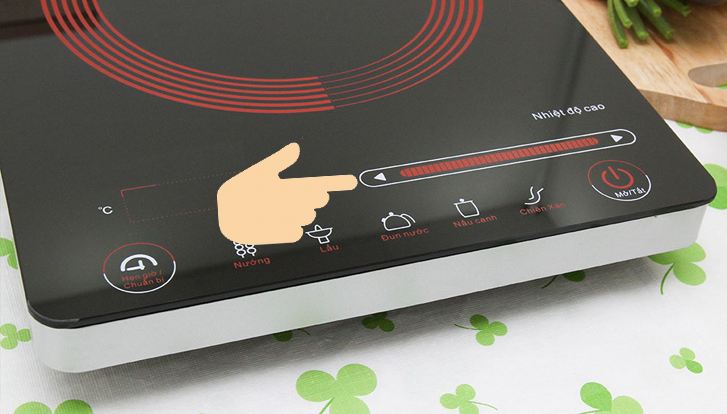
However, sometimes the induction hob turns off before the time is up, which may be due to the hob overheating, the cooking zone getting too hot when cooking for too long. If the temperature inside the hob is too high, the cooling fan does not operate sufficiently to cool the hob, the temperature sensor on the cooking zone will automatically turn off. This situation can still occur to ensure the safety of the hob.

Induction hob turns off suddenly when too hot

Adjust the temperature of the induction hob appropriately

In the case of an overheating cooking zone, the induction hob will automatically turn off without being able to display an error code on the control panel before shutting down. Therefore, if you have set a cooking timer but the hob turns off before the time is up, check if you are cooking at too high a temperature for too long. Let the hob pause cooking and have time to cool down, then adjust the temperature of the induction hob for the next cooking session.

Sensor detects no cooking utensils

There are 5 situations that can easily cause the induction hob to turn off automatically when there are no pots:

First, if you have turned on the hob but have not placed a pot on the cooking zone, after a certain period, usually 2-30 seconds, the hob will warn with an error displayed on the control panel, accompanied by a sound notification, then turn off.

Second, when you are stir-frying or cooking, you accidentally lift the pot/pan to flip the food, skillfully tossing food like on TV… this causes the sensor to detect that there are no cooking utensils. The hob will temporarily stop to avoid wasting electricity. This sensor is similar to that on induction cookers, especially on the multi-functional product lines of reputable brands. If you are unsure which brand of induction hob is good with smart detection sensors to choose, seeking out major brands will help ensure uninterrupted cooking.
Incorrect pot placement

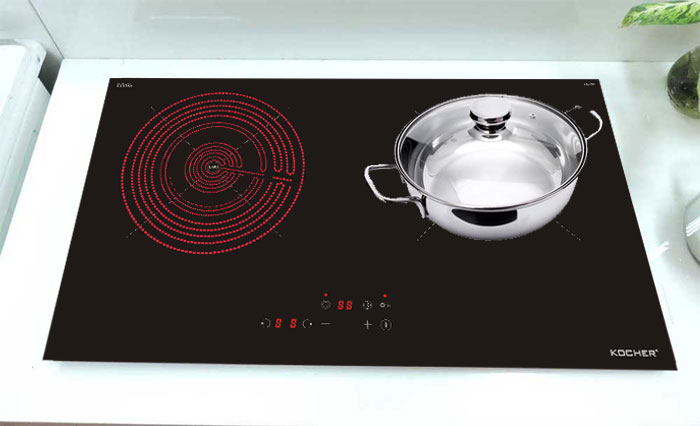
Incorrect pot placement is also a reason for the hob to turn off

Third, there are some cases where users place the pot incorrectly, not centered, which also causes the hob to turn off.
Fourth, if the cooking utensils are not the correct size, there is a high possibility that the hob will turn off automatically.
Fifth, if the cooking pot does not meet the standards, for example, a pot/pan with a non-flat bottom, or the diameter of the pot bottom is not sufficient for contact to cook.

Liquid boiling over on the cooking zone surface of the hob

The induction hob can grill food on its surface. However, liquids such as oil, grease, butter, or liquids flowing from food within permissible limits will not cause the induction hob to turn off. But if there is an overflow due to too much liquid spilling over the controlled area, it will cause the hob to turn off.

If the user does not manage to pause cooking (Pause) or remove the spilled liquid, the hob will automatically turn off to ensure safety.

What to do when the induction hob turns off automatically

If the induction hob turns off while cooking, you can refer to the user manual specific to each type of hob for more detailed information. Troubleshoot if possible and restart with different settings.
 
Before turning off the hob, sometimes on the control panel of each hob, an E code will blink before it turns off. Almost all manuals come with instructions for you to handle these E codes. Including reasons for displaying E codes and quick fixes to troubleshoot at home.
 

Before buying an induction hob, you should also consider the power supply performance in your area. If you are in Vietnam, the voltage is usually 220V.

If you encounter voltage fluctuation issues, wait until the voltage stabilizes and then restart. You should also plug the induction hob into a separate outlet to ensure it always receives sufficient power. Do not plug it into the same outlet as a rice cooker, electric fan, dishwasher, refrigerator, or any other electrical appliances already in the kitchen.
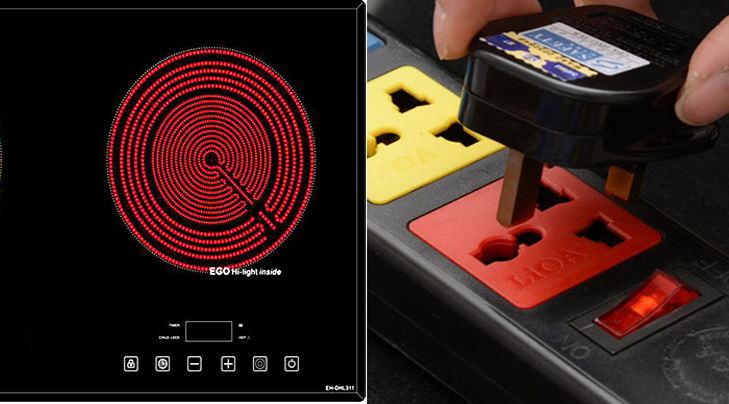
What to do when the induction hob turns off automatically

It is advisable to use a separate outlet for the induction hob

If the reason the induction hob turns off is an internal circuit issue, do not attempt to repair or disassemble the hob. Refer to the user manual or call a technician for repairs. Sometimes, control system errors or broken heating element wires can also cause the induction hob not to heat even though the device’s indicator light is still on and displays power levels as usual.
 
If it has turned off due to overheating, wait for it to cool down before restarting the hob. Always ensure that the cooling fan operates steadily, is not obstructed, or malfunctioning. Try to avoid prolonging average heat while cooking, adjust the temperature of the induction hob accordingly. If cooking at high temperatures, only cook for a short time. Especially balance the heat when cooking all cooking zones at the same time.

Do not place pots or pans that are too small, with a convex bottom, or turn on the hob for too long without placing a pot on it. This will automatically activate the protective device due to the sensor detecting cooking utensils on the hob and lead to the device turning off automatically.

Do not lift your cooking utensils during the cooking process. Ensure that the cooking utensils are ready before turning on the hob.

In summary, the induction hob turning off is a safety feature to ensure user safety, prolong the lifespan of the hob, and prevent energy waste. You should not worry too much about this issue. Hopefully, after this article, you will use induction cookers and induction hobs more wisely.

Köcher is proud to be a pioneer in Vietnam bringing German technology into induction hob products.

post related

Decoding 11 important technical specifications of induction hobs when choosing to buy a stove

Understanding the technical specifications of induction hobs is the first step to choosing the right hob that truly fits your kitchen and your family’s cooking habits. The article below will help you decode each important specification in the easiest way, from size, power to the material of the glass surface and international safety certifications. Summary [...]
Sharing Corner

What is a smart induction hob? 11 essential features for induction hobs

Smart induction cookers are a line of premium induction cookers integrated with modern technologies such as sensors, automation, wireless connectivity, remote control… ensuring safe cooking and enhancing user experience. Below is a summary of 11 essential features and suggestions for some worthwhile induction cooker products. 2 groups of smart features on induction cookers today To [...]
Sharing Corner

German-style potato salad: 3 authentic recipes with Köcher

German Potato Salad (Kartoffelsalat) is not just a side dish – it is the soul of German meals for 200 years. This article from Köcher will summarize the 3 most classic variations from two different regions of Germany, clearly explaining the secrets behind the distinctive sweet and sour flavor that no two lines are alike [...]
Sharing Corner

2 authentic German potato pancake recipes Kartoffelpuffer

Kartoffelpuffer – the crispy potato pancakes of German cuisine are appealing thanks to their golden, crispy exterior and soft, fragrant potato interior. This article from Köcher will guide you through two original recipes from the book Great German Recipes, explaining each step to maximize the performance of the Köcher induction hob. Summary of content:   [...]
Sharing Corner

Sauerbraten recipe: tender, flavorful German-style vinegar-marinated beef

Sauerbraten is a national treasure of German cuisine – even the toughest beef becomes tender after being marinated in vinegar for 3 to 6 days, then slow-cooked until the brown sauce is thick and glossy. This article from Köcher will guide you step by step in preparing authentic Sauerbraten, explaining the secrets behind the marinating [...]
Sharing Corner

German-style Sauerkraut recipe

Sauerkraut – German-style fermented cabbage is one of the oldest food preservation techniques in Europe, and in German cuisine, it appears everywhere: from side dishes with grilled sausages to luxurious stews alongside roast duck. This article from Köcher will guide you on how to make authentic Sauerkraut. Main content summary: Sauerkraut is not just pickled [...]
Sharing Corner