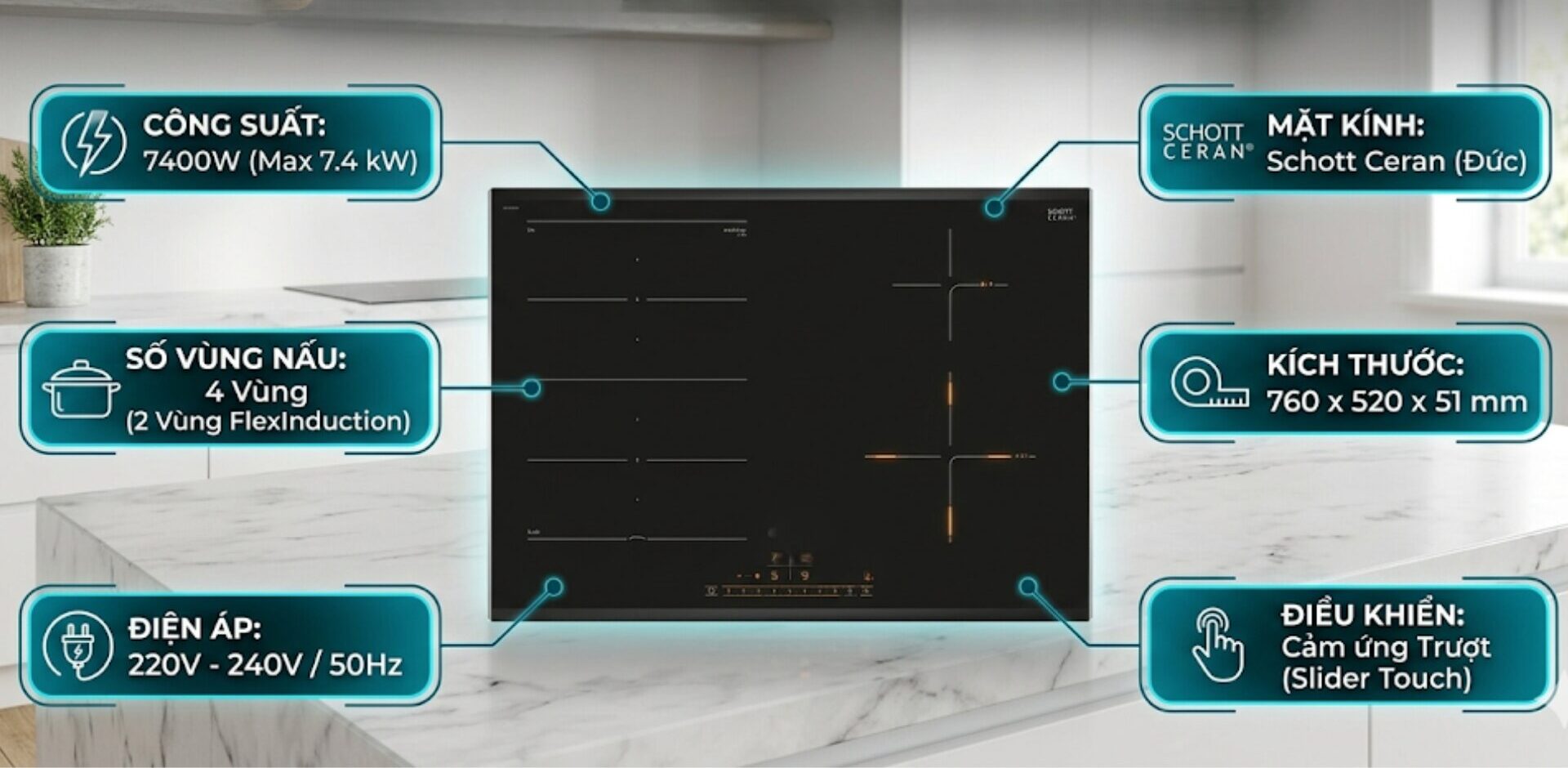
The induction cooktop beeps continuously is a situation many families encounter but do not know the cause. This sound may just be a warning from the smart feature of the cooktop, or it could be a sign of a fault in the cooktop’s components. The article below will analyze in detail the 6 most common causes and guide you on how to effectively handle them at home.
6 reasons why the induction cooktop beeps continuously
The beeping from the induction cooktop is a warning signal that the cooktop is experiencing an issue that needs to be addressed. The cause may come from the cooking utensils, power supply, internal temperature, or the cooktop’s features, so correctly identifying the issue will help you quickly resolve it and avoid long-term damage.
Using incompatible cookware or placing it incorrectly
This is the most common cause, often accompanied by the cooktop not heating or not recognizing the pot.
- Signs: The cooktop beeps immediately when turned on, does not heat up, and the display shows error code E0 (unable to recognize the pot). This issue is usually equivalent to the error Induction cooktop not recognizing pot on the control system of modern cooktops.
- Cause: The induction cooktop operates based on the principle of electromagnetic induction directly affecting the bottom of pots with magnetic properties. If you use pots made of glass, aluminum, or ceramic without a magnetic base, the induction coil will not be able to generate heat. Additionally, placing the pot off-center from the cooking zone will also cause the sensors to not adequately recognize the pot’s bottom area, leading to an audible warning.

The power supply to the cooktop is unstable
Induction cooktops are high-power devices that require a stable power supply to operate correctly. When the voltage is not up to standard, the cooktop will activate its automatic protection mechanism and beep continuously.
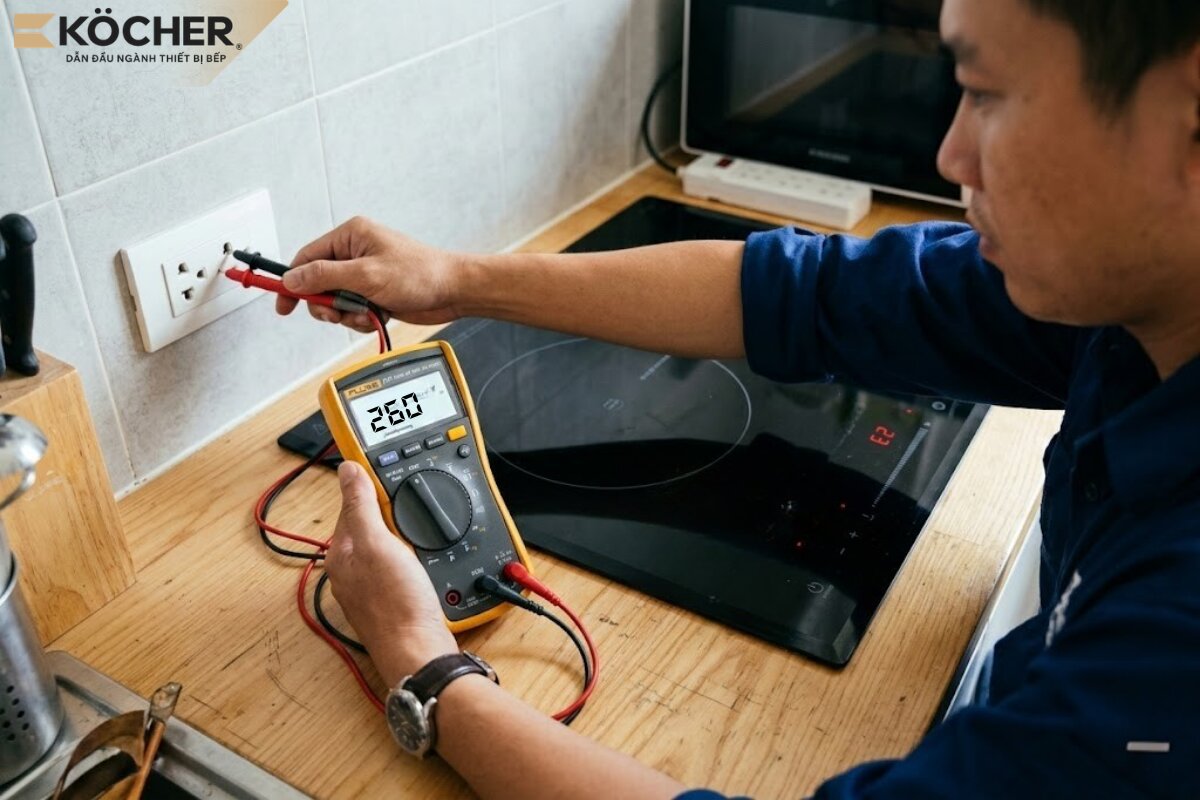
- Signs: The cooktop beeps, turns off by itself, or operates unstably; the display shows error code E2 (voltage too high) or E3 (voltage too low).
- Cause: If the household voltage is too high (above 260V*) or too low (below 170V*) compared to the standard, it will activate the safety protection mode of the circuit board. This phenomenon often occurs during peak hours or when the household uses too many electrical devices simultaneously on one circuit.
*Note: To know the appropriate voltage range for your induction cooktop, you should check directly in the user manual or the technical specification label of the device (usually clearly stating the operating range, for example, 160V – 260V).
The system is overheating or the cooling fan has a problem
When the internal temperature exceeds the safe threshold, the cooktop will turn off and beep to protect the internal components.
- Signs: The cooktop beeps after prolonged cooking, the body of the cooktop is unusually hot, no sound from the fan; the display may show error code E1 (cooktop or fan overheating).
- Cause: The cooling fan may be clogged with dust, or the air vent at the bottom of the cooktop may be obstructed, preventing hot air from circulating, causing the system to overheat. At this point, the temperature sensor will immediately cut off the power to the induction coil to prevent overheating that could damage the components.
Sensors and internal components are malfunctioning
When components such as IGBT, temperature sensors, or control boards encounter issues, the cooktop may stop working and issue warnings to protect the system.
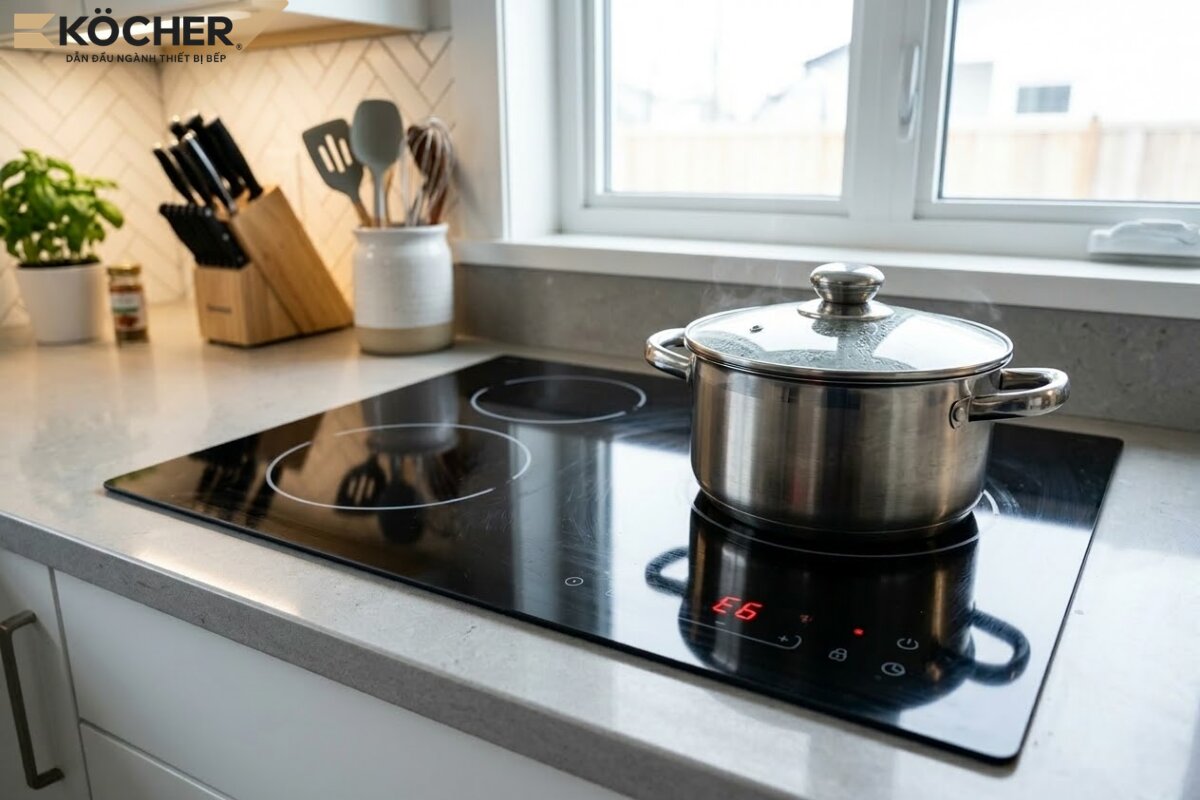
- Signs: The cooktop beeps with error code E5 (IGBT overheating) or E6 (temperature sensor overheating), the cooktop turns off or turns on and then off repeatedly. For the e5 induction cooktop error, this is a signal that the sensor system recognizes that the power module is experiencing severe thermal overload.
- Cause:
- The cooktop operates at high power for an extended period, causing the temperature of the components to exceed the safe threshold (protection mechanism, not necessarily immediate failure).
- Long-term use or unstable voltage can degrade components, leading to repeated errors.
Note:
It is important to distinguish between overheating (the cooktop turns off to protect itself, and can operate again after cooling) and actual component failure. In most cases reporting E5/E6, you only need to turn off the cooktop, wait for it to cool down, and check the ventilation. If the error persists even after the cooktop has cooled down, you should contact a technician for further inspection.
The control panel is wet or has foreign objects on it
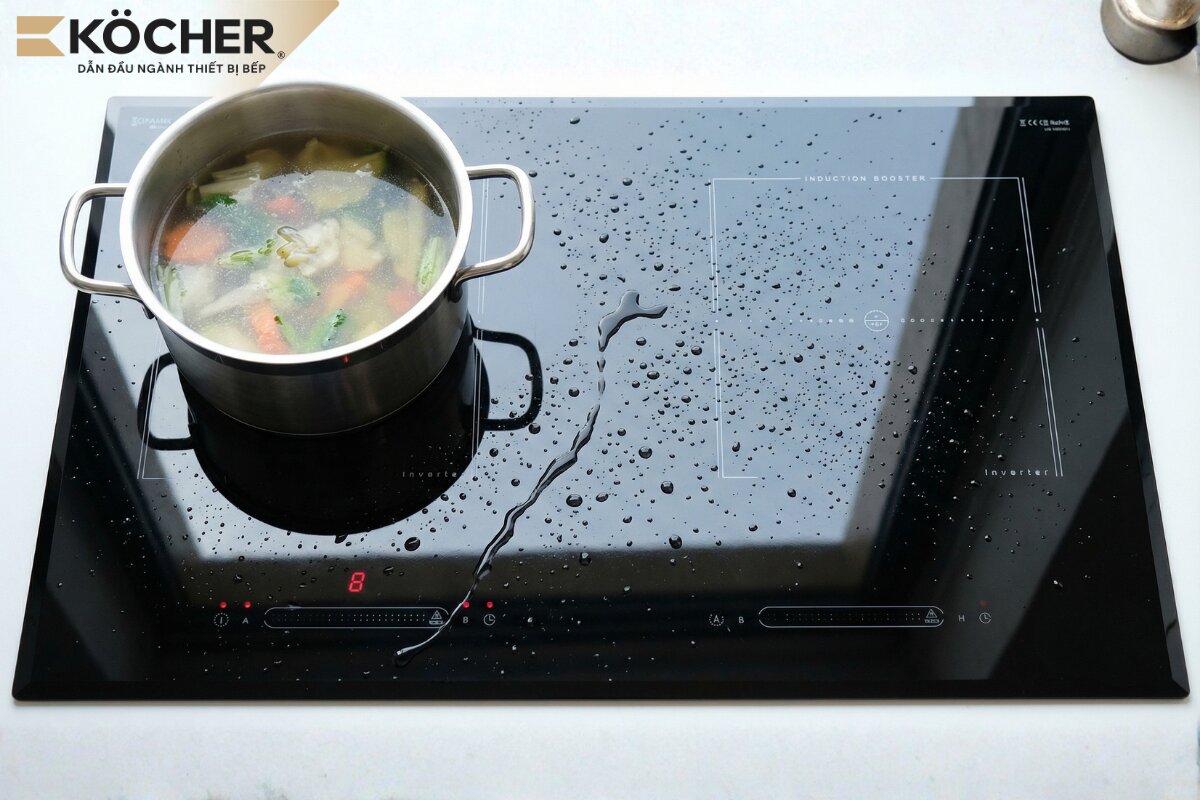
The capacitive touch system of the cooktop is very sensitive; even a small drop of water or a cloth accidentally placed on it can cause the cooktop to misinterpret signals and beep continuously.
- Signs: The cooktop beeps when not in use or just turned on; the touch buttons light up or change modes by themselves.
- Cause: A foreign object is pressing on the touch button area (such as a cloth, spoon) or the glass surface is wet, with water or grease spilling from the cooking pot causing the cooktop’s capacitive touch system to misinterpret signals.
Smart features are active (Timer, Child Lock)
Sometimes the beeping is not an error but just a sound indicating the operational status from integrated features such as the timer mode or child safety lock.
- Signs: The cooktop beeps after a certain period; the display shows a lock icon or clock; the cooktop does not respond when pressing buttons even though there is no error code.
- Cause: The timer mode has ended the cooking time or the child safety lock feature is activated, causing the cooktop to emit a sound to alert the user of the status change. When the beeping sound indicating the end of the cycle occurs, the user just needs to perform the Turn off the timer mode of the induction cooktop on the control panel to return the cooktop to normal cooking status.
How to fix the beeping induction cooktop at home
Most cases of the induction cooktop beeping continuously can be handled at home without needing to take it to a service center if you correctly identify the cause. Below are the ways you can check and quickly resolve the issue:
- Fix issues related to the pot: Use a magnet to check the magnetic property of the pot’s bottom (a strong magnet indicates the pot can be used on the induction cooktop). Also, ensure the pot’s bottom is flat, not deformed, and placed directly in the center of the marked induction zone on the glass surface.
- Check and clean the cooling system: Turn off the cooktop but do not unplug it immediately so the fan can continue to run for cooling. If the cooling vents are dirty, use a handheld vacuum or a dry cloth to clean the air vents.
- Check the household power supply: If the voltage is frequently unstable, consider installing a voltage stabilizer specifically for the induction cooktop. Additionally, the induction cooktop should use electrical wires with a cross-section of 2.5mm to 4.0mm depending on the cooktop’s power to ensure load capacity.
- Handle the control panel: Use a soft dry cloth to clean the glass surface, completely removing any water or grease stains on the touch button area and ensure no objects are pressing on the cooktop’s buttons.
- If you have completed the above steps and the induction cooktop still beeps continuously, it may be due to faulty internal components. Stop using the induction cooktop and contact a reputable service center for repairs and replacement of new components.
Frequently asked questions about sound issues on induction cooktops
Below are detailed answers to common questions users often ask when experiencing the beeping of the induction cooktop.
Why does the cooktop suddenly beep and turn off while cooking?
When the induction cooktop is operating normally and suddenly beeps and turns off, the most common cause is overheating. After a period of continuous cooking at high power, the internal temperature of the cooktop exceeds the safe threshold, and the temperature sensor will activate the automatic protection system to turn off the cooktop to prevent damage to the components.
Additionally, the cause may also be due to a sudden drop in grid voltage (the cooktop reports error E3), the pot running dry (the cooktop reports error E4), or the cooling fan stopping unexpectedly. When the cooktop turns off, turn off the power and wait 15 – 20 minutes for it to cool down before trying to turn it back on. If the cooktop continues to turn off after a short time, it needs to be checked by a technician.
Is the beeping a sign of fire or explosion?
The beeping is not a sign of fire or explosion; it is a signal for users to pay attention and check the cooktop’s status in a timely manner. However, if the cooktop beeps accompanied by a burnt smell, smoke, or the cooktop’s casing is unusually hot, immediately cut off the power and do not continue using it until it has been checked, as this may be a sign of burnt components inside that need to be addressed.
Can this error beep be completely turned off?
The beeping is designed as part of the safety standard to facilitate interaction between the user and the device. You should not try to turn off the cooktop’s beeping as it will eliminate the ability to recognize emergency situations, compromising safety during cooking.
The phenomenon of the induction cooktop beeping continuously usually arises from external factors such as cookware, power supply, or cleaning habits. Understanding error codes and following the technical handling process will help your device operate reliably, maintaining stable cooking performance. In case of errors arising from the circuit board, please replace with genuine components to ensure long-lasting durability for the cooktop.
If you are looking for a high-quality induction cooktop, please refer to Köcher products. As a leading brand in the kitchen appliance industry with E.G.O components that meet German standards, Köcher induction cooktops operate stably over long periods, minimizing the occurrence of continuous beeping on the device.
Köcher induction cooktops pioneer German technology – For detailed product information, please contact:
|