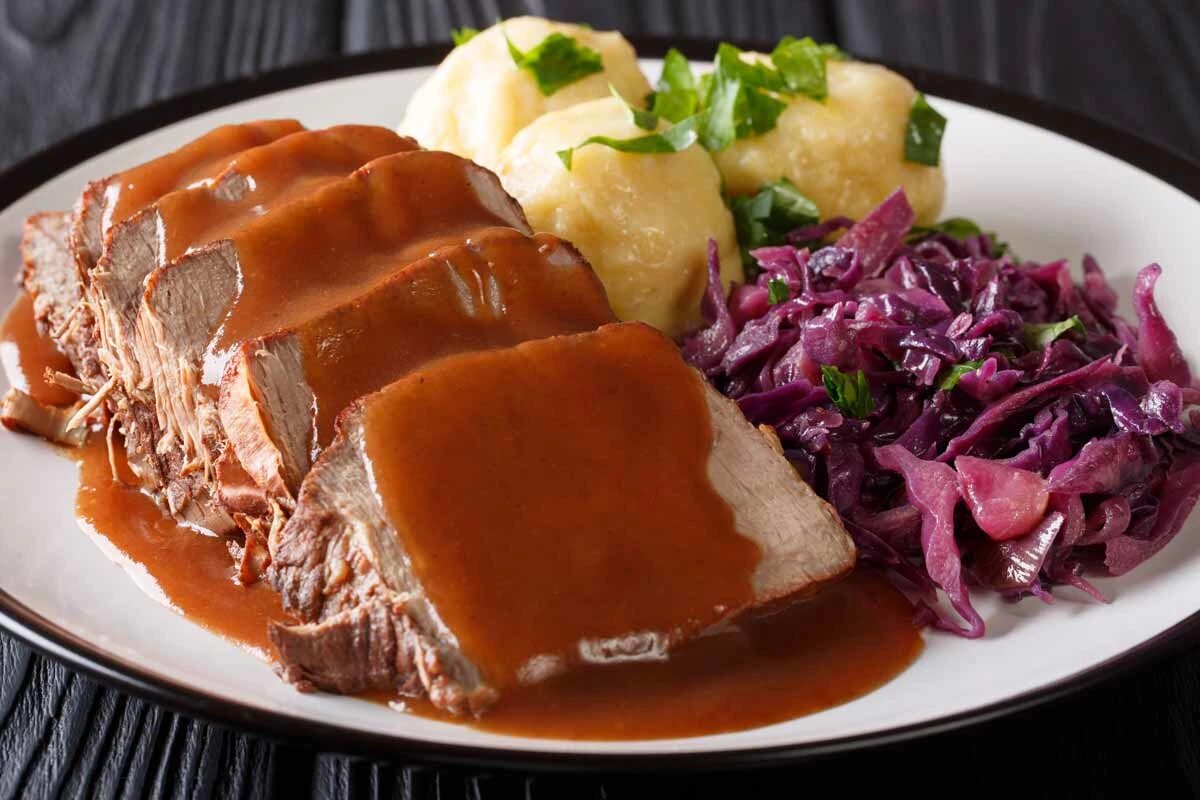
Sauerbraten is a national treasure of German cuisine – even the toughest beef becomes tender after being marinated in vinegar for 3 to 6 days, then slow-cooked until the brown sauce is thick and glossy. This article from Köcher will guide you step by step in preparing authentic Sauerbraten, explaining the secrets behind the marinating process and highlighting the role of temperature control at each stage to maximize the performance of Köcher induction cookers.
|
Content Summary:
|
What is Sauerbraten? Why is it the “national treasure” of German cuisine?
The name Sauerbraten is a combination of two German words: sauer (sour, pickled) and Braten (roasted or braised). Literally translated, it means “sour braised meat,” but in reality, this is a piece of beef that is braised after a long marinating process in a mixture of vinegar, wine, and complex spices.
This is the national dish of Germany, regularly appearing in German restaurants worldwide and deeply connected to family gathering culture across generations. The origin of the dish dates back to the time of Julius Caesar, according to legend when Roman warriors transported pickled meat across the Alps to what is now Cologne. By the 13th century, Saint Albertus Magnus of Cologne was noted for popularizing this dish.
Each region of Germany has its own interpretation of Sauerbraten: Rhineland, Bavaria, Saxony, Swabia each have different marinating and sauce recipes. The common point is that all require time – and precise temperature to create the final product.
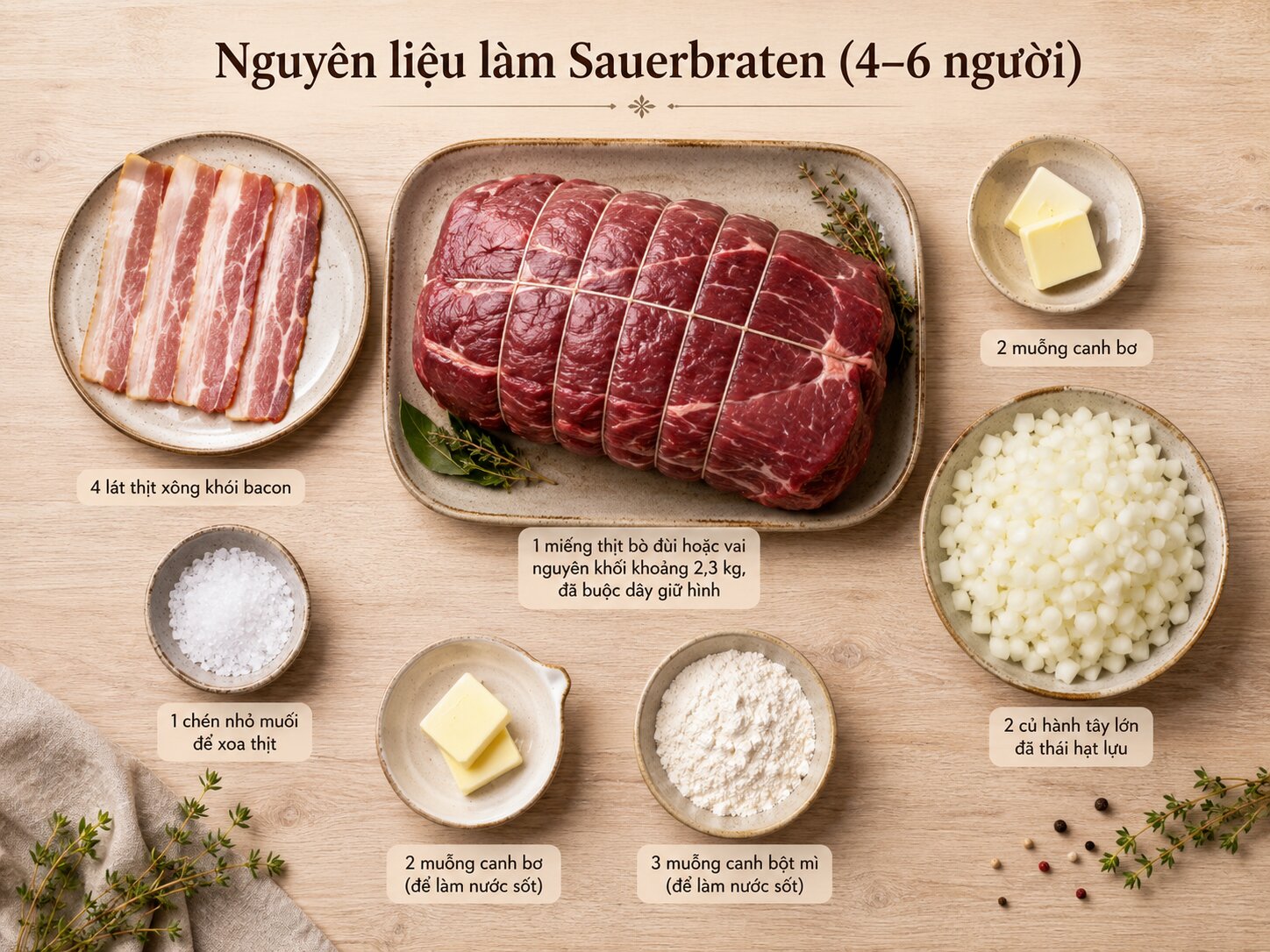
Ingredients for Sauerbraten (4 to 6 people)
The following recipe is based on the classic version recorded in the Great German Recipes & German Style Recipes, adjusted to suit easily available ingredients in Vietnam.
Main ingredients
- 2.3 kg beef shank or shoulder (whole piece, tied to maintain shape)
- 4 slices of bacon
- 2 tablespoons of butter
- 2 large onions, diced
- 2 tablespoons of butter + 3 tablespoons of flour for the sauce
- Salt to rub on the meat
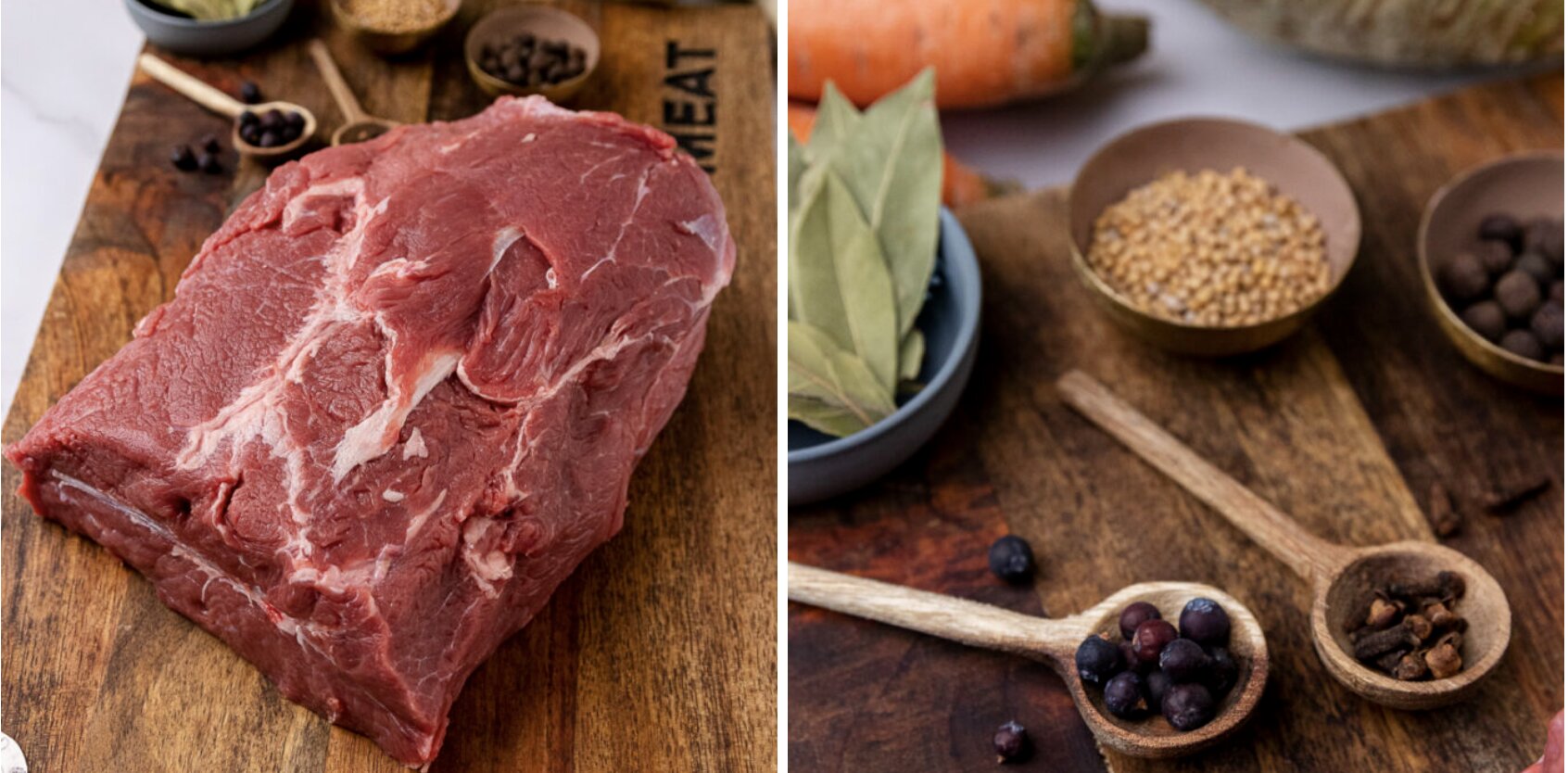
Marinade
- 3 cups (720 ml) white vinegar
- 1 large onion, sliced
- 1 medium carrot, sliced
- 2 bay leaves
- 6 whole cloves
- 8 black peppercorns
- 1 tablespoon pickling spice, or substitute with 1 teaspoon mustard seeds and ½ teaspoon coriander seeds
Step-by-step guide to making Sauerbraten
Marinating the meat (3 to 6 days in advance)
Tie string around the meat in several places to maintain its shape during braising. Rub salt evenly over the entire surface of the meat. Place the meat in a glass bowl or food-grade plastic container.
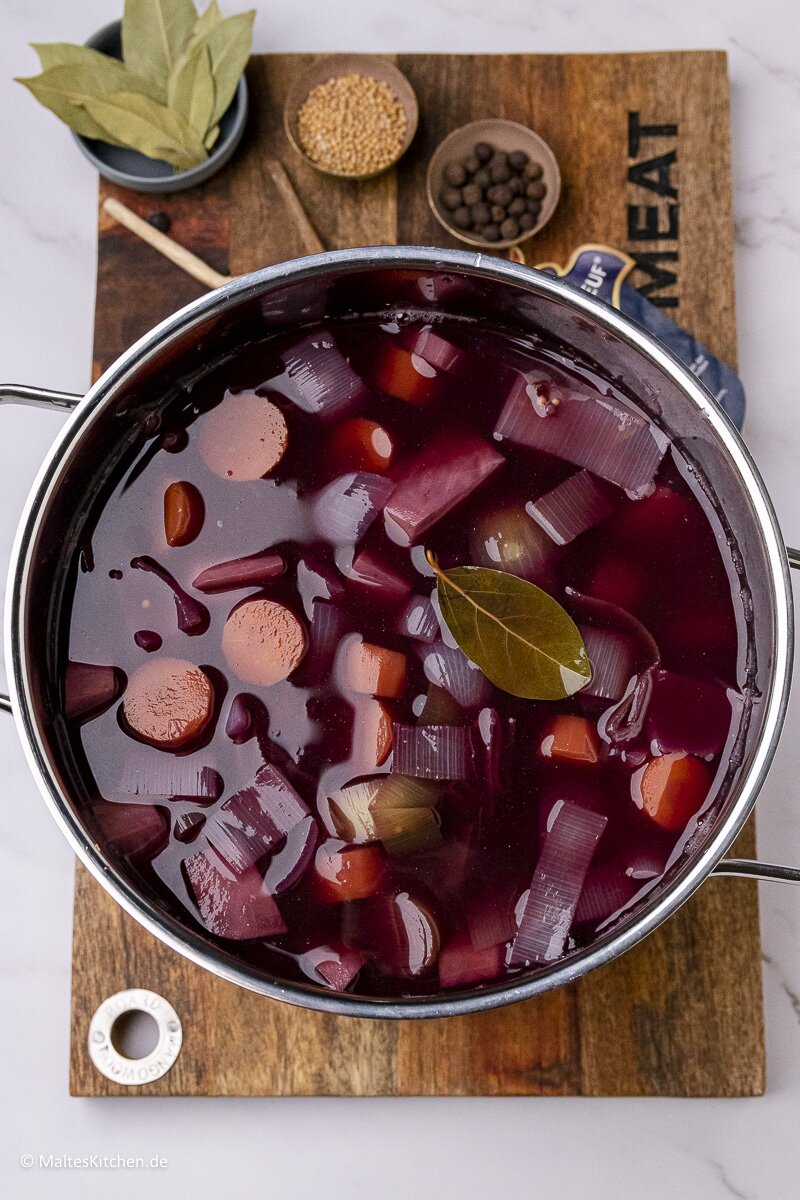
Put all the marinade ingredients into a pot, bring to a boil for about 5 minutes, let cool completely, then pour over the meat. The meat must be completely submerged in the marinade. Cover tightly and refrigerate. Turn the meat once a day to ensure even marination.
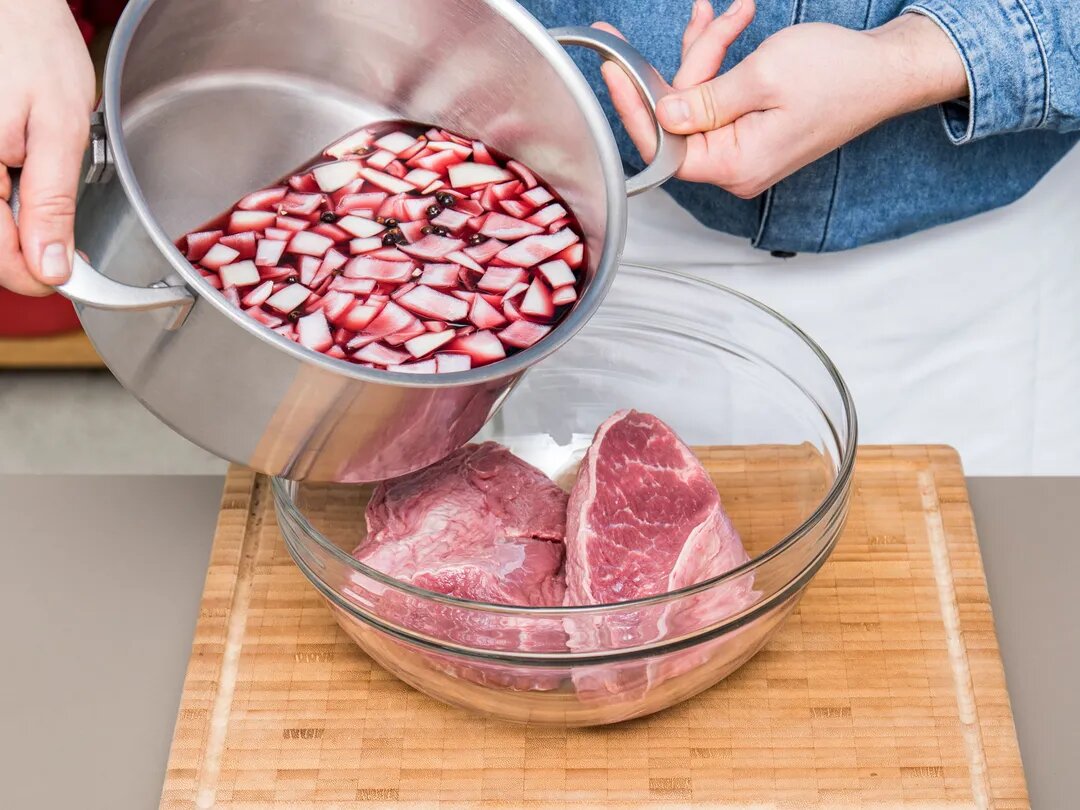
Important note: Do not use metal bowls or pots for marinating. The acid in the vinegar reacts with metal, altering the flavor. Only use glass bowls, ceramic dishes, or food-grade plastic containers.
Searing the meat
Remove the meat from the refrigerator and let it sit at room temperature for about 30 minutes. Strain the marinade through a sieve, retaining the liquid and discarding the solid spices. Keep 1 bay leaf for braising later.
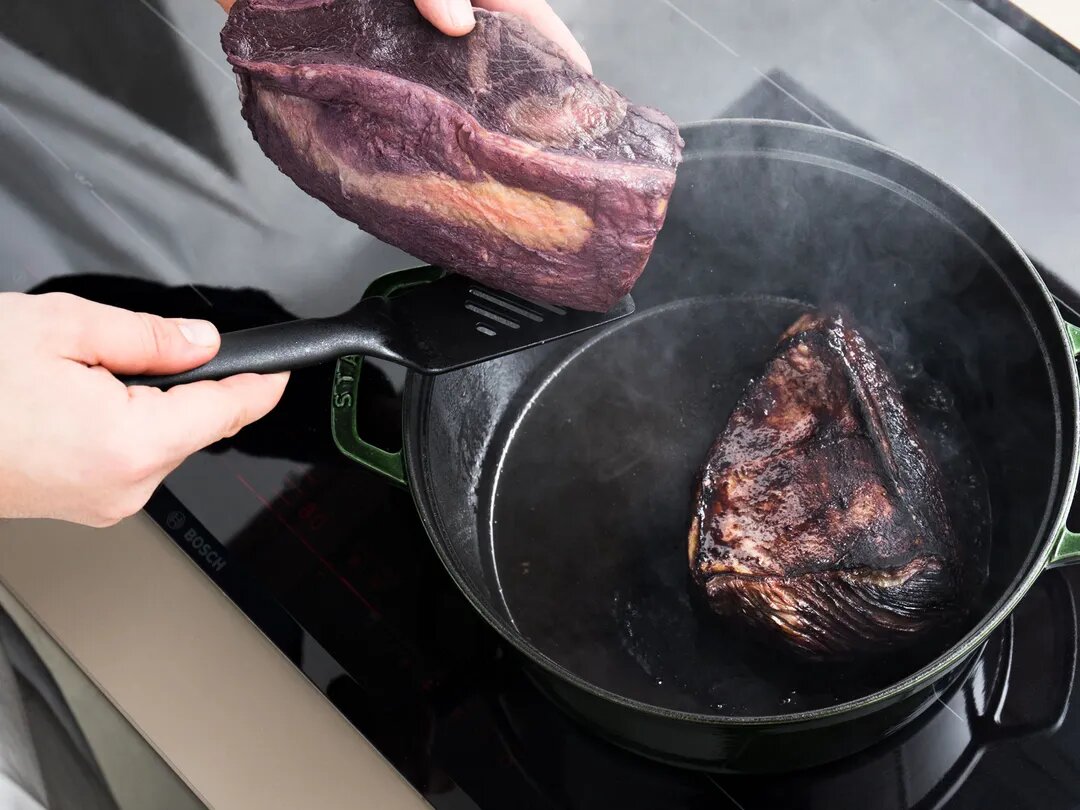
Pat the meat dry with paper towels. On the Köcher induction cooker, heat a heavy pot over medium-high heat. Sauté the bacon in butter until the fat renders. Add the beef and sear until golden brown on all sides, about 3 to 4 minutes per side.
Slow braising the meat
In the same pot, add the onions and sauté until lightly golden. Place the meat back into the pot. Pour the strained marinade in until it reaches halfway up the meat. Add the reserved bay leaf.
This step requires the most precise temperature control. Cover tightly and braise on low heat, maintaining a temperature of 80 to 90°C for 3.5 to 4 hours. The Köcher induction cooker with induction technology allows for stable maintenance of this temperature without continuous adjustments. Turn the meat every 30 minutes. The meat is done when it can be easily pierced with a fork without resistance.
Making the sauce
Remove the meat and let it rest for at least 15 minutes before slicing. Strain the braising liquid through a fine sieve.
On the Köcher induction cooker, melt 2 tablespoons of butter over medium heat. Add 3 tablespoons of flour, stirring continuously for about 2 minutes until the mixture turns light golden. The Köcher induction cooker allows you to switch from “medium heat” to “low heat” in seconds, preventing the roux from burning. Gradually pour in the strained braising liquid, stirring vigorously to avoid lumps. Simmer gently until the sauce is thick and smooth.
Tip: Crush 5 to 8 pieces of hard gingerbread (or Lebkuchen) and add them to the sauce while it is simmering. The light sweetness and warm spice of the gingerbread add a characteristic depth to the most famous version of Sauerbraten.
Presentation and serving
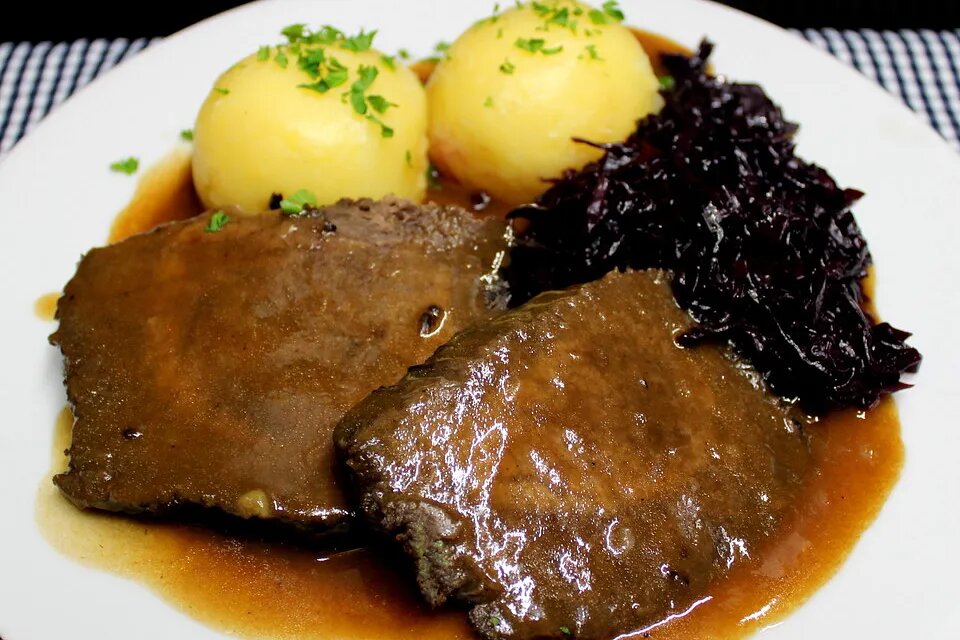
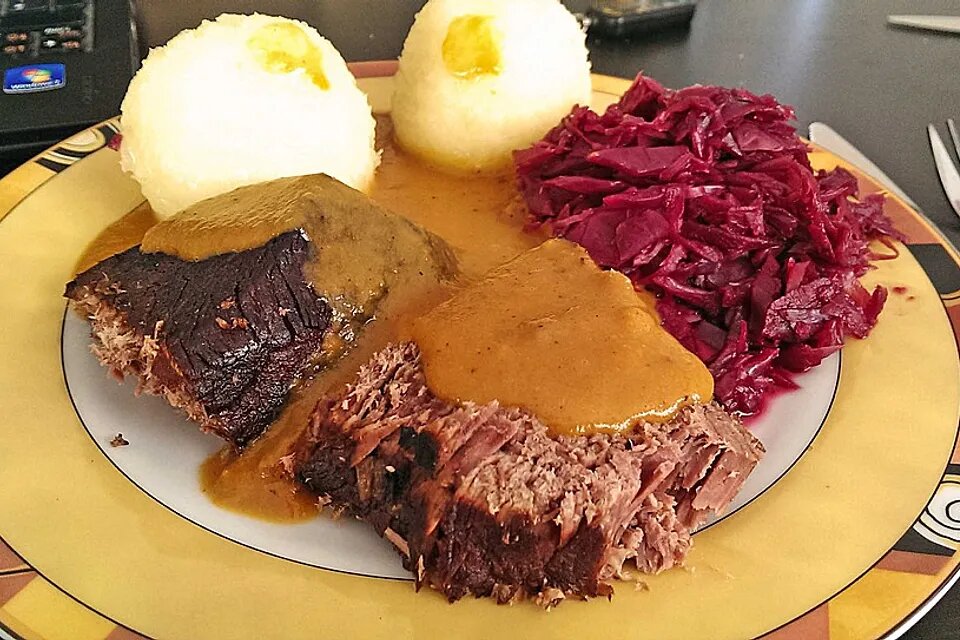
Remove the string, slice the meat into thick slices about 1 to 1.5 cm thick. Arrange on a plate, drizzling the glossy brown sauce over the top. Serve hot.
Present the Sauerbraten on a plate. (Source: kitchenstories.com)
What to serve with Sauerbraten?
Traditionally in Germany, Sauerbraten is almost always served with at least one of the following side dishes:
| Side dish | Suitable Sauerbraten version |
| Potato pancakes (Kartoffelpuffer) | Rhineland, Bavaria – the sweet and sour balance complements the crispy richness of the pancakes |
| Potato dumplings (Semmelknödel) | Bavaria, Swabia – dumplings soak up the sauce very well |
| Braised red cabbage (Rotkohl) | All versions – the light sweet and sour flavor of the cabbage balances the rich sauce |
| Egg noodles Spätzle | Swabian version – Spätzle soak up the sauce, popular in southern Germany |
| Mashed potatoes | Württemberg version – light, does not overpower the meat flavor |
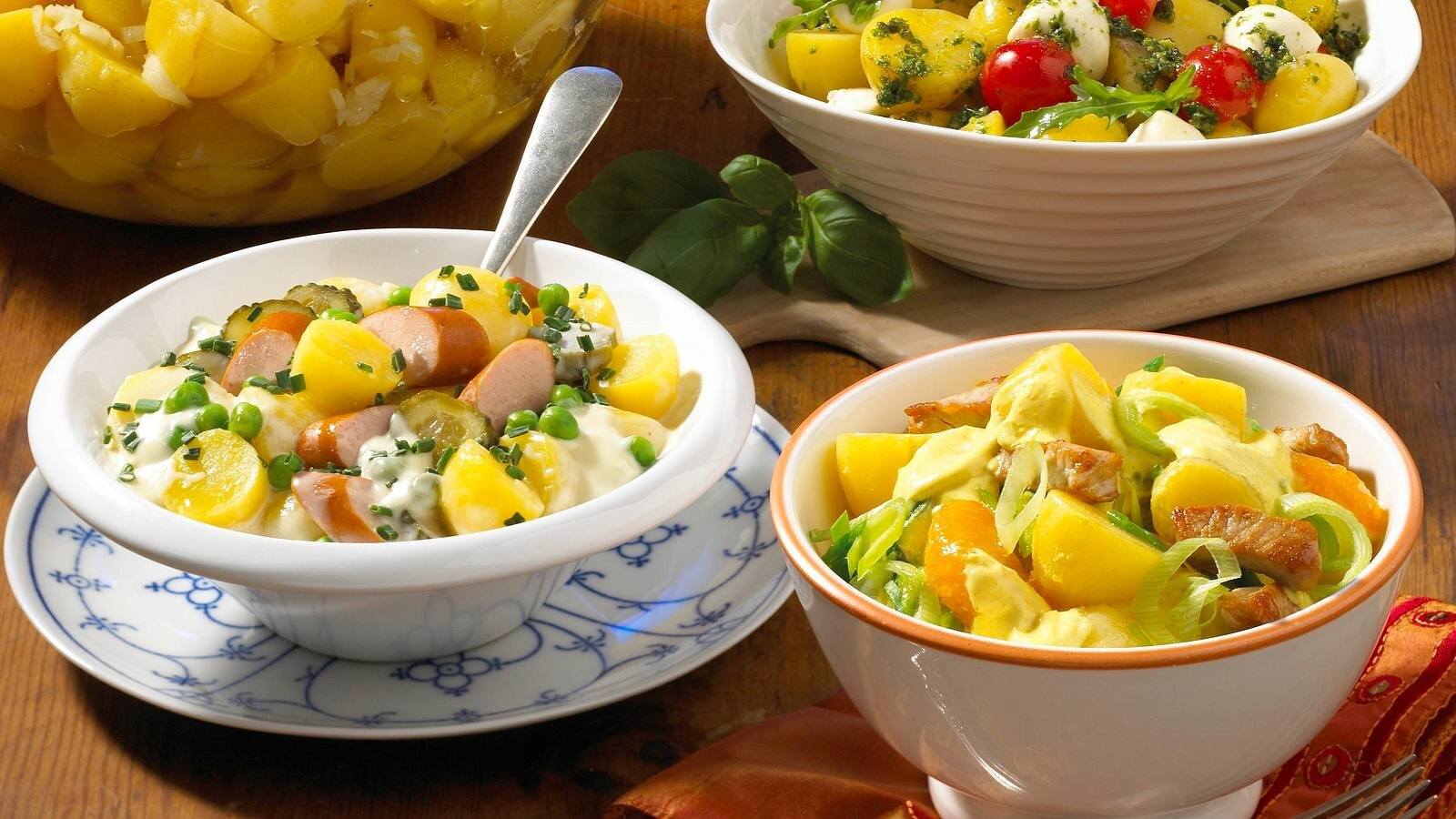
You can also refer to the recipe for German-style potato pancakes (Kartoffelpuffer), how to make German-style braised red cabbage (Rotkohl), and German-style potato salad (Kartoffelsalat) to create a complete German meal.
Regional variations of Sauerbraten
Each region in Germany has its own interpretation of Sauerbraten. The differences mainly lie in the marinade and the sauce preparation.
Rhineland Sauerbraten
This version is considered the original and most famous. It specifically uses crushed Aachener Printen gingerbread to thicken and add a light sweetness to the sauce. In the Rhineland region, horse meat was once used instead of beef, but today beef is more common.
Saxony Sauerbraten
Uses red wine vinegar combined with malt wine and the marinade includes thyme, creating the characteristic forest aroma of East Germany.
Bavaria Sauerbraten
Often uses buttermilk instead of some vinegar in the marinade, resulting in a more tender meat and a milder sour flavor compared to the Rhineland version.
Swabia Sauerbraten
Usually served with Spätzle instead of potato dumplings and the sauce sometimes includes sour cream for a light richness.
Köcher induction cooker – German temperature control for Sauerbraten
Sauerbraten requires precise temperature control at each step:
- When searing the meat: Medium-high heat to achieve an even golden brown without burning.
- When braising the meat: Maintain a stable 80 to 90°C for 3.5 to 4 hours – do not boil vigorously but keep hot enough.
- When making the roux: Switch from medium heat to low heat in seconds to prevent the flour from burning.
- When finishing the sauce: Low, even heat for a smooth sauce without lumps.
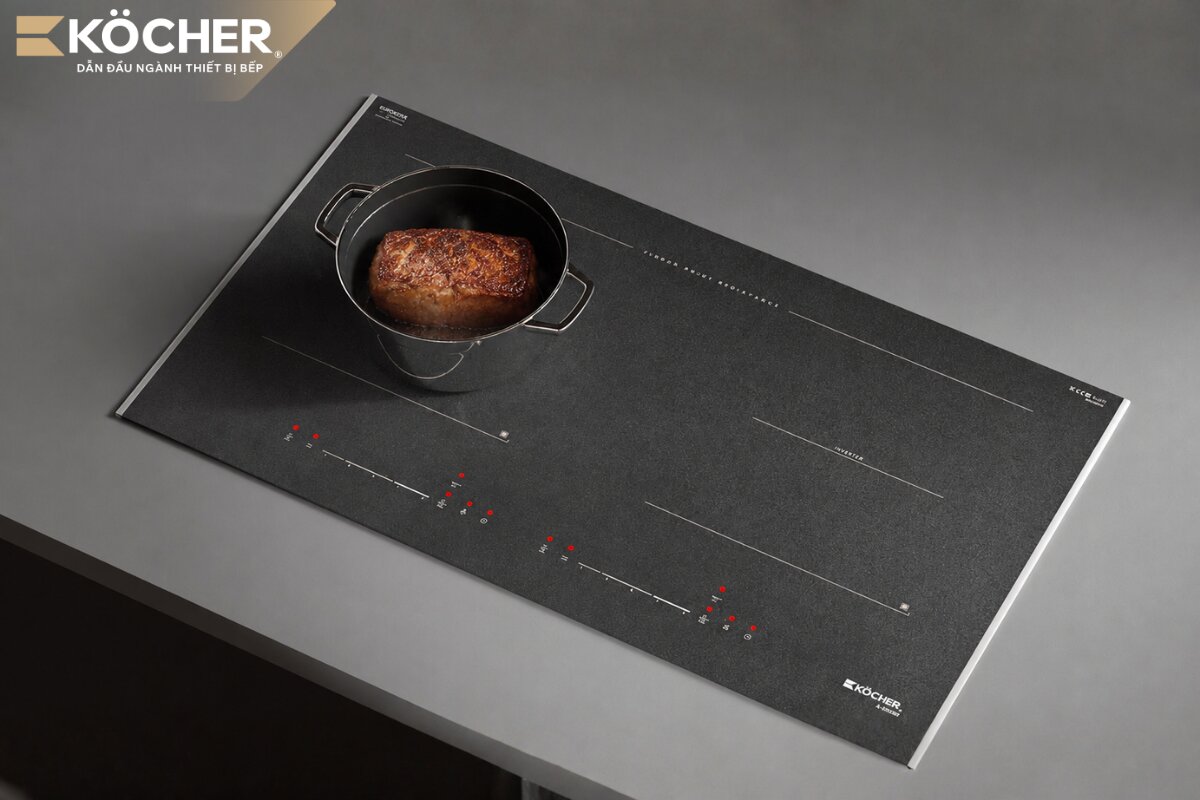
Köcher – the pioneering German technology induction cooker – is designed to meet these exact requirements. Induction technology transfers heat directly to the bottom of the pot instead of through the cooktop surface, allowing:
- Maintain a stable simmer for hours: Sauerbraten needs to braise continuously at 80 to 90°C – not boiling vigorously but not losing heat. The Köcher induction cooker keeps this threshold stable without continuous adjustments, unlike traditional gas stoves.
- Sear on high heat and braise on low heat in the same pot: With the same cast iron pot on Köcher, you can sear at high temperatures to achieve a beautiful Maillard color, then immediately reduce to a simmer without changing stoves or waiting for the pot to cool down.
Germans believe that good cuisine starts with good tools. Köcher brings that philosophy to Vietnamese kitchens.
→ Discover the Köcher induction cookers suitable for your kitchen here
Frequently Asked Questions about Sauerbraten
Can Sauerbraten be made with pork?
Yes. In some regions of Germany, especially Franconia, there is a version of Sauerbraten made from pork. The marinating time is usually shorter, about 2 to 3 days.
Can the strained marinade be discarded?
No. This is the most important part of the recipe. The strained marinade is the flavor base for the Sauerbraten sauce. Discarding the marinade means losing all the flavor layers accumulated over several days.
Can a pressure cooker be used to shorten the braising time?
Yes. With a pressure cooker, the braising time is reduced to about 60 to 70 minutes. However, traditional slow braising for 3 to 4 hours yields a richer sauce and better meat texture.
How long can Sauerbraten be stored?
In the refrigerator, cooked Sauerbraten can last for 3 to 4 days. It is better to store the meat and sauce separately, as reheating will taste better. It can be frozen for up to 3 months.
Sauerbraten is a testament to the philosophy of German cuisine: simple ingredients, solid techniques, sufficient time for flavors to mature, and precise temperature control. Once you make it yourself, you will understand why Germans call this dish the embodiment of Gemütlichkeit – warmth, friendship, and the joy of simple living.
Contact Köcher for advice on choosing the right induction cooker for your kitchen space and cooking habits.
|
For detailed information about the product, please contact:
|