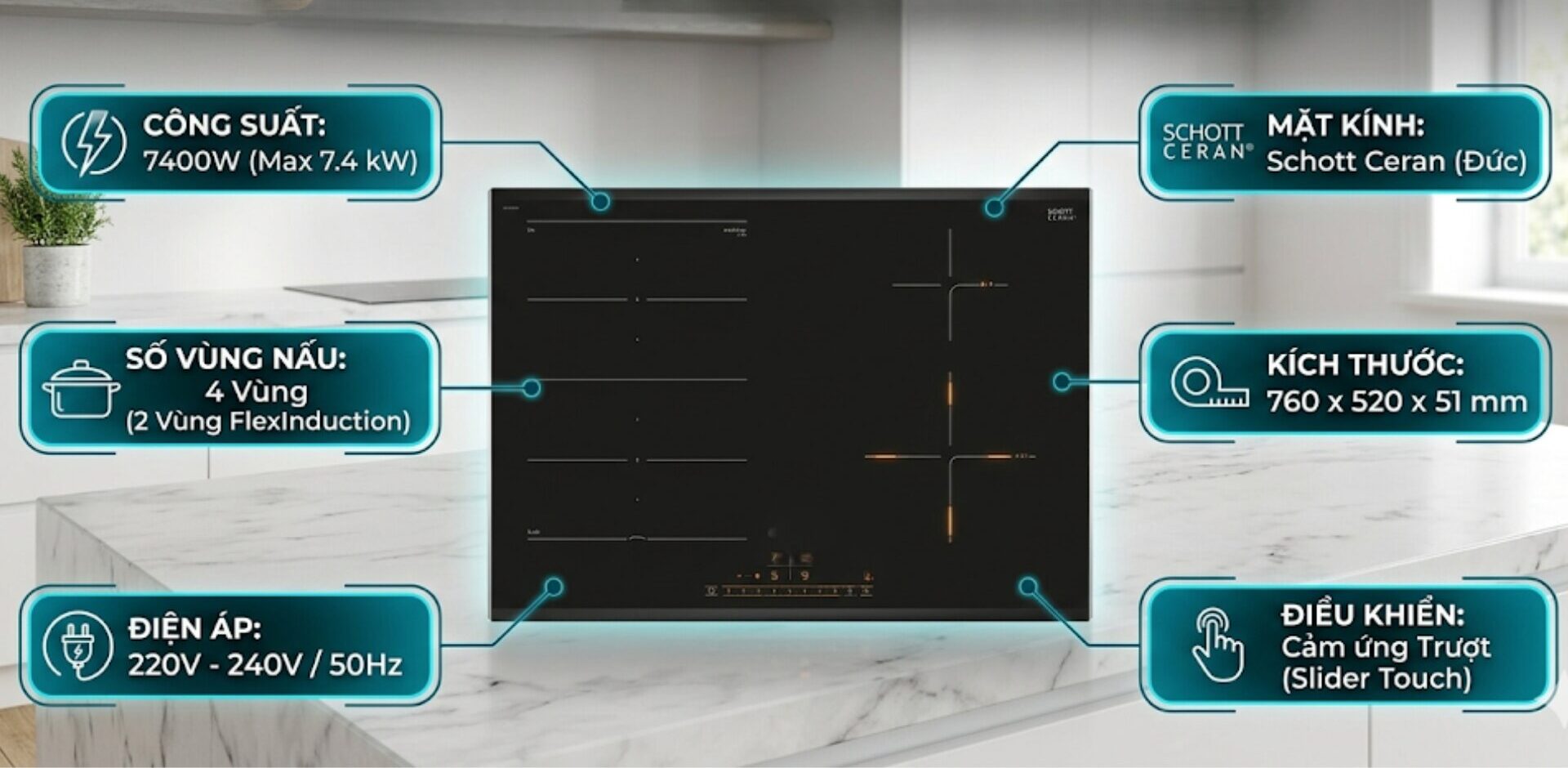
Schott Ceran glass induction hobs are very durable, rated as one of the most durable glass types in the world. This glass stands out for its heat resistance, impact resistance, and scratch resistance. Join us to explore Schott Ceran glass, its origin, detailed advantages and disadvantages, and whether it should be used!
Are Schott Ceran glass induction hobs durable? Which country is this glass from?
Schott Ceran glass is a high-end ceramic glass produced in Germany. This type of glass is notable for its heat resistance of up to 750°C, excellent thermal shock resistance, and can withstand weights of up to 15kg. The special feature of Schott Ceran is its clean manufacturing process, free of heavy metals, and its directional heat transfer capability that maximizes energy savings. Many consumers exploring the high-end kitchen appliance segment often wonder why Schott Ceran glass is used as the standard for imported hobs. The answer lies in the exclusive tempering process that gives Schott Ceran glass superior physical properties, enhancing the lifespan and safety of induction hobs:
Maximum heat and thermal shock resistance
The stable heat resistance at 750°C and thermal shock resistance of up to 800°C. The clearest evidence is that the glass does not crack even when ice water is poured directly onto the hob while cooking at high power.
Superior impact resistance and scratch resistance
Practical tests show that the glass can withstand impact loads from 1000 – 4000 Mpa. The high surface hardness minimizes scratches from metal pots and pans, maintaining long-lasting shine. The glass has undergone strict testing (dropping a heavy steel ball) and can withstand large impact forces, much higher than standard norms.
Directional heat transfer efficiency
The thermal expansion coefficient is nearly zero, allowing 100% of the thermal energy to be transferred directly to the bottom of the pot. This keeps the area around the hob always below 50°C, optimizing energy use and ensuring absolute safety.
Actual durability of over 10 years
The crystalline ceramic structure ensures that the product does not deform or age. In fact, high-end hobs using Schott Ceran typically have an average lifespan of 10 – 15 years if used and cleaned properly.
Luxurious aesthetics and safety
The glass surface has high transparency, free from heavy metals such as Arsenic or Antimony (certified for international environmental safety), providing a luxurious look and peace of mind for users.
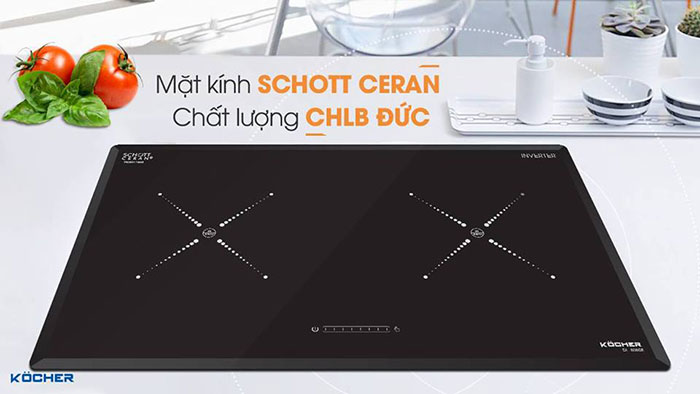 Schott Ceran glass induction hobs have high heat resistance and durability
However, to possess these advantages, users will need to invest a high cost. Induction hobs using Schott Ceran glass often have a quite high price, not suitable for the mass market segment. Additionally, during use, if users accidentally drop a heavy object directly onto the cooking area, the risk of the induction hob glass cracking can still occur. At that time, the cost of replacing genuine glass components from Germany will also be higher than regular glass.
Comparing Schott Ceran glass with Ceramic, EuroKera, and other glass types
To have the most objective view, let’s compare based on actual technical criteria between Schott Ceran and popular competitors today:
- Compared to regular Ceramic glass: This is the most common type of glass. While Schott Ceran can withstand temperatures up to 750°C – 800°C, Ceramic glass usually can only withstand below 500°C, easily cracking when cooking at high power for long periods and having significantly poorer surface shine.
- Compared to EuroKera (K+ – France): This is a direct competitor of Schott Ceran. In terms of thermal and impact resistance, both are comparable (~700°C – 750°C). However, Schott Ceran is rated slightly higher in transparency and directional heat transfer capability, while EuroKera has an advantage in color and pattern variety.
- Compared to Kanger glass (K – China): This type of glass is popular in mid-range hobs. Kanger can withstand temperatures of about 500°C – 600°C. Although it is cheaper, its scratch resistance and thermal shock resistance are inferior to Schott Ceran, and after 2-3 years of use, the glass surface easily becomes dull or shows small cracks.
- Compared to Crystallite glass (Crystal): This type of glass has very high gloss but is brittle. Its heat resistance is only average and is very prone to cracking if subjected to strong impacts from pots or kitchen utensils, incomparable to the mechanical durability reaching 1000 – 4000 Mpa of Schott Ceran.
| Type of glass | Origin | Heat resistance | Actual durability | Segment |
| Schott Ceran | Germany | 750°C – 800°C | Over 10 years | Premium |
| EuroKera (K+) | France | ~700°C | 7 – 10 years | Premium |
| Kanger (K) | China | 500°C – 600°C | 3 – 5 years | Mid-range |
| Crystallite | Common | < 500°C | 1 – 3 years | Cheap |
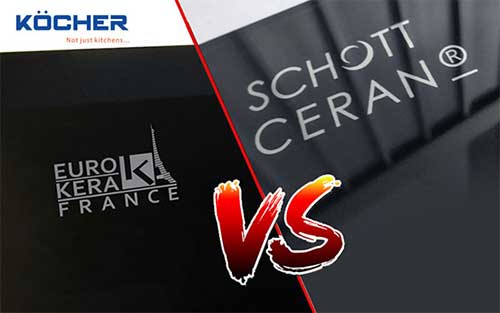 Schott Ceran induction hob glass and Eurokera glass are equivalent in heat and impact resistance
Owning a Schott Ceran glass induction hob from Germany not only makes the kitchen more luxurious but also provides absolute peace of mind for the cook thanks to smart directional heat transfer technology. If you are looking for a durable cooking solution that stands the test of time, check out the top durable Schott Ceran glass products that are officially distributed in Vietnam. Köcher is proud to be a pioneer in Vietnam bringing German technology into induction hob products. As the first unit to collaborate in research, production, and distribution with Schott Ceran, Kocher proudly invites you to experience our premium induction hob line. The Kocher induction hobs proudly use 100% genuine Schott Ceran glass from Germany, combined with E.G.O components to provide optimal cooking performance and timeless durability.