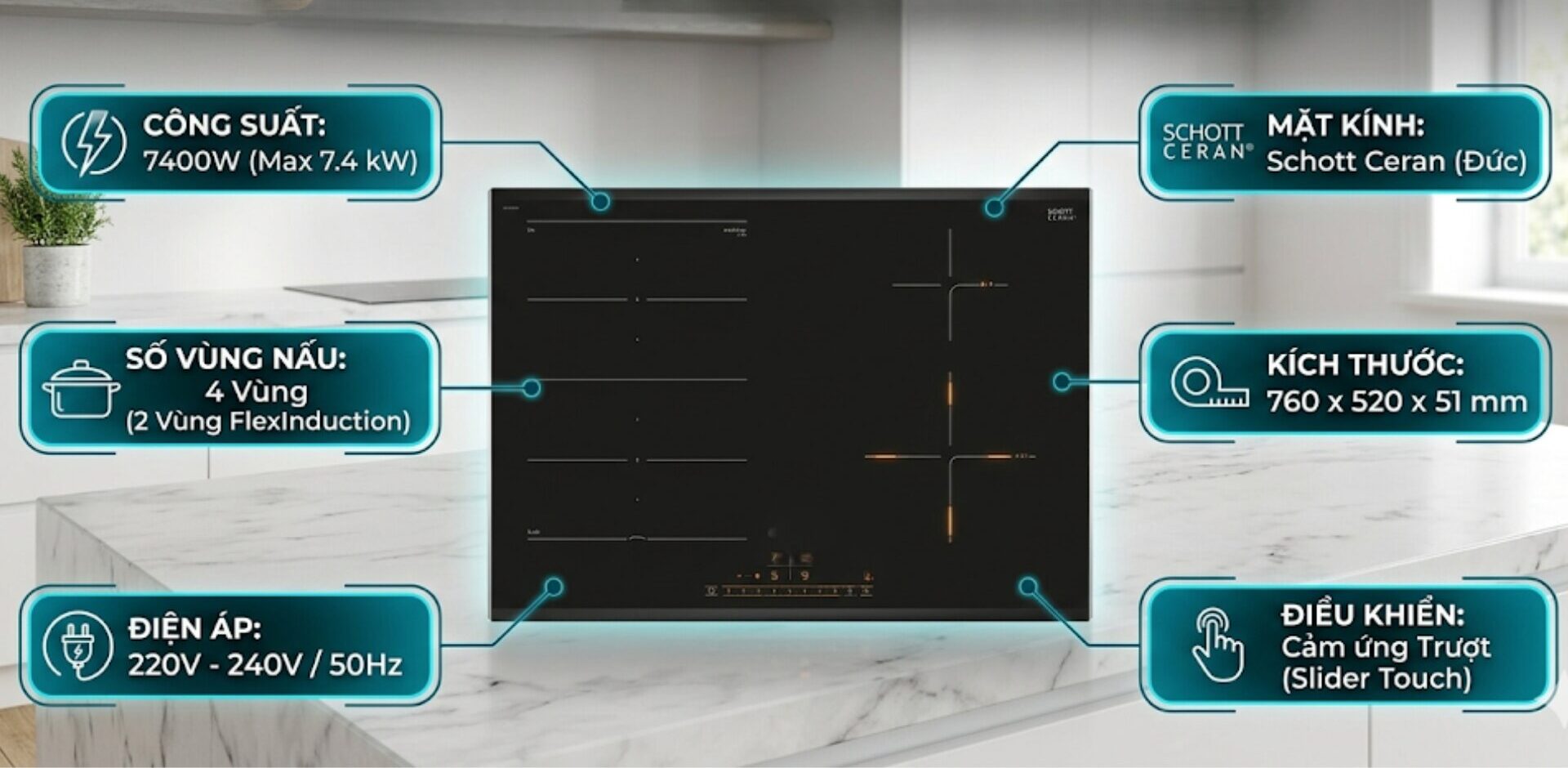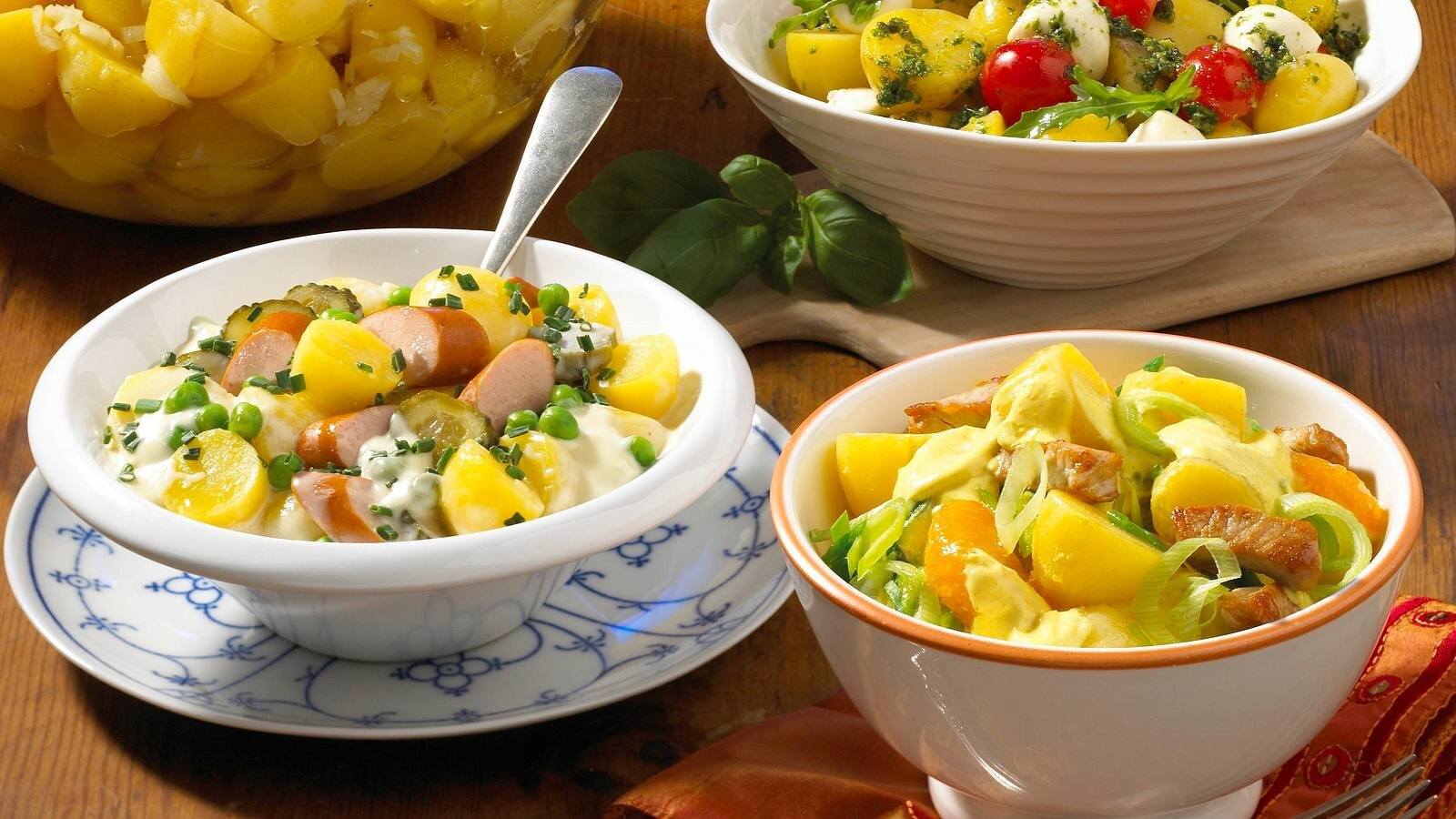
The temperature of the induction hob is not the number displayed directly on the control panel. What you see is power level (W), not degrees Celsius. This is exactly why many people set the wrong temperature when frying, simmering, or boiling, leading to food being burnt or unevenly cooked. The article below provides a detailed conversion table from the control level to the corresponding power and temperature, along with instructions for controlling the temperature of the induction hob for each cooking mode.
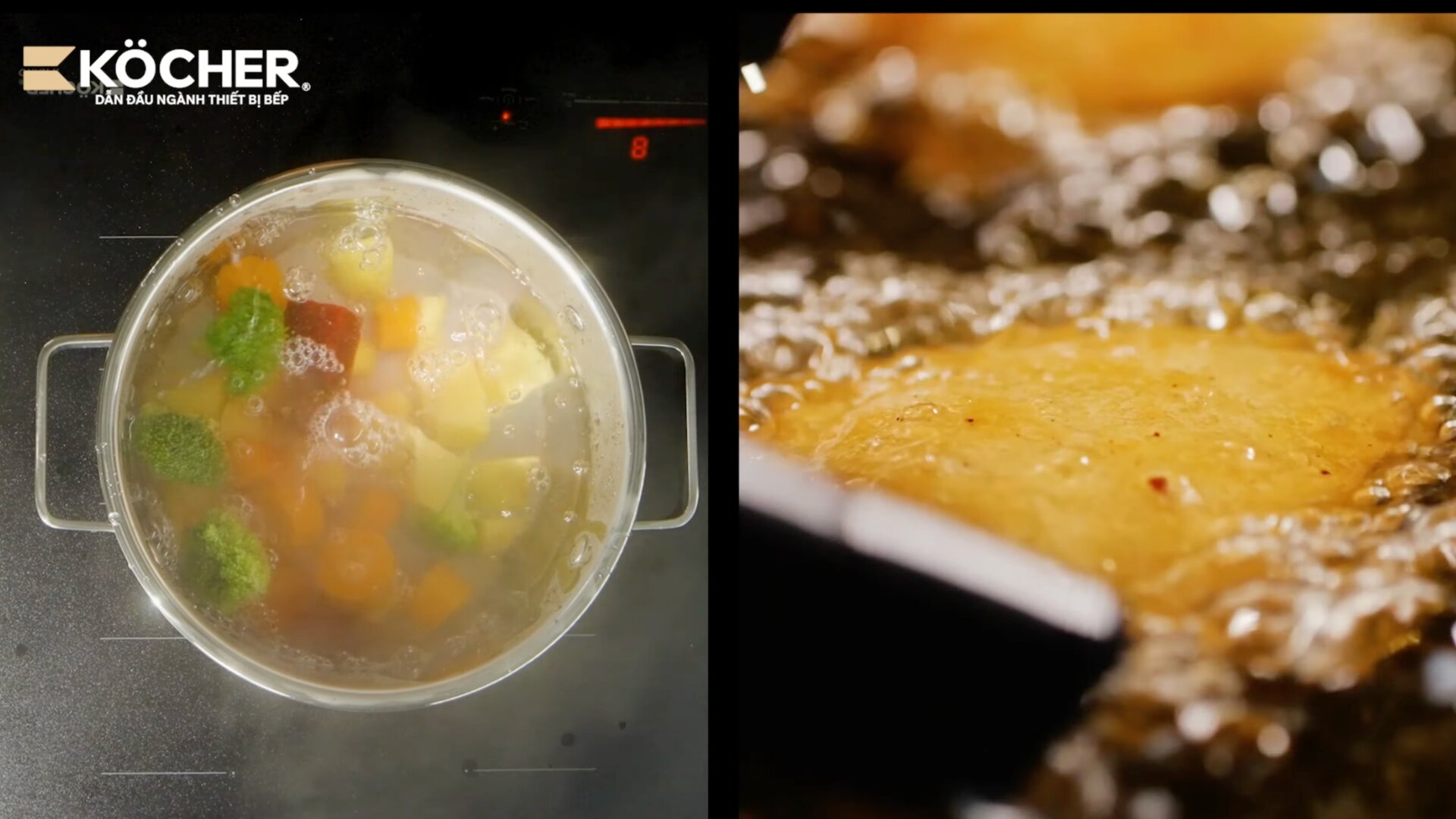
Discover the Köcher induction hobs at kocher.vn – designed with a 100% pure copper heating element, accurately adjusting the induction hob temperature according to each W level, X-Nano glass surface withstands temperatures up to 750°C. Genuine products, officially warranted in Vietnam.
Induction hob temperature table by control level, power, temperature
The induction hob controls temperature indirectly: the induction coil creates a magnetic field, activating a vortex current in the bottom of the pot, thus generating heat right at the bottom of the pot rather than on the glass surface. Therefore, the actual temperature of the induction hob depends on the power (W) set, the type of pot, and the amount of food inside.
The table below is a common reference specification:
| Control Level | Power (W) | Estimated Temperature |
|---|---|---|
| Level 1 | 200 W | 60 – 80°C |
| Level 2 | 400 W | 80 – 100°C |
| Level 3 | 500 W | 100 – 120°C |
| Level 4 | 900 W | 120 – 150°C |
| Level 5 | 1,000 W | 150 – 170°C |
| Level 6 | 1,400 W | 170 – 190°C |
| Level 7 | 1,500 W | 190 – 210°C |
| Level 8 | 1,800 W | 210 – 230°C |
| Level 9 | 2,000 W | 230 – 240°C |
| Booster | >2,200 W | >240°C |
Specifically:
- Low temperature range (Level 1 – 2): 200 – 400 W: The induction hob temperature fluctuates around 60 – 100°C, just enough to keep cooked food warm, to keep thin porridge for children, or to warm milk without boiling over.
- Medium-low temperature range (Level 3 – 4): 500 – 900 W: The induction hob temperature in this range is about 100 – 150°C, ideal for simmering meat, braising fish, cooking soup, or steaming.
- Medium temperature range (Level 5 – 6): 1,000 – 1,400 W: This is the frying temperature zone. The induction hob reaches 150 – 190°C, suitable for deep frying (chicken, fish, potatoes) or stir-frying vegetables to retain their green color. Note: cooking oil usually reaches its smoke point at around 180 – 230°C depending on the type, so choose the oil suitable for the temperature used. For example, sunflower oil smokes at ~227°C, extra virgin olive oil at ~191°C.
- High temperature range (Level 7 – 8): 1,500 – 1,800 W: The induction hob temperature reaches 190 – 230°C, used for high-heat stir-frying, quick boiling, or bringing a large pot of water to a boil.
- Maximum temperature range (Level 9 / Booster): 2,000 – 2,200 W: The Booster mode pushes the level above 2,200 W (some models like X-Nano 9 can reach up to 3500W) equivalent to the induction hob temperature exceeding 240°C at the bottom of an empty pot. This function is used to shorten the initial boiling time. Do not maintain Booster for more than 10 continuous minutes to protect the heating element.
Technical note: The induction hob temperature in the table is the estimated temperature at the bottom of a standard 3mm thick stainless steel pot, without food inside. When there is food or water, the actual temperature is lower by 20 – 40°C due to heat absorption.
How to accurately adjust the induction hob temperature
Basic operations
Step 1: Place a pot with a magnetic bottom correctly centered on the cooking zone. A pot placed incorrectly or a pot that is too small or too large compared to the cooking zone can reduce thermal efficiency by 15 – 20%, or even prevent the hob from starting.
Step 2: Press and hold the Power button for about 1 – 2 seconds to start the hob. The hob will beep and the LED light of the cooking zone will illuminate to confirm.
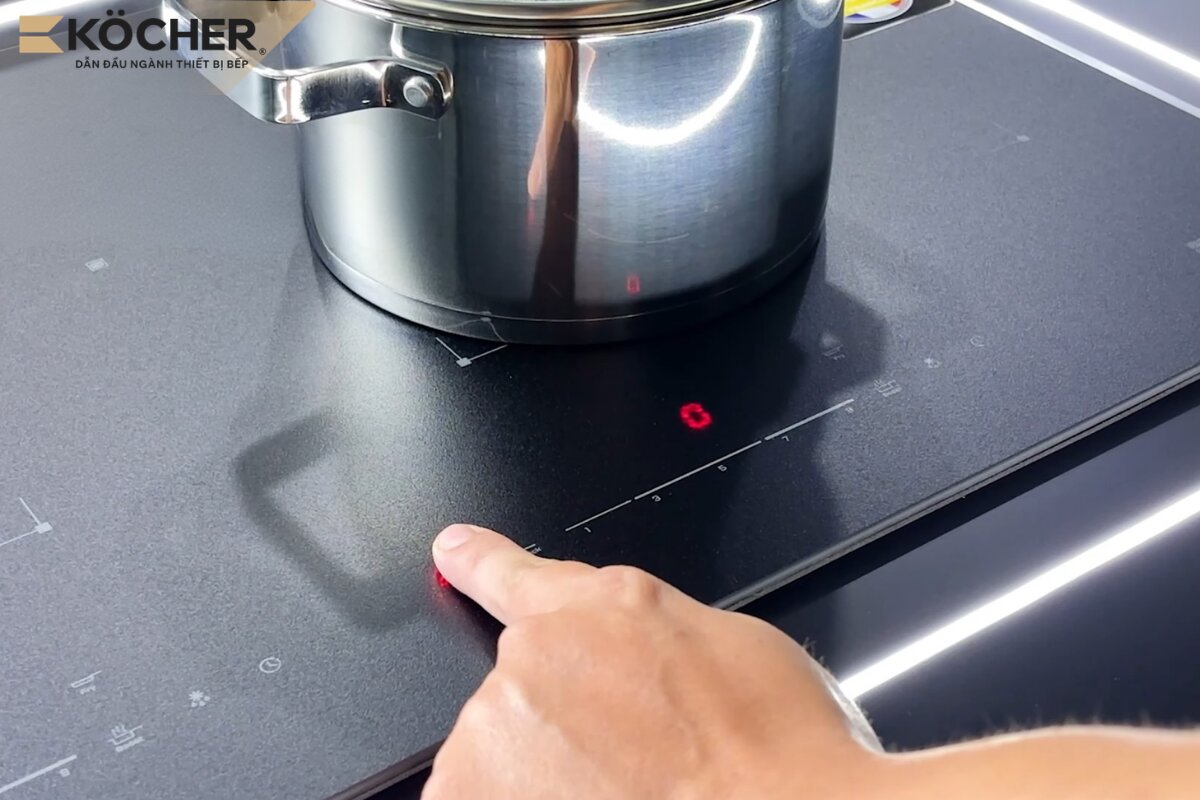
Step 3: If using a double or triple hob, select the corresponding cooking zone before adjusting the temperature to avoid confusion.
Step 4: Set the temperature according to one of the methods in section 2.2 below.
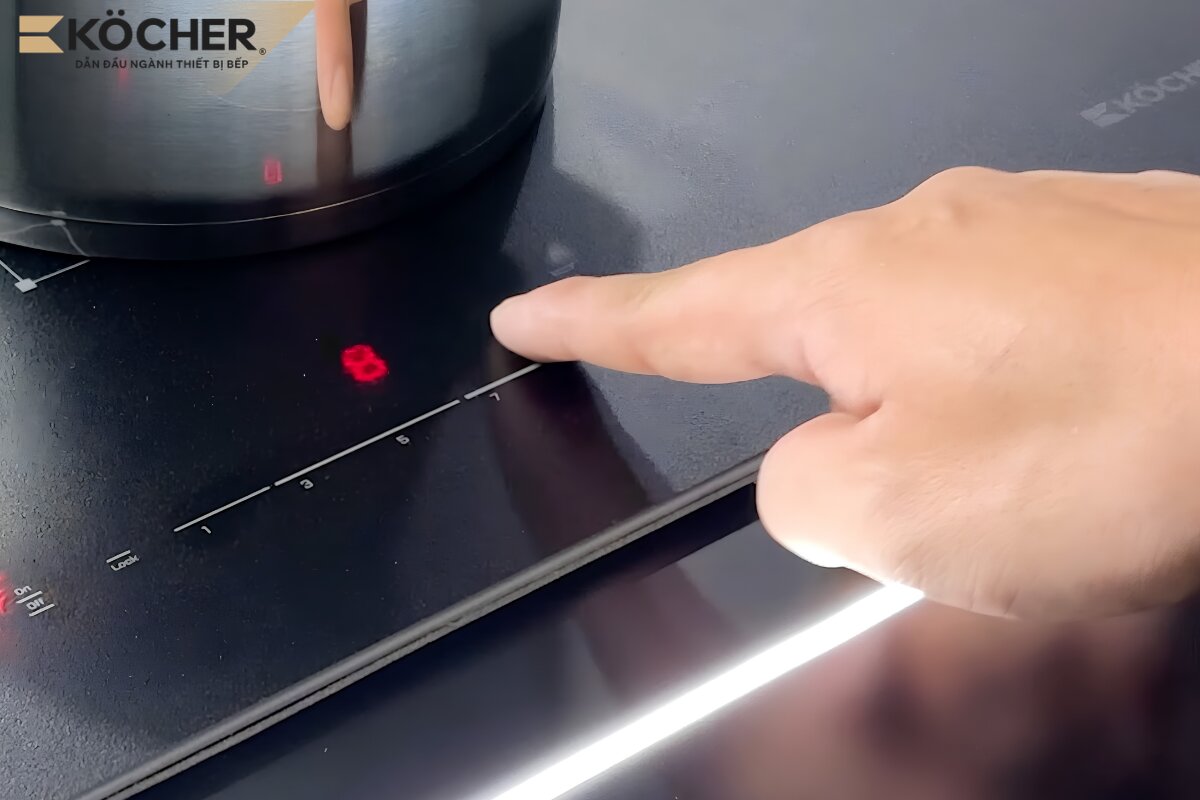
Step 5: Monitor and adjust during cooking. End by pressing the Power button to turn off; the hob will display a residual heat warning (indicated by “H”) until the glass surface cools down to below 50°C.
Ways to adjust the induction hob temperature according to hob design
Depending on the product line, induction hobs have different temperature control methods:
Button type (+ / −) or numerical order: Press the (+) button repeatedly to increase or (−) to decrease the induction hob temperature by one level. Some Köcher hobs have a number range from 1 to 9 displayed directly, you just need to tap the desired number to jump straight to that temperature level without pressing multiple times.
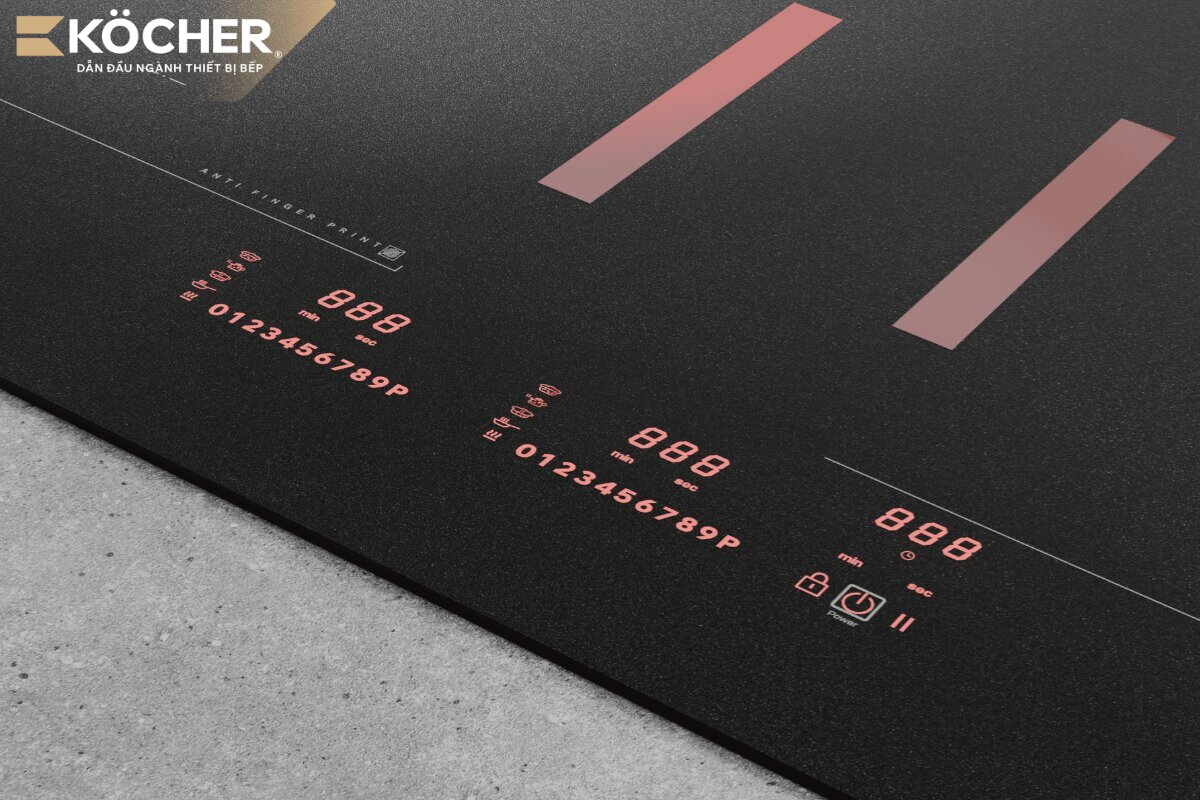
Slider type: Place your finger and gently swipe on the horizontal touch bar. Swipe to the right (or up) to increase the induction hob temperature, and vice versa to decrease. You can tap directly on the end point of the slider to reach the highest temperature level immediately, which is very convenient when you need a quick Booster at the start of cooking.
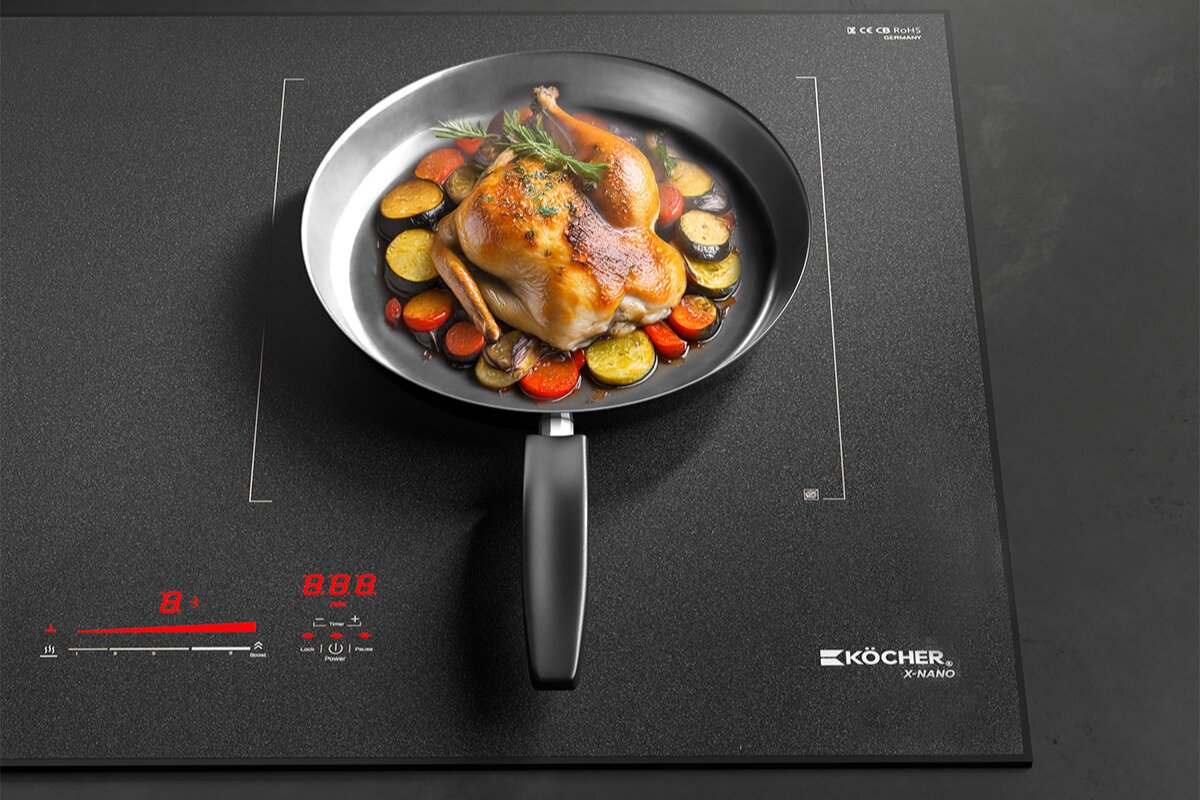 X-Nano 8 Plus induction hob with smooth Slider touch
Mechanical / Magnetic Knob control: Rotate the knob clockwise to increase the induction hob temperature, counterclockwise to decrease. This design provides clear tactile feedback, especially suitable when your hands are busy or when looking at the pot instead of the control panel.
Control via App or Voice: Open the app on your phone, select the cooking zone, and slide the power slider on the app interface. Or command by voice: “Lower the hob power to level 3”. This feature is available on some smart hob models integrated with control apps.
Tips for accurately controlling the induction hob temperature
Setting the correct level on the control panel is not enough, as the actual temperature of the induction hob also depends on the quality of the components and cooking utensils. Below are four key factors to help control the temperature more accurately.
Prioritize induction hobs with 100% pure copper heating elements
The heating element (induction coil) made from pure copper conducts electricity better than aluminum alloys or mixed copper by about 40 – 60%, meaning the generated magnetic field is more uniform and stronger. As a result, the temperature of the induction hob is evenly distributed across the entire bottom of the pot, without localized hot spots that can burn food in the middle of the pot.
Use quality induction pots
Good pots for induction hobs need to meet two criteria: absolutely flat bottom (warping < 0.5mm) and a magnetic steel layer at least 3 – 4mm thick. Warped pots reduce heat transfer efficiency, and thin pots are prone to warping, leading to uneven heat distribution.
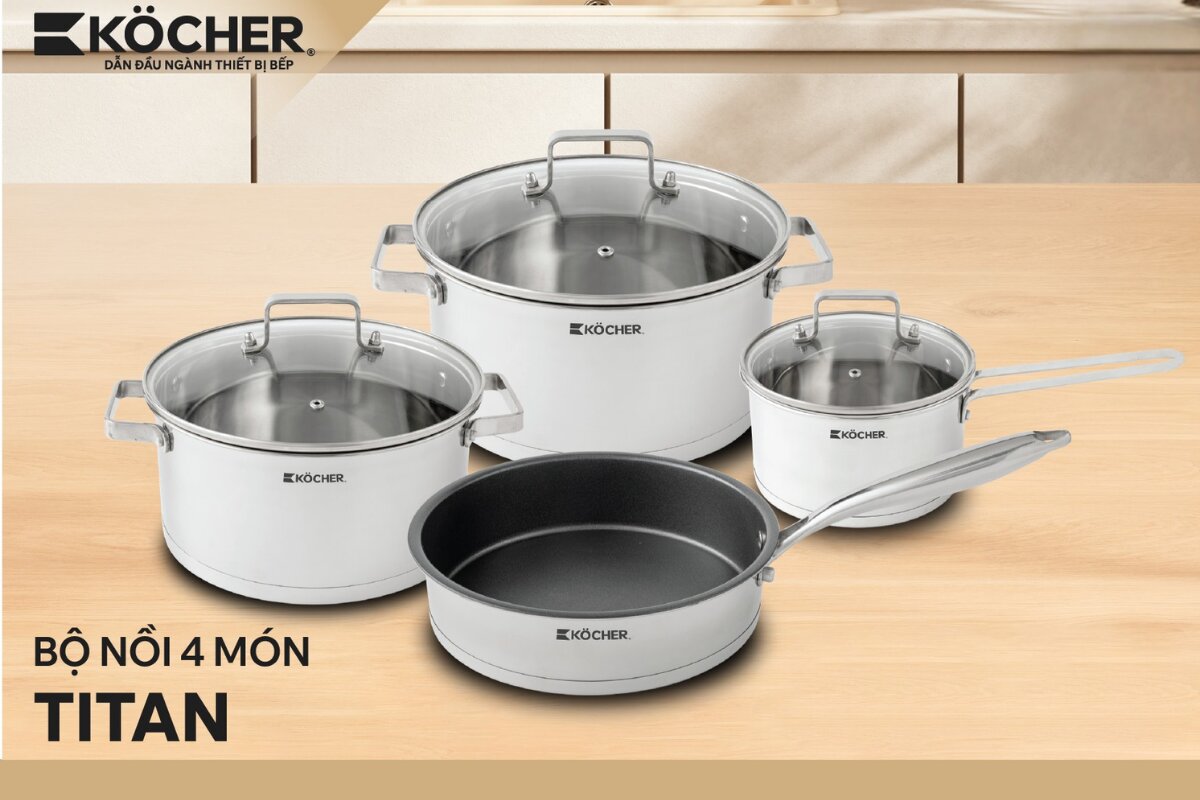 Using quality induction pots with flat bottoms to optimize magnetic field transmission
Use the available cooking modes on the hob
Instead of manually adjusting the induction hob temperature, the available cooking modes (Booster, Fry, Defrost, Keep Warm…) on Köcher hobs have been programmed with automatic temperature control cycles, meaning the hob automatically adjusts power within the optimal range for each task.
Use a thermometer
An infrared thermometer (remote) or a probe thermometer inserted into oil is a tool that allows you to know exactly the actual temperature of the induction hob in the pot. This tool is particularly useful when deep frying, making candy/caramel, or cooking sous-vide.
Common infrared thermometers cost 150,000 – 300,000 VND, accurately measuring the surface of oil or water to ± 2°C.
Frequently asked questions about induction hob temperature
Is the temperature and power of the induction hob the same?
No. These are two different quantities. Power (W) is the amount of electrical energy that the induction hob consumes in one second. This is the number you see on the control panel, usually from 200 W to 2,200 W. Temperature (°C) is the actual heat level at the bottom of the pot, resulting from that power affecting the pot material and the food inside.
What is the highest temperature of the induction hob?
The Booster mode can push the power to the maximum, with the induction hob temperature estimated to exceed 240°C at the bottom of the pot when empty. In practice, when cooking, the peak temperature is usually around 220 – 230°C because food and water absorb some heat.
Should the highest temperature be used continuously?
No. The Booster mode is designed for quick start: to initially boil water, quickly raise the oil temperature before frying. You should reduce to level 7 – 8 after about 10 minutes. Maintaining Booster for too long can overload the heating element, shorten the lifespan of the coil, and increase the risk of oil splatter and water overflow.
The temperature of the induction hob is not a parameter that can be read directly from the control panel. You need to understand the relationship between the control level, power (W), and estimated temperature to cook the right dish.
If you need advice on choosing an induction hob suitable for your kitchen space and cooking habits, contact Köcher now at kocher.vn. The consulting team is ready to assist in comparing induction hob temperature specifications, power, and selecting the most suitable model for you.
|
Köcher induction hobs pioneer German technology – For detailed product information, please contact:
|