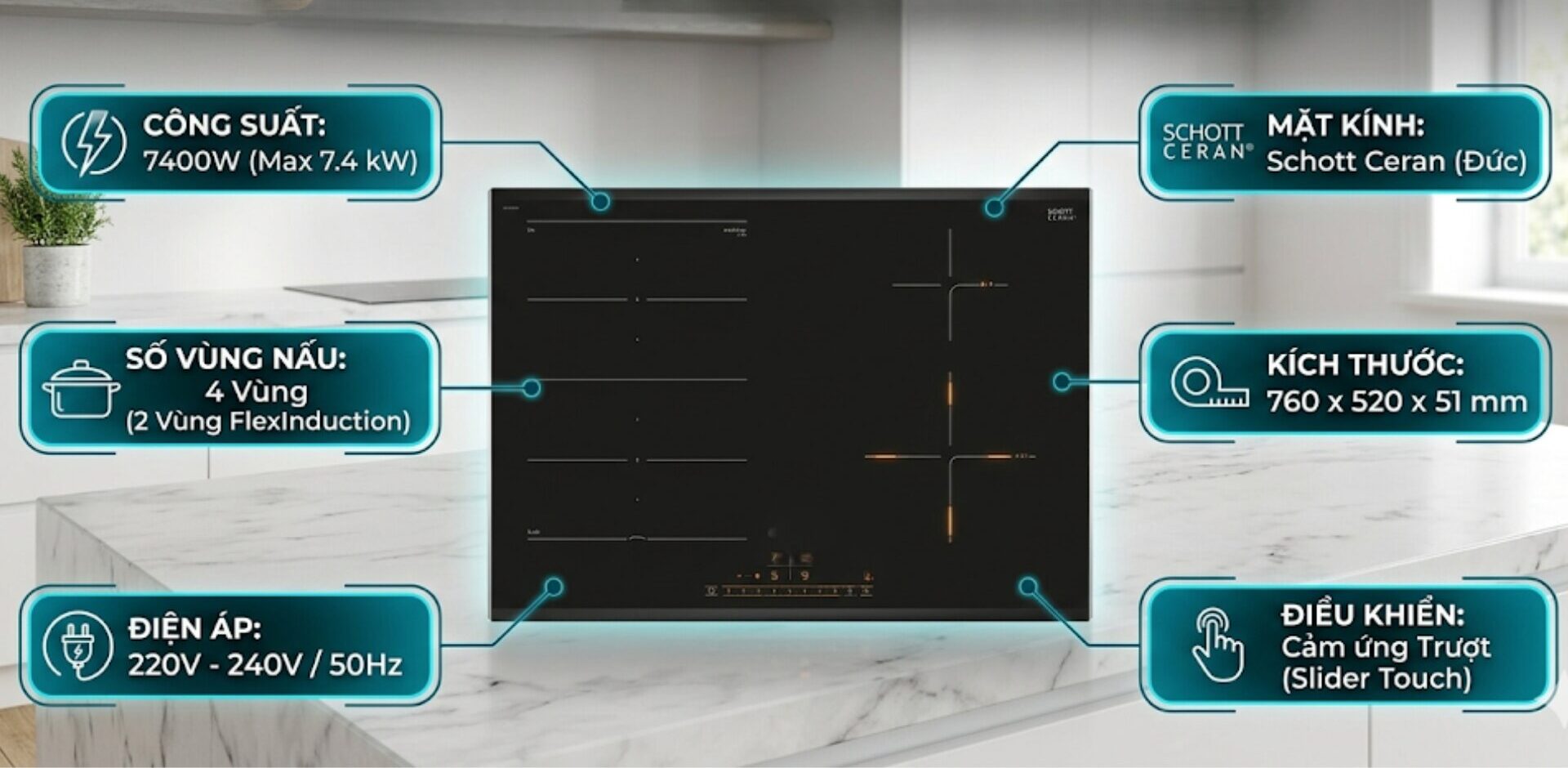
Built-in induction cooktop dimensions are a crucial factor to determine before designing kitchen cabinets or replacing a new cooktop. A properly fitting cooktop not only ensures aesthetics but also directly relates to the durability of components and operational safety. This article will summarize the standard dimensions of built-in induction cooktops currently available and guide you on how to measure the stone cut accurately to create a professional kitchen space.
Summary of popular built-in induction cooktop dimensions on the market
Currently, built-in induction cooktop dimensions are extremely diverse, designed based on the number of cooking zones and user habits. Typically, the glass surface dimensions will be larger than the stone cut dimensions by 2 – 3cm on each side (for cooktops with a larger belly) and from 20 – 35cm (for high-end cooktops with a smaller, more compact belly) to create a “ledge” that supports the entire cooktop body on the stone surface.
Below is a table of standard dimension specifications (Unit: mm):
| Number of cooking zones | Width (mm) | Depth (mm) | Height/ Thickness (mm) | Stone cut dimensions (L x W) | Application |
| 2 cooking zones (Double cooktop) | 700 – 750 | 400 – 450 | 40 – 60 | 670 – 710 x 370 – 410 | Family of 3 – 4 people (Most popular) |
| 3 cooking zones (Square) | 580 – 620 | 510 – 530 | 50 – 65 | 480 – 560 x 490 – 500 | Family of 5+ people, spacious area |
| 3 cooking zones (Rectangular) | 750 – 860 | 430 – 450 | 50 – 65 | 710 – 800 x 380 – 410 | Large family, long kitchen table |
| 4 cooking zones | 590 – 900 | 520 – 600 | 50 – 70 | 560 – 850 x 490 – 560 | Restaurants, Penthouse, large families |
Explanation of dimension specifications:
- Glass surface dimensions: Calculated based on the optimal distance between cooking pots to avoid collisions. Nowadays, the trend is for wider glass surfaces but with a thinner and more compact base.
- Cooktop belly dimensions: This area determines the stone cut dimensions. High-end cooktops like Köcher have optimized components, allowing for a more compact belly, reducing the stone cut area without affecting power.
- Heat dissipation standards: The stone cut dimensions always have a small margin of error to create a gap for air circulation, cooling the circuit board.
In addition to considering dimensions, to choose the most durable and suitable product for your family, you can refer to the article about which built-in induction cooktop is good today.
Dimensions of double built-in induction cooktops (2 cooking zones) – The most popular product
Double induction cooktops are the choice of over 80% of Vietnamese families. The most popular models today typically have a glass surface size of about 730 x 420 mm and corresponding stone cut dimensions of about 690 x 390 mm (+/- depending on the design).
This size is considered the “golden ratio” as it fits most standard kitchen countertop widths in Vietnam. Notably, this size is quite similar to the cutout of old double gas cooktops. This is a significant advantage that allows users to easily upgrade to an induction cooktop without needing to modify the stone countertop too much. To be more proactive in designing cabinets, you should check out the summary of double built-in induction cooktop dimensions to compare the differences between beveled edge and rounded edge cooktops.
Some typical products from Köcher:
| Model | Glass surface dimensions (mm) | Stone cut dimensions (mm) | Outstanding features |
| DI-608SE | 730 x 430 | 695 x 395 | Keramik glass with beveled edges, luxurious Aluminium frame |
| DI-806GE02 | 750 x 450 | 685 x 385 | Schott Ceran glass (Germany), high-quality E.G.O circuit board |
| X-Nano 8 | 730 x 420 | 680 x 370 | X-Nano scratch-resistant glass 5 times, E.G.O circuit board (Germany) |
Dimensions of built-in induction cooktops with three cooking zones
If your family has many members or needs to cook large quantities of food, a 3-zone induction cooktop is the optimal solution. In fact, the dimensions of many 3-zone cooktops are only slightly larger than double cooktops, significantly saving stone cut area.
- Square shape: Glass surface dimensions from 580mm – 620mm. Stone cut dimensions range from 480x540mm to 560x490mm depending on the model. This design helps save countertop length.
- Rectangular shape: Glass surface dimensions are about 700mm – 850mm, depth about 400mm – 450mm. Common stone cut dimensions are 680 – 800 x 380 – 410 mm.
In fact, many modern rectangular 3-zone cooktops have stone cut dimensions only slightly larger than double cooktops, allowing users to upgrade easily without worrying about breaking the old cabinet structure.
Below is a table of popular dimensions for built-in double 3-zone induction cooktops:
| Model | Dimensions of double built-in induction cooktop with 3 cooking zones | Stone cut dimensions | Outstanding features |
| DI-855GE | 750 x 450 mm | 710 x 410 mm | Premium Schott Ceran glass from Germany, G5 Smart Inverter technology |
Dimensions of built-in induction cooktops with four cooking zones
4-zone induction cooktops are mainly European imported models, serving very spacious kitchen spaces. In Vietnam, this line is less popular due to the typically compact cooking sizes of Vietnamese cooktops.
The most common dimensions for 4-zone cooktops are usually around 550 x 600 mm or larger. These products are very difficult to calculate standard stone cut dimensions, requiring skilled technicians to measure and install accurately.
Dimensions of single cooking zone induction cooktops (Single cooktop)
Single cooktops typically have glass surface dimensions of about 280mm x 300mm – 350mm x 400mm. Most single cooktops today are not designed for built-in installation due to their convenience (easy to move). However, some high-end induction cooktops still support built-in installation for studio apartments with extremely limited space.
Dimensions of built-in induction cooktops by brand: The difference from design philosophy
Each brand on the market has its own standard dimensions based on the components used and the target customer group. Understanding this characteristic helps you choose products that fit your existing kitchen cabinet space:
European brands like Bosch, Teka, Hafele often strictly adhere to European kitchen cabinet module standards. The common feature is that 3 – 4 zone cooktops usually have a square shape (glass surface dimensions of about 590x520mm), requiring the countertop to have a large depth for accurate built-in installation.
Köcher’s difference lies in its understanding of Vietnamese kitchen spaces. Köcher products are designed to be good replacements for old gas cooktops without requiring too much intervention in the stone countertop infrastructure. At the same time, if you want to install new, the product specifications are well compatible with the dimensions of kitchen countertops and cabinets in families.
Thanks to using high-quality components from strategic partner E.G.O (Germany), Köcher’s circuit boards are extremely compact. This helps the cooktop belly take up less space, not only making stone cutting easier but also freeing up space under the cabinet. To avoid unnecessary mistakes during construction, do not overlook the Notes when buying induction cooktops to know how to check the machine specifications carefully before payment.
 The integration of E.G.O standard components allows the cooktop to ensure a compact size, quick heat dissipation, and increase component lifespan up to 15 years
Technical standards related to built-in induction cooktop dimensions
To ensure the cooktop operates stably, dissipates heat well, and protects the structure of the stone countertop, you need to strictly adhere to the following safety distance technical standards:
Distance to the wall
The distance from the edges of the cooktop to surrounding objects must be at least 50mm (5cm). This specification ensures a safe thermal expansion space and prevents heat accumulation that could damage the wall surface around the cooking area.
Distance to surrounding objects
To maintain the structural integrity of the stone countertop and kitchen cabinet, the edge of the cutout must be at least 65mm (6.5cm) away from the edges of the cabinet or the outer edge of the stone countertop. This distance helps the countertop withstand large loads from cooking pots without cracking at weak points along the cut line.
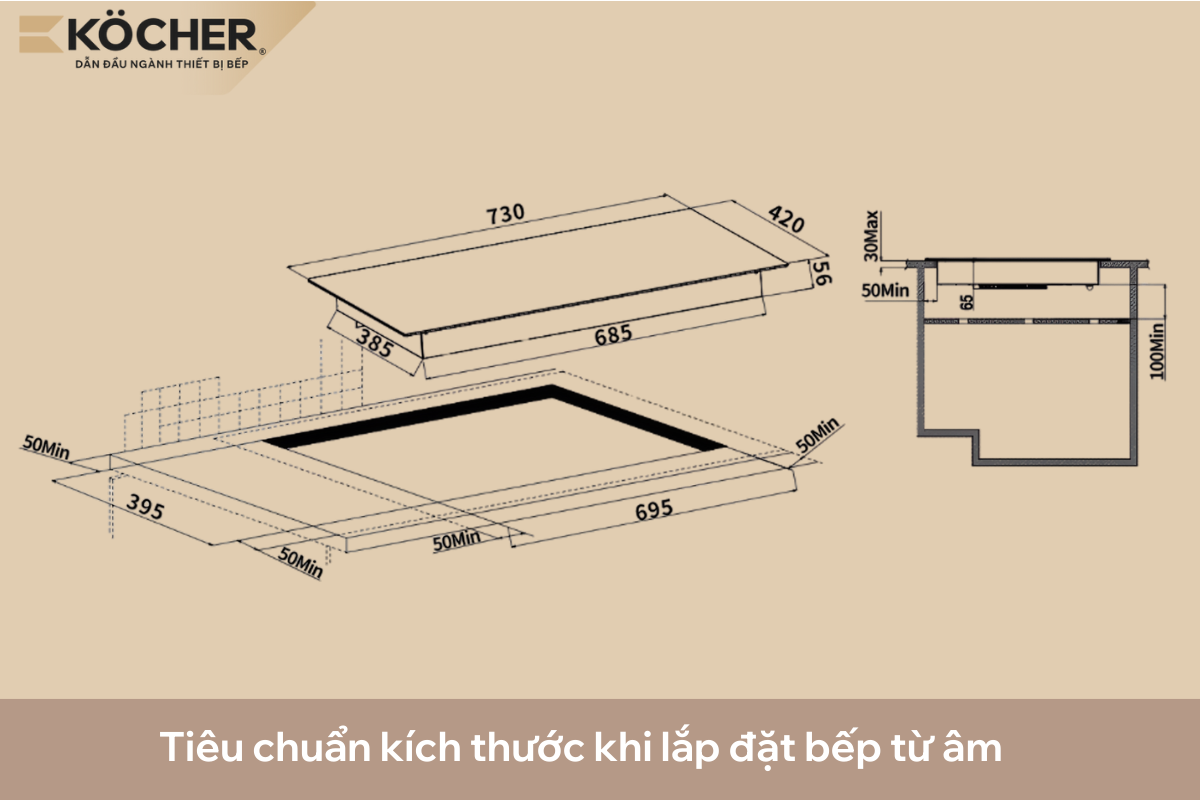 Distance standards when installing built-in induction cooktops
Thermal ventilation gap
The minimum distance between the cooktop and items below (drawers, cabinets) must be 20mm (2cm). This gap creates the necessary ventilation space for the cooling fan to draw fresh air to effectively cool the circuit board during cooking.
Stone cut error
The stone cutting dimensions must be executed accurately according to the technical drawing specifications of each specific cooktop model. The maximum allowable error is only about 1 – 2mm. Cutting too wide will weaken the glass surface support, causing it to crack, while cutting too narrow will cause the cooktop belly to be pressed, leading to overheating errors.
Frequently asked questions about built-in induction cooktop dimensions
Below are answers to the most common questions users have when learning about built-in induction cooktop installation dimensions, helping you be more proactive in designing and constructing your kitchen space.
Can a cooktop be installed if the stone cut dimensions are incorrect?
Incorrect stone cut dimensions can be addressed, but it will affect aesthetics or durability if not reinforced properly. If the cutout is too wide, technicians need to use support bars or specialized patch stones; conversely, if the cutout is too narrow, stone workers can use grinders to widen the cutout to fit the cooktop belly.
How to measure the stone cut dimensions accurately?
To measure the cutout dimensions accurately, you should read the manufacturer’s instructions, then measure the dimensions according to the stone cut specifications. After placing the cooktop in position, if it does not fit, you can adjust the dimensions accordingly.
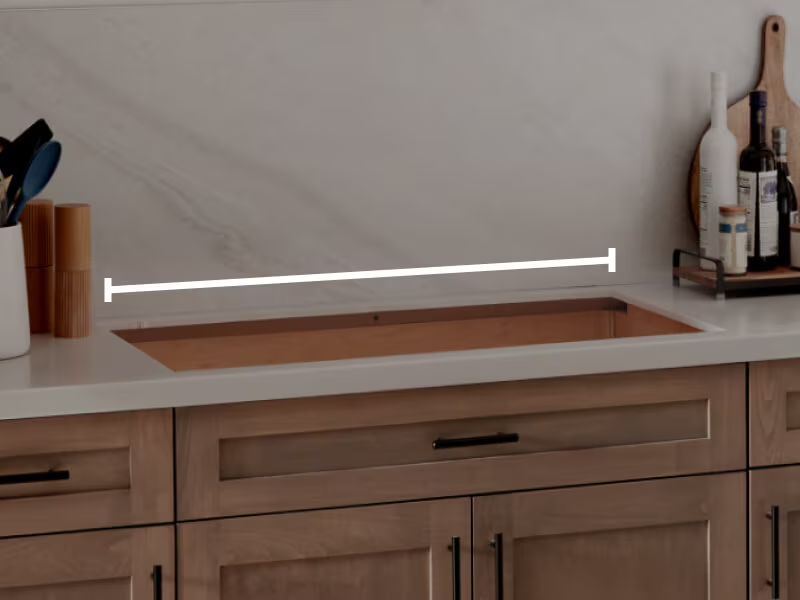 You should read the manufacturer’s instructions and cut according to requirements. (Source: Internet)
What is the difference between overall dimensions and stone cut dimensions?
Overall dimensions refer to the glass surface covering the stone surface to help you visualize the actual area occupied by the cooktop on the countertop. Meanwhile, stone cut dimensions refer to the cutout dimensions under the stone countertop to fit the cooktop body.
Can a built-in induction cooktop be installed above an oven or dishwasher?
You can install a built-in induction cooktop above an oven or dishwasher if the minimum ventilation distance is ensured and a specialized heat insulation panel is used. However, this design is generally not recommended as it can easily lead to electrical short circuits or overheating risks.
Understanding built-in induction cooktop dimensions and installation technical standards is key to creating a kitchen that is both aesthetically pleasing and durable. This article has fully summarized the common specifications from double cooktops to four-zone cooktops, along with important regulations on standard thermal distances. Köcher is proud to be the pioneer in Vietnam bringing German technology into induction cooktop products. We hope this information will help you measure accurately and choose the most suitable product for your family.