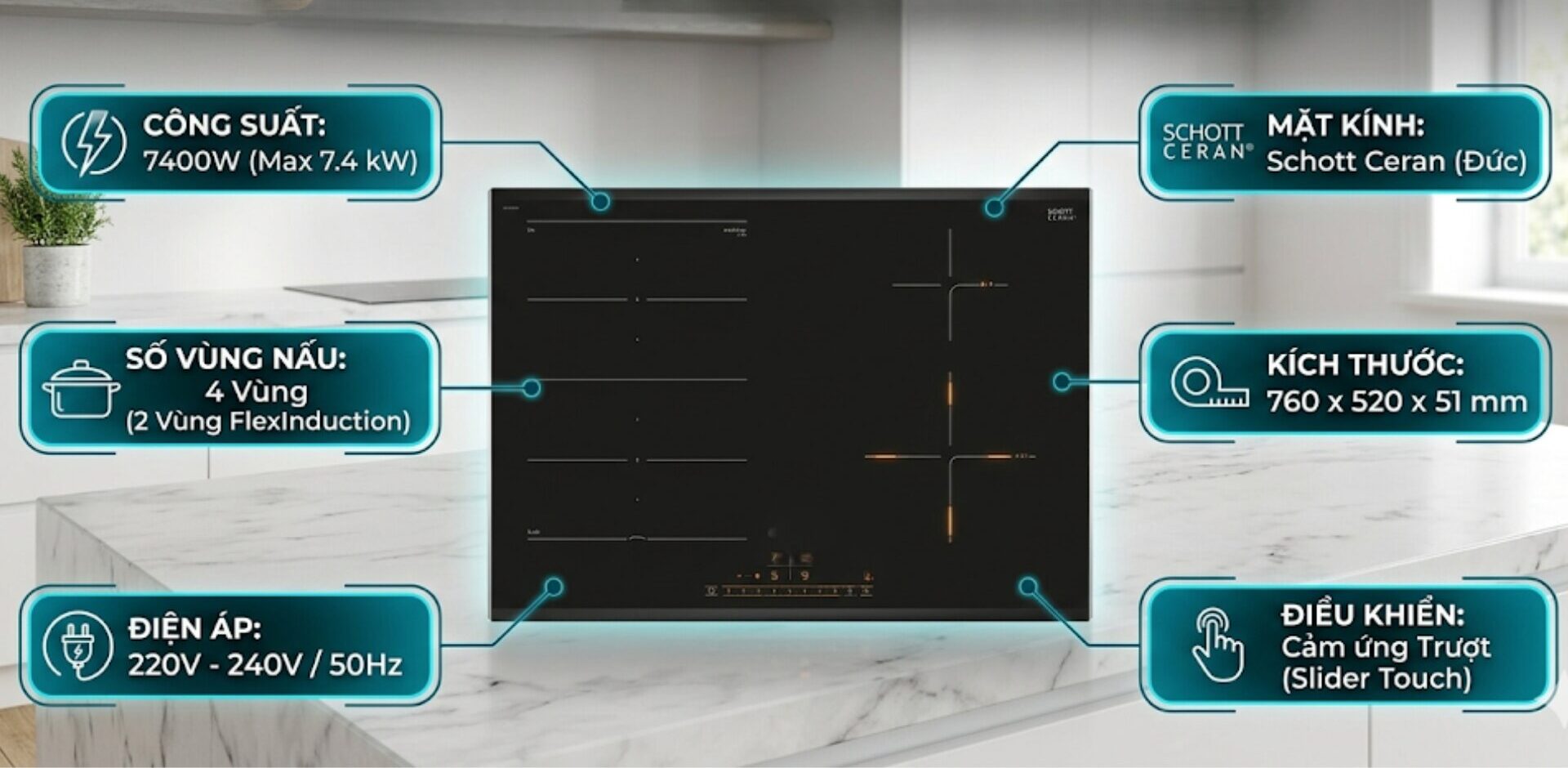
The size of the induction cooktop is an important factor that directly affects the layout with the countertop and kitchen cabinets. If the wrong size is chosen, you may have to modify the countertop or face difficulties when replacing the cooktop. Therefore, the article below will summarize the common sizes of induction cooktops and suggest how to choose the right one for your family’s kitchen.
Classification of induction cooktop sizes by installation method
The installation method determines the size of the induction cooktop that you need to choose, especially when you are transitioning from traditional gas cookers to modern induction cooktops. Specifically:
- Built-in induction cooktop: You need to pay attention to the size of the glass surface (Length x Width x Height) to ensure that the cooktop does not take up too much space on the countertop. This type of cooktop is suitable for families renting houses or those who do not want to interfere with the countertop.
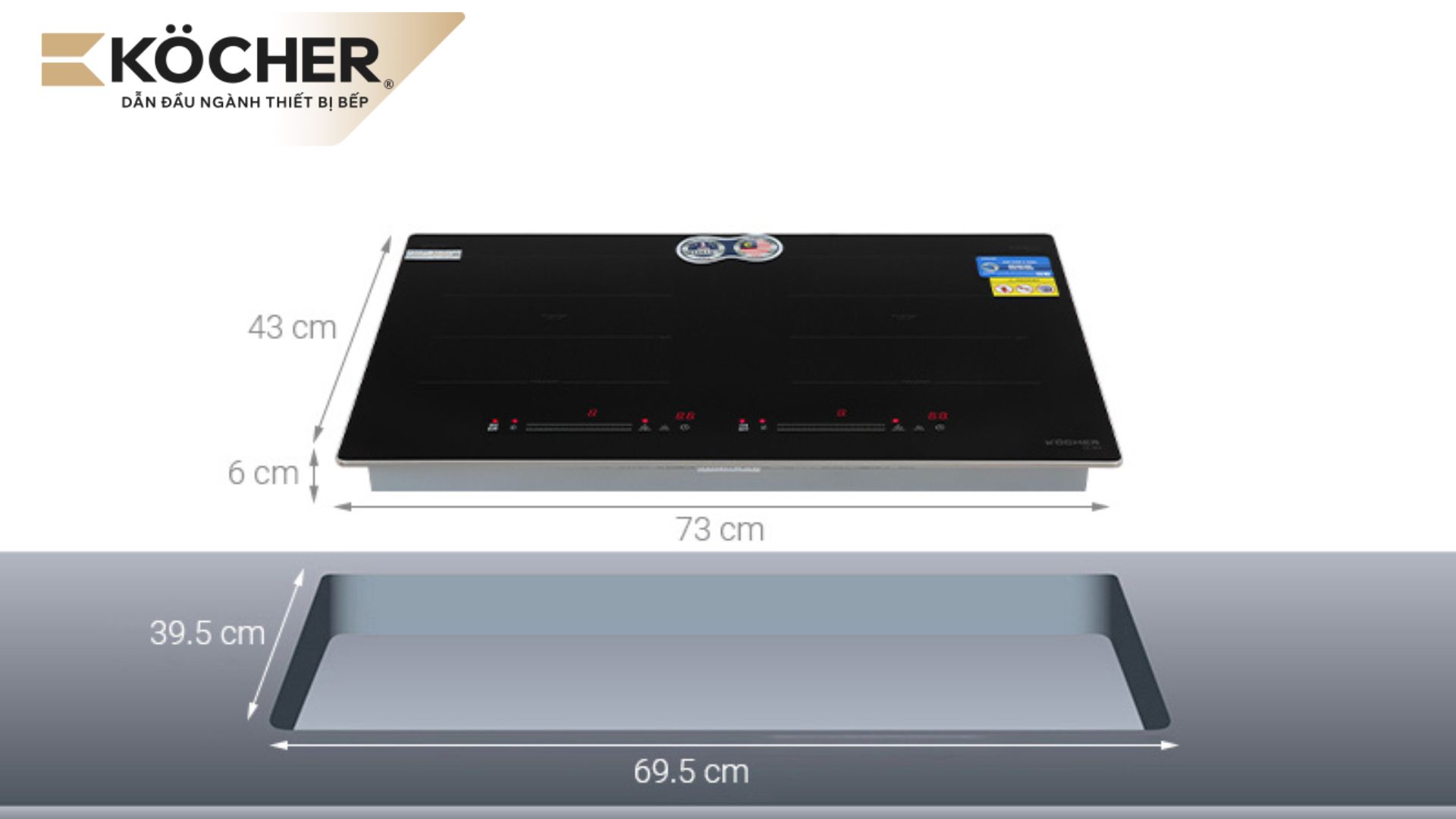
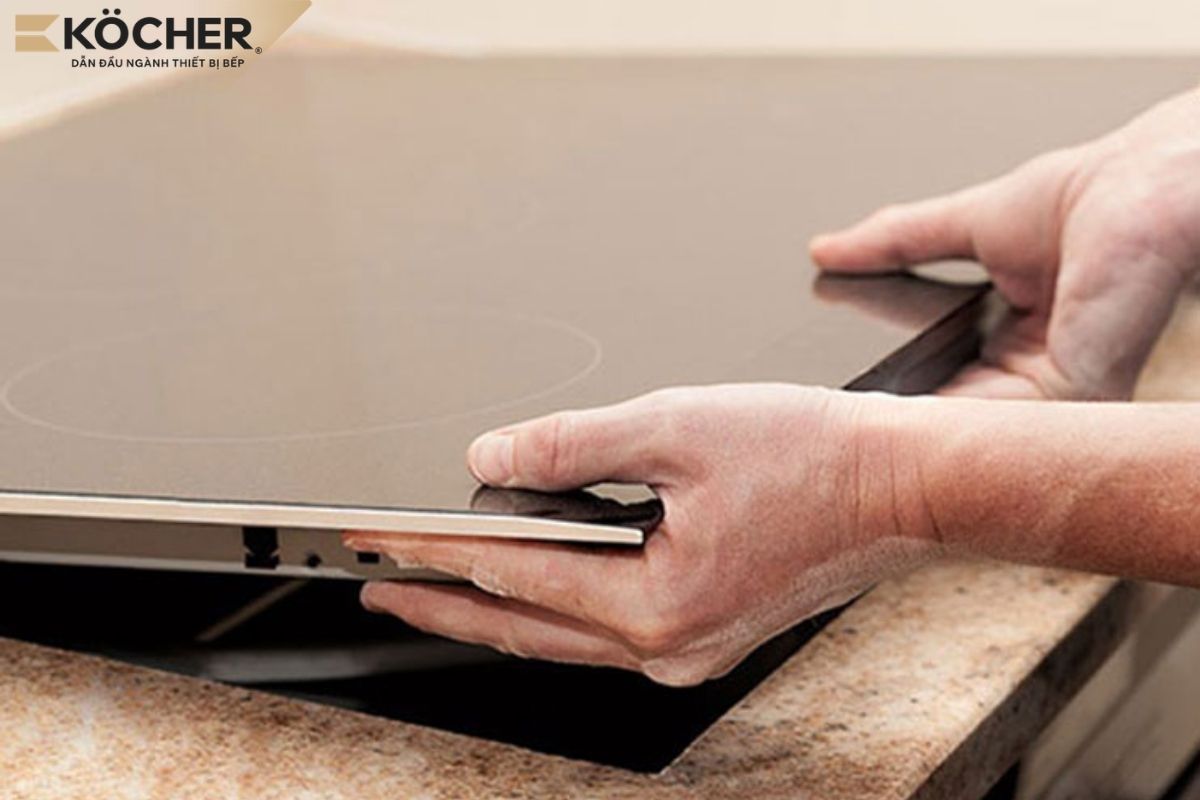
- Flush-mounted induction cooktop: Flush mounting requires you to choose the exact size of the induction cooktop according to the cutout area. You must check two parameters: the size of the glass surface (to ensure aesthetics) and the cutout size (the part of the cooktop that fits into the cabinet). Typically, understanding the standard size for flush-mounted induction cooktops will help homeowners be more proactive in advising stone cutters right from the cabinet finishing stage.
Summary of induction cooktop sizes on the market
Currently, induction cooktop sizes are very diverse, with widths ranging from 280mm to 900mm, depths from 300mm to 600mm, and thicknesses from 40mm to 70mm depending on whether the cooktop has 1, 2, 3, or 4 cooking zones. Specifically:
| Number of cooking zones | Width (mm) | Depth (mm) | Thickness (mm) | Cutout size Width – Depth (mm) |
| 1 cooking zone (single cooktop) | 280 x 350 | 300 x 400 | 40 – 80 | Not applicable |
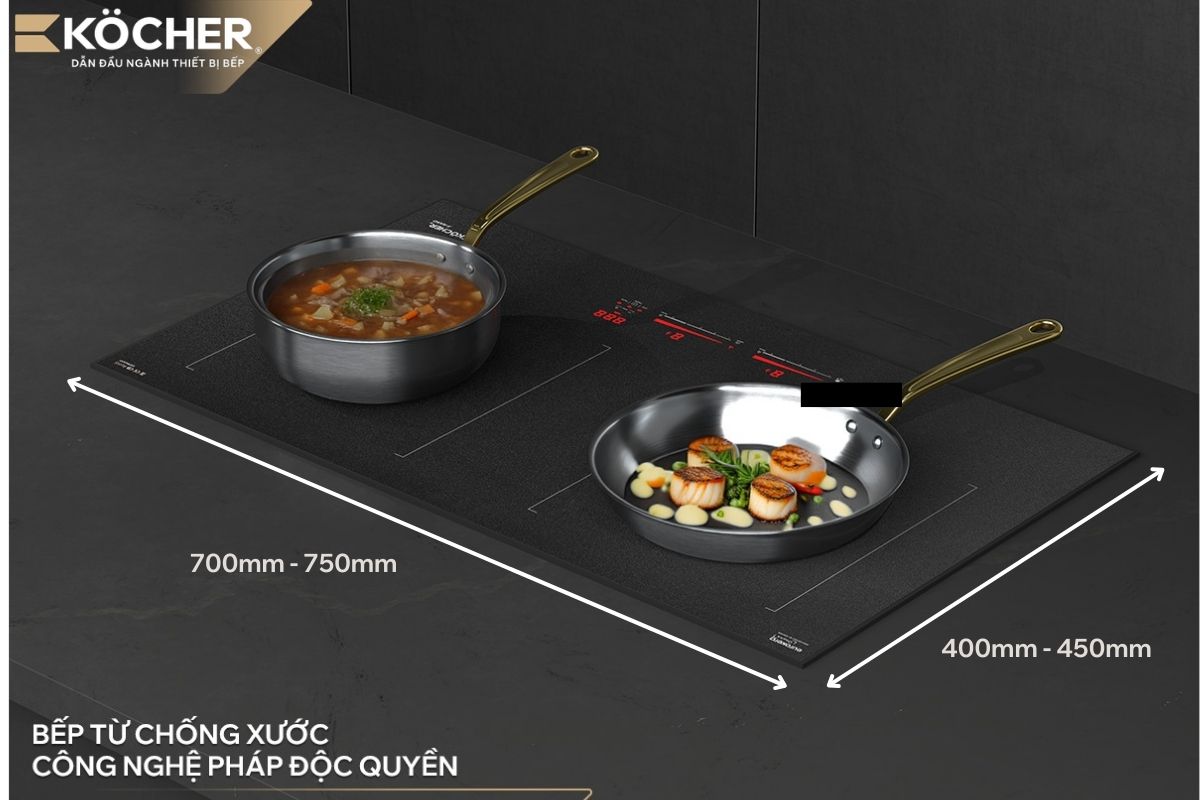
| 2 cooking zones (double cooktop) | 700 – 750 | 400 – 450 | 40 – 60 | 670 – 710 x 370 – 410 |
| 3 cooking zones – square cooktop | 580 – 620 | 510 – 530 | 50 – 65 | 480 – 560 x 490 – 500 |
| 3 cooking zones – rectangular cooktop | 750 – 860 | 430 – 450 | 50 – 65 | 710 – 800 x 380 – 410 |
| 4 cooking zones | 590 – 900 | 520 – 600 | 50 – 70 | 560 – 850 x 490 – 560 |
Single induction cooktop size
Single induction cooktops typically have a length ranging from 350mm – 400mm and a width from 280mm – 320mm. With a compact design, this size is particularly suitable for individuals renting, students, or small families of 1 – 2 people with infrequent cooking. Additionally, due to their compact size, single induction cooktops are often invested in by homestays to serve the flexible cooking needs of guests.

Below is a technical specification table for some popular single induction cooktops on the market:
| Size (L x W x H) (mm) | Cutout size (mm) |
| 350 x 280 x 39 | Built-in |
| 310 x 380 x 42 | Built-in |
| 320 x 280 x 60 | Built-in |
Double induction cooktop size
Double induction cooktops typically have a length ranging from 700mm – 750mm and a width from 400mm – 450mm, with a height of about 40mm – 60mm. The design with two independent cooking zones allows users to cook multiple dishes simultaneously while keeping the kitchen space tidy. With this size, double induction cooktops are particularly suitable for families of 2 – 4 people or families with medium to frequent cooking frequency. To ensure smooth construction, you should refer to the summary table of double flush-mounted induction cooktop sizes for the most accurate comparison between brands.
Below is a size table for some popular double induction cooktops on the market:
| Product | Double induction cooktop size (mm) | Cutout size (mm) |
| X-NANO 8 | 730 × 420 × 56 | 680 × 370 |
| X-NANO 8 PLUS | 730 × 420 × 56 | 680 × 370 |
| DI-633 | 730 × 430 × 60 | 695 × 395 |
| DI-806GE02 | 750 × 450 × 60 | 685 × 385 |
Three cooking zone induction cooktop size
Induction cooktops with three cooking zones on the market typically have two popular designs: square and rectangular. Square products usually have a length of about 580mm – 620mm and a width of 510mm – 530mm, while rectangular cooktops typically have a length of about 750mm – 860mm and a width of 430mm – 450mm. With three independent cooking zones, this type of cooktop is suitable for families of 4 – 6 people or families with frequent cooking.
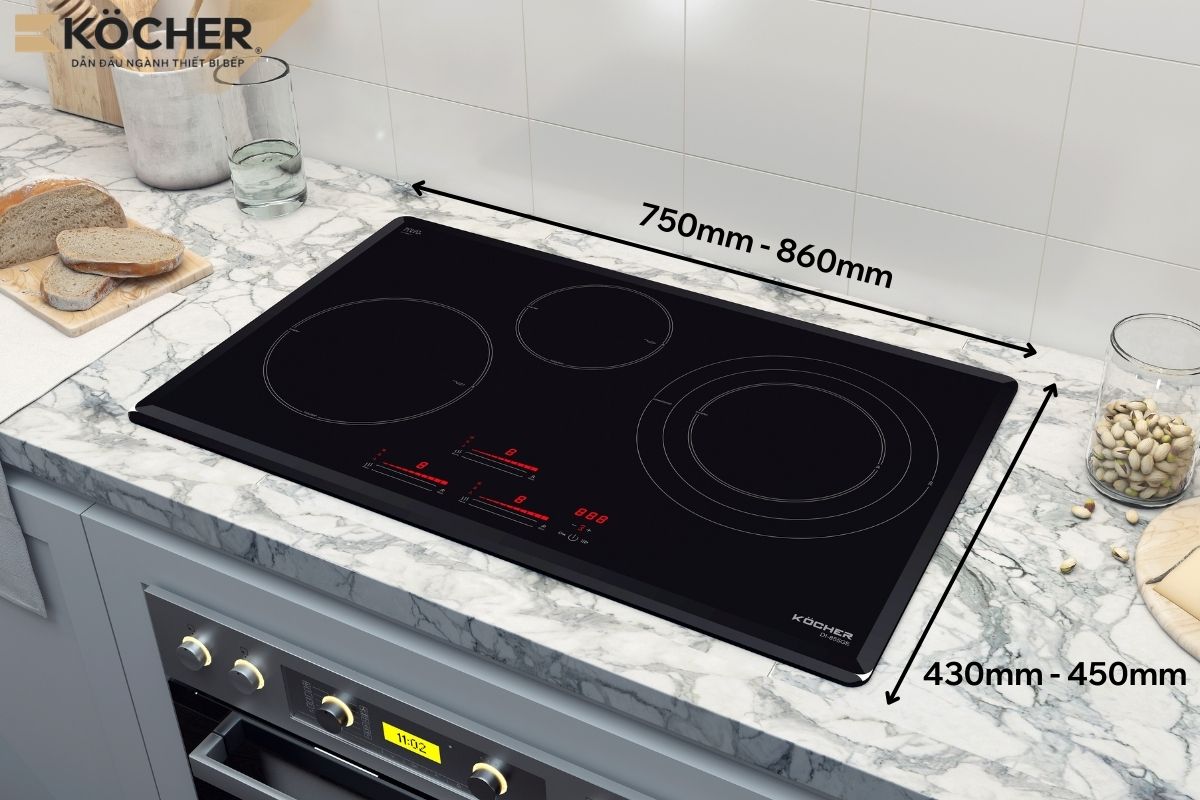
Below is a size table for Köcher’s three cooking zone induction cooktops:
| Product | Three cooking zone induction cooktop size (mm) | Cutout size (mm) |
| DI-855GE | 750 × 450 × 60 | 710 × 410 |
Four cooking zone induction cooktop size
Four cooking zone induction cooktops typically have a length ranging from 590mm – 900mm and a width from 520mm – 600mm. The larger size makes the cooktop suitable for families of 5 – 8 people or families with high cooking frequency, often preparing multiple dishes in each meal.
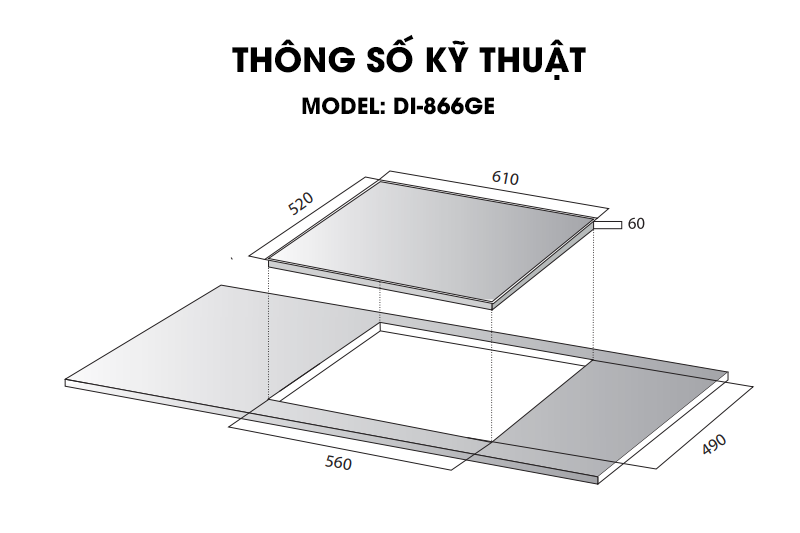
Below is the technical specification table for Köcher’s four cooking zone induction cooktops:
| Product code | Four cooking zone induction cooktop size (mm) | Cutout size (mm) |
| DI-866GE | 610 x 520 x 60 | 560 x 490 |
Induction cooktop sizes by brand
Each induction cooktop brand has different design styles and size standards, depending on technology and product orientation.
- Köcher: Understanding the Vietnamese kitchen space, Köcher’s products are designed to effectively replace old gas cookers without requiring too much intervention in the countertop infrastructure. At the same time, if you want to install new, the product specifications are well compatible with the sizes of kitchen countertops and cabinets at home.
- Other European brands: Often develop many lines of 3 – 4 cooking zones with larger cooktop sizes (about 70 – 90 cm). The design focuses on cooking performance and wide cooking zones, so the cooktops often require larger installation space and bigger cutouts.
- Popular brands in the Vietnamese market: with many models of 2 – 3 cooking zones. The sizes are quite diverse to fit various types of kitchen cabinets.
Guide to choosing the right induction cooktop size for your countertop area
One of the most important Notes when buying an induction cooktop is that you need to accurately calculate the area of the countertop to choose a balanced cooking zone distribution. To avoid a cramped or unbalanced kitchen, you can refer to the suggestions for choosing the right induction cooktop size for your countertop area below:
- Small countertop (Length under 1.5m): With limited kitchen space, you should prioritize single or small double induction cooktops (about 290 – 310 × 360 – 400 mm or double cooktops around 700 mm). A compact cooktop design helps keep enough space for the sink and preparation area on the countertop.
- Standard countertop (Length 1.5m – 2.5m): This is a common size in many families today. A double induction cooktop of about 730 × 430mm is often seen as a balanced choice, meeting the daily cooking needs of families of 3 – 5 people.
- Wide countertop or island (Length over 3m): For kitchens with large areas, you can consider 3 – 4 cooking zone cooktops with widths of about 750 – 900mm. This design allows for cooking multiple dishes at once, suitable for large families or those who frequently cook.
Technical standards related to induction cooktop sizes
When installing an induction cooktop, in addition to the cooktop size and cutout size, users also need to comply with certain technical standards regarding distance and ventilation. Below are the common installation standards applied to flush-mounted induction cooktops today.
Distance to the wall
The distance from the edge of the cooktop to the wall or surrounding cabinet should be at least 50mm (5cm). This gap allows the cooktop to have space for heat dissipation and expansion during operation, while also reducing heat accumulation that may affect the wall surface or cabinet materials near the cooking area.
Distance to surrounding objects
The distance from the edge of the cutout to the outer edge of the cooktop or the edge of the kitchen cabinet should be at least 65mm (6.5cm). This distance helps maintain the structural durability of the countertop, reducing cracking at load-bearing points and ensuring the cooktop remains stable when placing heavy cooking pots.
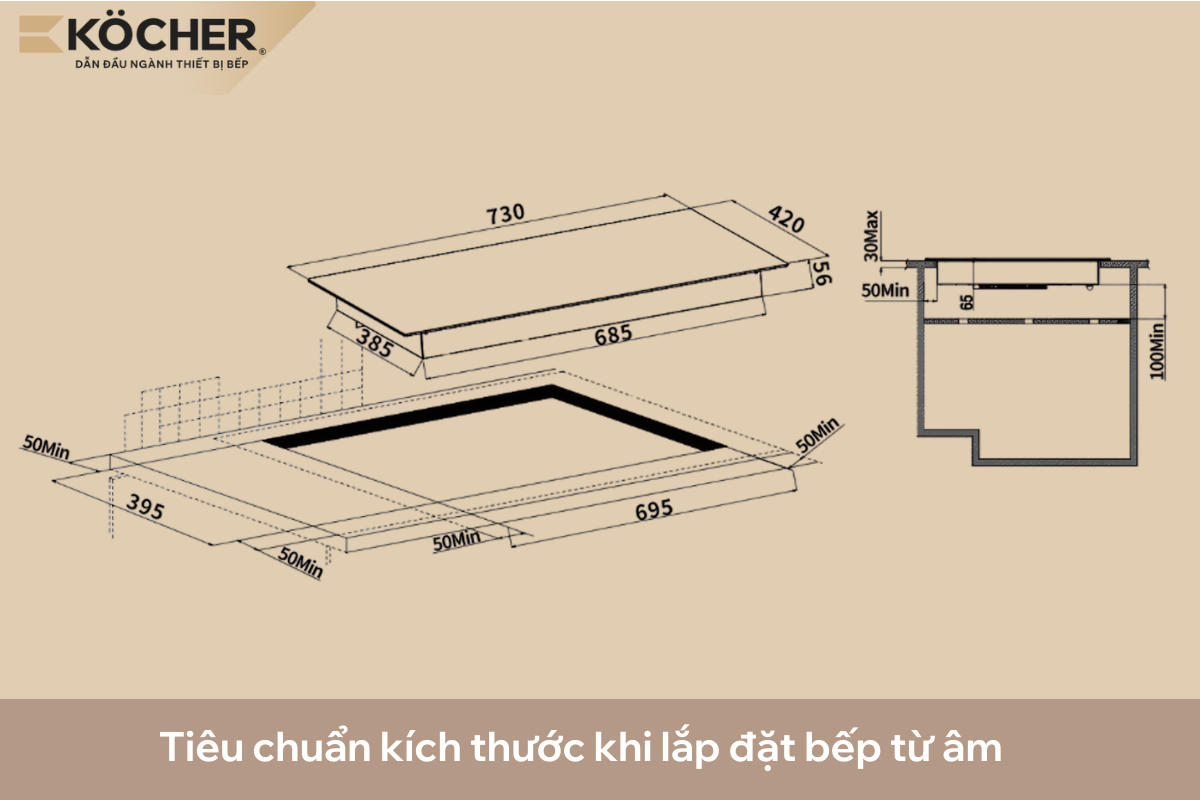 Distance standards when installing flush-mounted induction cooktops[/caption>
Thermal ventilation gap
When installing a flush-mounted induction cooktop, ensure a minimum distance of 20mm (2cm) between the bottom of the cooktop and any items below, such as drawers or cabinets. This gap creates the necessary ventilation space for the cooling fan to draw in cool air, helping to cool the components and circuit board during cooking, thereby ensuring stable operation and increasing the durability of the device.
Cutout tolerance – for flush-mounted induction cooktops
The cutout size must be executed according to the technical drawing of each specific cooktop model. The allowable tolerance is usually only about ±1 – 2mm. If the cutout is too wide, the support point of the glass surface will be weak and prone to cracking. Conversely, if the cutout is too narrow, it may cause the cooktop to be pinched, reducing heat dissipation and causing overheating errors during use.
Summary table of the sizes of the best-selling Köcher induction cooktops
To help you easily compare, below is a specification table for typical cooktop models that meet the needs of replacing old gas cookers and new installations for apartments:
| Product code | Type of cooktop | Glass surface size (mm) | Cutout size (mm) | Installation advantages |
| DI-221 | Double cooktop | 730 x 430 x 56 | 695 x 395 | Common size, easy to replace old built-in gas cooktops, minimal countertop modification required |
| DI-616SE | Double cooktop | 730 x 430 x 56 | Common cutout standard, quick replacement, minimal countertop modification required | |
| X-Nano 8 | Double cooktop | 730 × 420 × 56 | Compact cutout, easy to install in medium and small kitchen spaces | |
| DI-855GE | 3 cooking zone cooktop | 750 x 450 x 60 | Three cooking zones design but still compact size, suitable for standard countertops | |
| DI-801GE IPLUS | Double cooktop | 730 x 420 x 40 | Thin cooktop helps for a neat flush installation, reducing the need to modify cabinets | |
| DI-866GE | 4 cooking zone cooktop | 610 x 520 x 60 | Large size, suitable for installation in spacious kitchens |
Above are the summarized information about induction cooktop sizes, suggestions for choosing an induction cooktop suitable for your countertop area, and technical standards. We hope this article can help you choose a satisfactory product, optimize functionality, and fit your family’s kitchen space.
Köcher currently offers many lines of induction cooktops with various installation sizes, suitable for Vietnamese kitchen spaces. You can refer to Köcher induction cooktop models to choose a product that fits the countertop and your family’s cooking needs at the website kocher.vn.
|
Köcher induction cooktops pioneer German technology – For detailed product information, please contact:
|